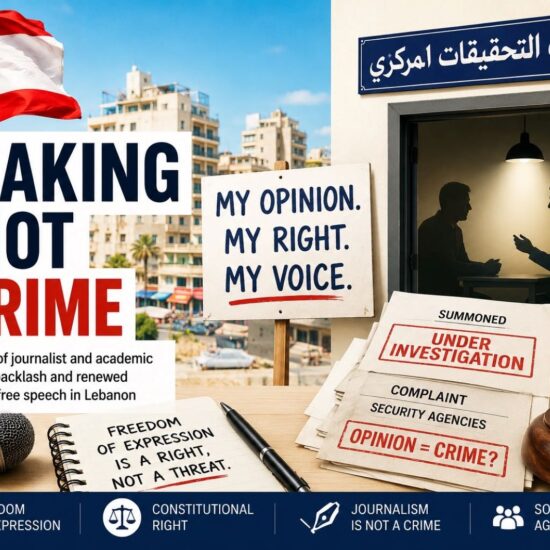
Lebanon’s parliament adopted a new law to increase media freedom last Tuesday — a first since the last century. But while the reform is meant to improve press freedom, critics warn that journalists are exposed to prison sentences and demand changes.
Shortly after the law was passed last week, several actors publicly supported the reform. The European Union’s delegation to Lebanon, for example, hailed it as a “long-awaited new media law, which introduces a number of significant reforms aimed at strengthening media freedom and safeguarding freedom of expression.”
But while the reform has received approval, there are major concerns. Last Wednesday, Lebanon’s Press Syndicate and the Press Editors’ Syndicate criticized and rejected the current law. Reporters without borders has also demanded changes.
The law in its current form still includes Article 104, which allows for journalists to be jailed on the basis of spreading false news. Several press unions and parliamentarians have long warned of Article 104 and its implications for journalists.
Why the law was rushed through parliament
To a certain degree, the decision to pass the law in its current state was a trade-off. Lebanon’s last media law dates back to 1962 — it has been mostly in place since, with some changes in the following years. Reforming the law was much needed, parliamentarian Waddah Sadek told Now. Under the previous law, the registration of media outlets was severely restricted to print media — with online and digital media not being accounted for.
The situation for Lebanese press outlets in the past decades was “a mess, a chaos, and controlled by a couple of parties”. According to him, reforming the law “is not a step backward.”
The proposal for the new law was first raised in 2010 by parliamentarian Ghassan Moukheiber and the NGO Maharat. In the following years, the draft became caught up in the consultation process with NGOs, stakeholders and in the parliamentary procedures. It took 16 years to finalize the law, but disagreements remained unresolved.
The law was quickly put to a vote last week, without the proper time for parliamentarians to change outstanding problems. Ayman Mhanna, the executive director of the Samir Kassir Foundation, told Now that the speaker of the house, Nabih Berri, “probably wanting to speed things up, put the entire text to a vote, as is.” The reason is simple: “The moment the discussion began about specific articles to change, there was a plethora of suggestions related to more than one article.”
This created several problems for parliamentarians. “There is a technical problem because we cannot just put amendments 48 hours before the general assembly,” Sadek explained. Rather than rushing the procedure, parliament should have allowed the committee meetings to convene a few weeks ahead of the General Assembly, he argues. Instead, there was a closed-door meeting a day before the voting, according to Sadek. “I’m a member of the subcommittee and I wasn’t invited to the last meeting one night before the General Assembly. The only MPs who were invited were the MPs of Amal and Hezbollah and one more MP I think and the minister,” he said.
How the law will change in the coming months
With major outrage over the law, it is unlikely to stay in place in its current form. According to Mhanna, Lebanon’s Information Minister Paul Morcos is already working on a government bill to be submitted to parliament. According to news reports, Morcos was in favor of abolishing Article 104 before the law passed parliament. He did not respond to several interview requests by Now.
While the current law reduces imprisonment possibilities in around 90 percent of the cases, exceptions remain. Civil society and NGOs are eager to lobby for changes that would make the media’s work more free. Several things need to be changed, Ayman Mhanna from Lebanon’s Samir Kassir Foundation said. He called for the “complete removal of any criminalization and prison sentence.”
But beyond removing jail terms, the law also sparks a bigger debate about false news. Since spreading misinformation is under the current law a basis of imprisoning journalists, Mhanna says a clear definition of false news is necessary. Without clear terms, the article opens the door to wide interpretation, allowing arbitrary arrests.
We also need “a clear establishment of the process through which information is confirmed as fake before any action is taken against journalists,” Mhanna added. “We will put all our weight to make sure these amendments reach the parliament within a very reasonable time and be adopted ideally before the end of the year,” he added.
Lebanon seems to enter a new cycle of debate about the future of the country’s media freedom. But overall, parliamentarian Sadek remains optimistic. “The drama that we are hearing is much bigger than the problem,” he said. But nevertheless “we’re trying to solve the problem.”