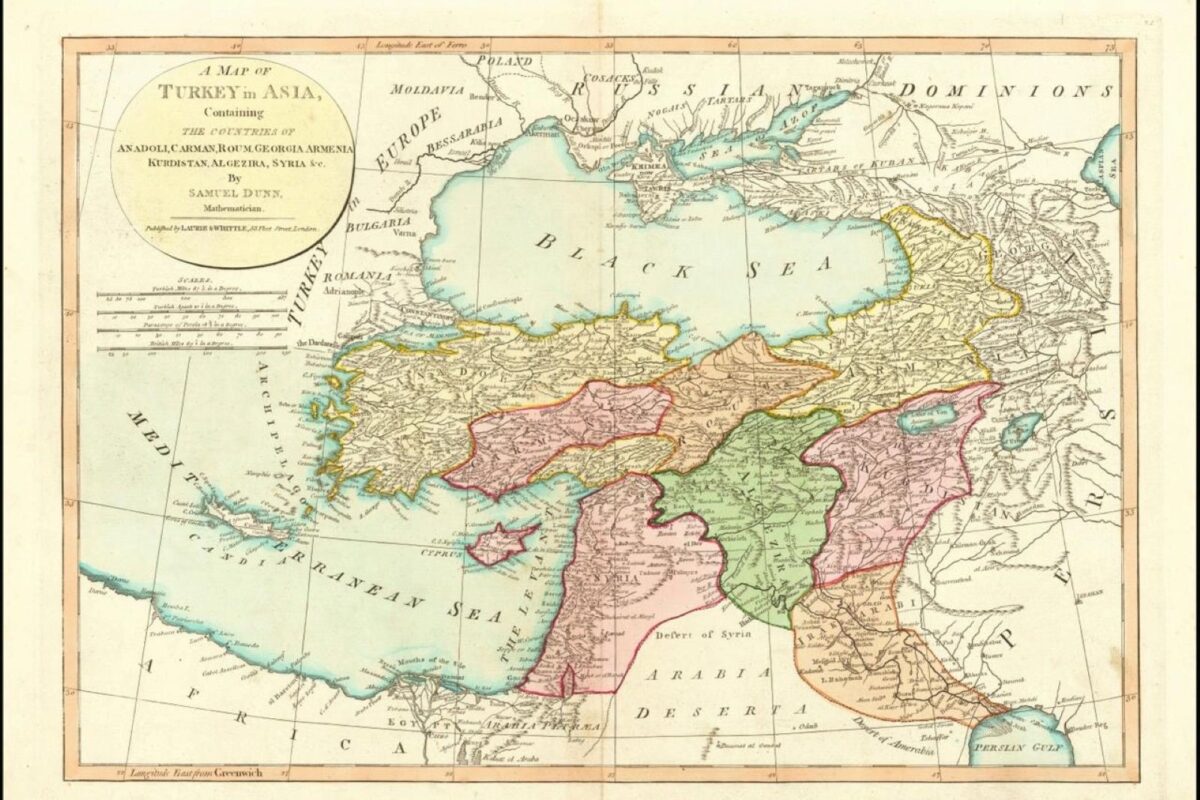
A 1794 map by Samuel Dunn of the Ottoman provinces in Asia
https://commons.wikimedia.org/wiki/Category:Maps_by_Samuel_Dunn#/media/File:1794_map_of_Turkey_in_Asia_by_Samuel_Dunn.jpg
The term Bilad al-Sham has returned to political discourse, in diplomatic pronouncements, in polemics, on social media, where it serves those who question Lebanon’s place, or deny it a place, in the region. Amid the noise, a set of fundamental questions deserves to be asked. What does Sham mean? When was the term used? What did it signify geographically, culturally, and politically? And was it ever a united political entity, a state? The questions sound simple. The answers are not.
Etymology offers a first clue. Bilad al-Sham means, in Arabic, “the country of the north“, literally, of the left hand, in contrast to Bilad al-Yaman, “the country of the south,” of the right hand. The logic is that of an observer facing the rising sun, the standard point of orientation in the ancient Near East, for whom the left hand points north and the right hand south. The division has deep antecedents: as early as the second millennium BC, Amorite nomadic groups appear in the Mari archives under names built on the same logic, the Banu Sim’al, “sons of the left,” and the Banu Yamina, “sons of the right.” From its very origin, then, the name designates a direction rather than a polity, a region defined by where it lies in relation to an observer, geographical in its very grammar.
The term enters the Islamic written record with the literature of the Arabo-Islamic conquests, as in the Futuh al-Sham (The Conquests of Greater Syria) attributed to al-Waqidi (d. 823). Among the earliest authors to define the borders of al-Sham was the Persian geographer Abu Ishaq al-Istakhri (d. 957), who wrote in his Kitab al-Masalik wa-l-Mamalik:
“…The land of al-Sham
As for al-Sham, its west is the Mediterranean Sea, its east is the desert from Ayla to the Euphrates, then from the Euphrates to the border of the Romans, its north is the land of the Romans, its south is the border of the Egyptians the land of the wandering of the Israelites (Sinai), and its last border towards Egypt is Rafah…”
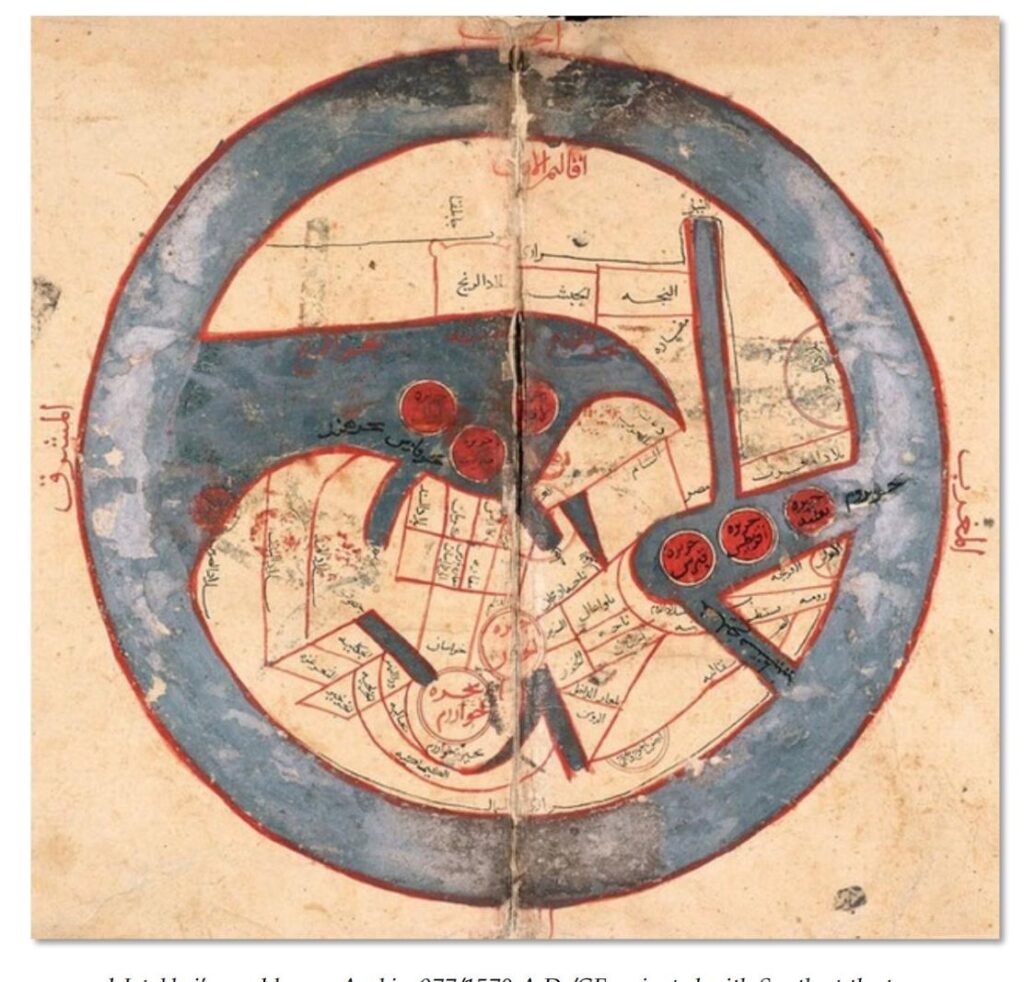
al-Istakhri’s world map, 10th c. AD https://www.myoldmaps.com/early-medieval-monographs/211-al-istakhris-world-map/211-istakhri.pdf
This definition is also attested, with some variations, in most of the Arabo-Islamic geographers of the Abbasid period, such as Ibn Hawqal (d. After 978), and al-Muqaddasi (d.991), who identifies it as “Iqlim al-Sham”, or the region of al-Sham.
In the Latin chronicles of the Crusader period, the term Suriani designates the local Christians, echoing the usage of the Christians of the Syriac tradition, who knew their land as Sūryā, the Syriac form of the Greek Syria. It was a communal label, carrying the old regional name with cultural rather than political content. Here too, the name described a heritage and a geography; it named no polity.
Under the Mamluks, the term entered administrative usage only in its narrow sense: Niyabat al-Sham designated Damascus and its dependencies, one province among several into which the region was divided. The advent of Ottoman rule changed this. In 1516, following the Battle of Marj Dabiq and the Ottoman victory over the Mamluks, the Ottomans reorganized the former Mamluk provinces of the eastern Mediterranean, Aleppo, Damascus, Tripoli, and Safed, into a single, vast eyalet of Sham. For the first time, the name in its broad sense acquired an administrative dimension, as a province of the Ottoman Empire, alongside its geographical meaning.
The arrangement proved short-lived. Distance and administrative burden led to the separation of the Eyalet of Aleppo in 1534, while the challenge of controlling Mount Lebanon and its emirs shaped the creation of the Eyalet of Tripoli in 1579 and, following the campaigns against the Druze emirs, of the Eyalet of Sidon in 1660, an administrative map that survived until the Vilayet Law of 1864.
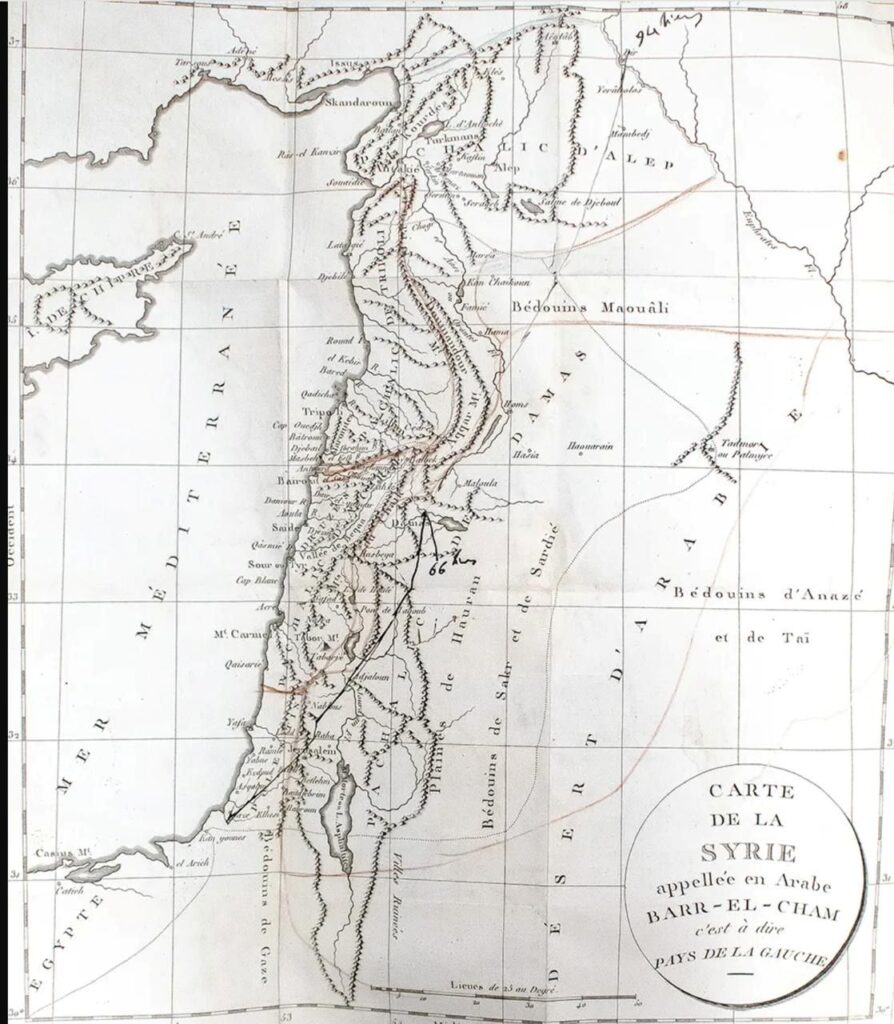
Map of Syria by Volney, 1780’s https://archive.org/details/voyageensyrieete01voln/page/n299/mode/1up
Chronicles of the Ottoman centuries, from urban centers and rural peripheries alike, continued to describe the region as Bilad al-Sham as a geographical region. Western writers, heirs to the Greek nomenclature, called the same space “Syria”, and the gap between the two usages struck the travelers themselves. Volney (1757–1820), the French orientalist who journeyed through the region in 1783–1785, recorded in his Voyage en Syrie et en Égypte:
“…The present inhabitants, who, according to the constant practice of the Arabs, have not adopted the Greek nomenclature, do not recognize the name of Syria; they replace it with that of Barr el-Cham, which means land of the left… This designation of land of the left, by its contrast to that of Yamin or land of the right, indicates as its capital an intermediate place, which must be Mecca…”
Some Orientalists were also using “Levant,” a derivative of the Italian Levante. Yet the term was associated with the cities of the eastern Mediterranean and with the Europeans living in the Ottoman Empire more than with the locals. The name traveled with its people. Over the nineteenth century, migrants to the Egypt of Muhammad Ali and his khedivial successors, a gateway to opportunity in the press, medicine, and entrepreneurship of Cairo and Alexandria, were collectively identified as “Shawam,” the people of Bilad al-Sham. The label is attached especially to the Christians among them, from Mount Lebanon, Beirut, Aleppo, Damascus, and elsewhere: a geography of origin carried abroad.
Within the region itself, the same century saw the name “Syria” begin to acquire a political charge. The pivotal witness is Butrus al-Bustani (1819–1883), Maronite convert to Protestantism, educator, encyclopedist, close collaborator of the American missionaries in founding the Syrian Protestant College, and one of the great figures of the nineteenth-century Arabic renaissance. His pamphlet Nafir Suriyya (“The Clarion of Syria”), written in the immediate aftermath of the sectarian crisis of 1860 in Mount Lebanon and Damascus, exhorted the inhabitants of Syria to unite and to reject sectarian fanaticism. In the fourth clarion, he writes:
“Countrymen, … Syria, which is known as Barr al-Sham and Arabistan, is our homeland with all its diverse plains, coastlines, mountains, and barren lands. The inhabitants of Syria, regardless of their religious beliefs, their physical features, their ethnicities, and their general diversity, are all our compatriots. For the homeland resembles a chain of many rings…”
The name’s fortunes rose on the official plane as well. The Ottoman Vilayet Law of 1864, an empire-wide administrative reform, led to the creation of the Vilayet of Syria out of the former eyalets of Damascus, Tripoli, and Sidon, the first time Suriyya figured in official Ottoman nomenclature. Mount Lebanon, meanwhile, stood apart: since 1861, in the settlement that followed the same crisis of 1860, the Mountain formed an autonomous mutasarrifiyya, excluded from the new vilayet. In 1888 the Vilayet of Syria was truncated in its turn, when the bourgeoisie of Beirut obtained a separate Vilayet of Beirut, in recognition of the city’s rising role as the main hub of trade and culture in the Ottoman eastern Mediterranean.
A parallel development unfolded in the diaspora, where the term “Syrian,” better suited to Western audiences, emerged in the United States and Latin America as a collective identity for immigrants from the Ottoman eastern Mediterranean. What the Shawam were in Egypt, the “Syrians” were in the Americas: a people named by its geography of origin, an identity social and cultural in content.
By the early twentieth century, American and French missionaries popularized the idea of Greater Syria in Beirut as a cultural and civilizational unit, most notably the Jesuit Henri Lammens, who conceived of Lebanon as the very heart of this historical Syria. The First World War transformed the idea’s fortunes. With the collapse of the Ottoman order, the emergence of proto-nationalism, and the redrawing of borders under the Allies, the term acquired an openly political dimension: the Arab nationalists around Emir Faysal projected a unified Syria that drew directly on the notion of Bilad al-Sham, while French colonial circles and trade interests promoted their own Syrie intégrale, a “natural Syria” under French tutelage.
The early Lebanese movement itself was conceived within the horizon of a greater Syria, though the precise nature of this perspective remains difficult to pin down. Many intellectuals, in the homeland (al-watan) and the diaspora (al-mahjar) alike, invoked Lebanon and Syria in the same breath when voicing their political aspirations. This was the formative period of both present-day Lebanese and Syrian identities, and in a period when both were still taking shape, such fluidity was to be expected.
The test came with the Ottoman collapse. In 1918 Emir Faysal established an Arab government in Damascus, and in March 1920 he was proclaimed King of Syria, the closest history has come to a state built on the aspiration of a unified Syria. Its reach into what is now Lebanon was confined to four cazas, Baalbek, the Beqaa, Hasbaya, and Rashaya, formerly of the Ottoman Vilayet of Syria, seated in Damascus. Mount Lebanon and Beirut stood outside it. The kingdom had yet to consolidate into an organized state when it fell at Maysalun in July 1920; weeks later, on 1 September 1920, France proclaimed the State of Greater Lebanon. Paris had by then abandoned the project of a Syrie intégrale: Lebanist lobbying and the influence of General Gouraud played a key role in the transition from the project of a unified to a fragmented Syria. A unified Syria thus failed to materialize under the Mandate, and a Syrian republic within borders approximating those of the present state consolidated only in the 1930s, culminating in the Franco-Syrian Treaty of 1936.
In the twentieth century, the notion passed from geography into ideology. In 1932, Antoun Saadeh founded the Syrian Social Nationalist Party (SSNP), shaped by the intellectual climate of interwar Europe, including its fascist currents, and resting on a doctrine of Syrian distinctiveness bordering on racial superiority. His “Greater Syria” obeyed the needs of doctrine rather than the record of usage, stretching beyond any historical Bilad al-Sham to embrace Iraq, Cyprus, and the Sinai. The Baath, in power in Damascus from 1963 and under Assad rule from 1970, instrumentalized Greater Syria in its turn, to project hegemony, to legitimize the regime, and, tragically, to justify occupation in Lebanon from 1976 to 2005.
To be clear: Lebanon was historically part of Bilad al-Sham as a geographical and cultural notion. Its incorporation into a Syrian state was chronologically impossible, for the simple reason that no such state existed before the twentieth century, and the sole, fleeting exception, the Faysal interlude of 1918–1920, touched four cazas of the future Lebanon, lasted under two years, and collapsed before the kingdom had become a state.
Thirteen centuries of evidence yield a consistent verdict. Bilad al-Sham was a real and remarkably durable notion, geographical in its very grammar, cultural in its uses, administrative under the Ottomans, but at no point was it a political entity or a state. Contemporary invocations of a lost unity to which Lebanon should “return” are therefore fictions. The term has survived into the present, in speeches, slogans, and social media, but survival and relevance are different things. A century of separate statehood has taken Lebanon and Syria along distinct social, political, and economic trajectories, and no appeal to an imagined past will merge them again. What the two countries genuinely share is heritage: language, memory, kinship, and trade accumulated across the centuries when this geography bore the old name.
That heritage, together with the sober instruments of statecraft: diplomacy, alliance, cooperation between sovereign equals, offers the only sound foundation for a common future, and after decades of catastrophe both countries need that future urgently. The alternative is an identitarian fiction, transposed onto an idealized geography, that blames colonialism alone for miseries with far more recent authors, and offers the past as a solution to problems only the future can solve.
Charles al-Hayek is a public historian and the founder of Heritage and Roots.
The views in this story reflect those of the author alone and do not necessarily reflect the beliefs of NOW.