Lebanon has 364 days. And the 4th of August.
To the families, the mothers who still keep a place set, the children who have run out of doors to knock on, Lebanon feels your pain, and the world acknowledges it.
Six years since the horror and the shock, and six years of a slower, crueler wound laid over the first: the forced waiting, the summons and the recusal, the hope continuously raised and lowered like a flag, the justice announced and promised and never arriving, and all the suffering being doubled.
I do not come to this day to make a cause of federalism, and I will not use your loss to win an argument. If I speak of another way of governing, it is not to campaign, but to open a window onto the darkness and shed a little light, and to ask, quietly, whether it might have been different under a system built to serve rather than to shield.
Because that is what we have watched, once again, amidst our suffering and collapse and wars: a centralized order that protects them and theirs, and never us and ours. Our system shields, it does not serve, and this has to change. Lives were massacred, more than 220 of them, families were broken, souls were lost, and so much blood was spilled in the heart of our own capital, because of the negligence of the very people the law and the constitution entrusted with keeping us safe.
This day has made the case for a federal Lebanon undeniable. It is no longer a matter of economy, jobs, or heritage. It has risen to non-negotiable ground: our lives, and our safety.
To understand why no one has answered for the 4th of August, stop looking for a villain and look at a pattern. Lebanon governs itself by “muhasasa”, confessionalism, the sectarian quota that shares out the state among its confessional leaders: ministries, directorates, seats, and beneath all of that, quietly, protection. Each leader shields his own and is shielded in return, so to hold one to account threatens the arrangement that guarantees them all. This is why an investigation reaching toward the top can be frozen for years and revive only when a war and an election shift the balance of power. Here, justice does not run on law, it runs on the permission of the powerful.
Set our system beside a working federal one. In Switzerland a catastrophe like this is carried by an independent prosecutor’s office rather than a lone judge who can be sued into paralysis, officials hold no blanket immunity, and any trial runs before an ordinary court with a right of appeal, not a special tribunal whose verdict is final. Federalism spreads power across 26 cantons so that no single national cartel can reach every prosecutor and every judge at once.
If you take one thing from this article, take this, and I will say it more than once because it deserves repeating: federalism removes the single chokepoint that impunity requires. You will see it fit the port, the banks, the electricity, the wars, the assassinations, every file where the powerful investigate themselves and walk free.
The record, step by step:
August 2020. The cabinet referred the file by decree to the Judicial Council, a special tribunal whose verdict cannot be appealed, where a federal state would have had the court fixed by law and the verdict open to appeal.
December 2020. Judge Fadi Sawan charged the caretaker prime minister and three former ministers, who invoked immunity and had him removed, something no defendant could do to his own judge in a federal order
2021 Judge Tarek Bitar took over and moved against sitting ministers, deputies and security chiefs, but parliament refused to lift immunity and a barrage of recusals froze his work, where a federal system lifts immunity on a deadline and lets no single objection halt the case.
January 2023 He charged eight new suspects including Prosecutor General Ghassan Oueidat himself, who retaliated by charging Bitar, freeing the detainees and ordering the police to ignore him, a power no indicted official would hold over his own case in a federal order.
2023 to 2024. The case went dark until Oueidat retired in 2024, whereas justice does not stop for two years in a federal order because one accused official forbids cooperation.
2025 It revived only after Aoun and Salam took office and a war weakened the bloc that had campaigned against Bitar, the plainest proof that no investigation should ever need a war and an election to breathe.
Late 2025. Bitar questioned the ship’s owner in Bulgaria and drew bank records from Germany, a foreign delay any system would share, unlike the domestic wall that was built by the accused.
30 March 2026. He closed his inquiry with about seventy people implicated, and six years on no senior official has been tried, while William Noun, whose firefighter brother Joe died at the port, has been summoned more than six times and hauled in over the very speech he gave at his brother’s commemoration, in which he named Hezbollah and Amal as the forces obstructing the judiciary, the powerful shielded and the grieving marched in, the two facts a federal order would reverse.
These six years were not a run of bad luck. Every obstacle was raised by the same mechanism, working as built. Muhasasa does not only divide the state, it insures it: each leader guarantees the others their share and their safety, a mutual defense pact, and to prosecute one for the port is to breach the pact that holds the edifice upright. So the impunity is not a flaw but the system’s condition of survival. It does not fail to deliver justice. It succeeds at the thing it was built to deliver, the safety of the powerful from the people. Which returns us to the one sentence worth carrying: federalism removes the single chokepoint that impunity requires. One Prosecutor General, one cabinet, one parliament, held by the same hands that need the protecting.
Federalism spreads the courts and prosecutors across regions that answer to no single national cartel, and there is no longer one lock for the powerful to hold. This is why our system shields and cannot serve: a state built on muhasasa can do nothing else. It shields because shielding is what it is for.
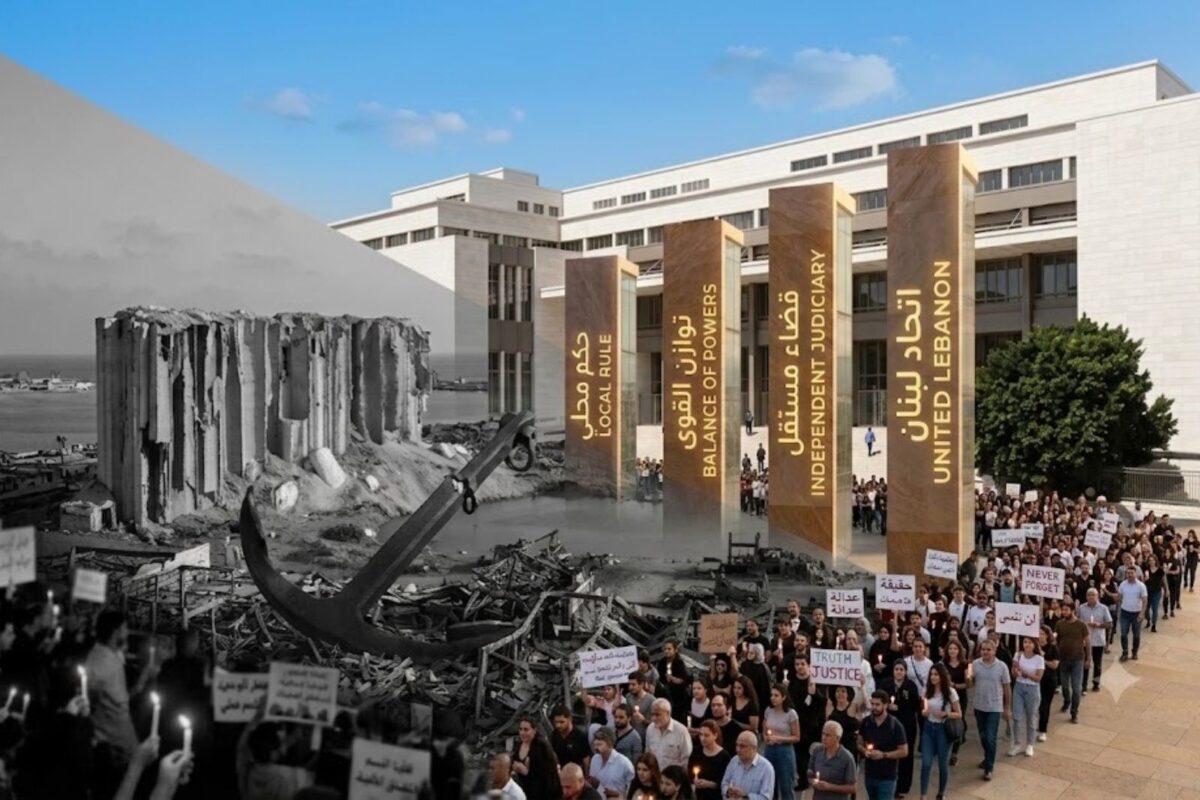
So let me end where honesty demands, not with a system but with the people it failed. More than 220 of them, not casualties of a war they chose but at their desks, at their windows, at home, trusting that the people paid to keep them safe were doing it. When the smoke cleared, the state did the one thing it knows how to do: shield the men who let the port fill with ammonium nitrate, and summon the families who asked why. This is not a justice system that broke down. It is one that worked, for the only people it was ever built to serve.
To the families: your wait is not a delay that patience will cure. There is no justice coming from this system, because it cannot condemn its own without condemning itself, and it will not. What has failed you is the design, and the design can be changed.
That is the whole reason to speak of federalism on a day like this. It will not raise your dead. It offers only this, which is everything to you right now: a state in which the next fourth of August could deliver justice.
In Lebanon, the year has 364 days, and the 4th of August. Let it be the last one without an answer. Let us build a Federal Lebanon.
Cathryn Papadopoulo is the Secretary of Foreign Affairs and The Diaspora, in Lebanon’s National Liberal Party, called Ahrar.
The views in this story reflect those of the author alone and do not necessarily reflect the beliefs of NOW.