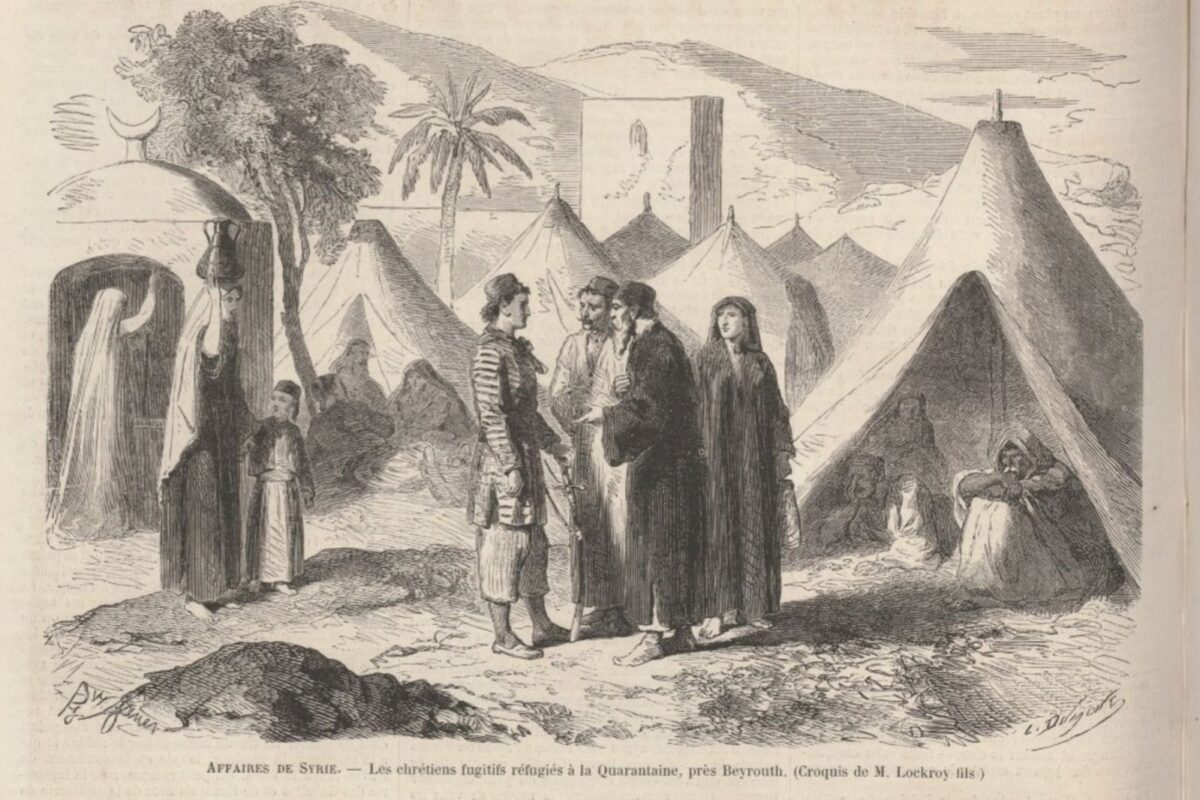
Christian refugees in Beirut, engraving published in Le Monde illustré, no. 189 (24 November 1860), p. 23. Bibliothèque nationale de France (Gallica).
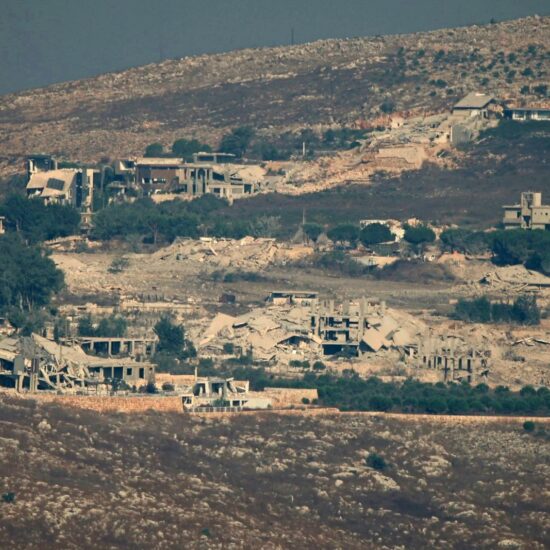
What can two engravings, published in a Parisian magazine in September 1860, tell us about one of the most violent summers in the Ottoman Levant? In May 1860, civil war broke out in Mount Lebanon; by July, the violence had reached Damascus. An estimated 15,000 to 20,000 Christians were killed across these Ottoman lands: some 10,000 in Mount Lebanon, where around 200 villages were burned, and between 4,000 and 6,000 in Damascus, where a mob destroyed the Christian quarter of the old city, razing houses, businesses, monasteries and churches. Around 30,000 Christian refugees from both Mount Lebanon and Damascus flocked to Beirut.
Material culture is seldom used in the writing and teaching of Lebanese history, especially in textbooks. The cost is threefold: the subject turns dry, the absence of visual evidence leaves room for misrepresentation and exaggeration, and the human scale of events disappears behind names and numbers. The illustrated press of the time offers a remedy. In September 1860, Le Monde Illustré, a French weekly that carried images of world events into European households, devoted coverage to the massacres. Among its many engravings, two stand out, both by the same hand. The first carries the caption “Affaires de Syrie — Réfugiés chrétiens à la Quarantaine, près de Beyrouth (croquis de M. Lockroy fils)” — Christian refugees at the Quarantine, near Beirut, sketched by Lockroy Junior. The second shows the camp of the French troops in the Plain of Pines, “Camp des troupes françaises dans la plaine des Pins, près de Beyrouth.”
Their author, Édouard Lockroy fils, was a young French journalist who had come to the Levant with Ernest Renan’s Mission de Phénicie, the archaeological expedition attached to the French intervention of 1860.
The first scene shows a refugee camp: rows of tents, pitched in the “Quarantine” area on Beirut’s edge. At its heart is a well crowned with a crescent moon, and the camp’s placement beside it was a matter of survival. Two women stand there: one draws water, the other balances a jug on her head in the traditional manner. Both wear the long white veil, once widespread among the communities of the Mountain and still preserved today among the Druze. A child wears a tarbush, the Ottoman headgear fashionable at the time. Behind them, men and women wait among the tents.
The center of the composition is occupied by a conversation. An Albanian soldier, recognizable by his white shirwal, striped shirt, and sword, one of the Ottoman troops dispatched with Fuad Pasha to end the crisis and punish its perpetrators, stands listening to a man in a long dark robe with a long beard, probably a priest. Beside them, a man wears a long ghumbaz, a garment that may mark him as a refugee from Damascus, and a woman in a black veil follows the exchange. In the background rise a tower-like structure and a wall, perhaps part of the same mosque complex; behind it all, Mount Lebanon. In one tent, finally, a young man, a woman behind him, and an elderly man, waiting. It is one of the earliest visual documents we possess of a displacement crisis in Beirut.
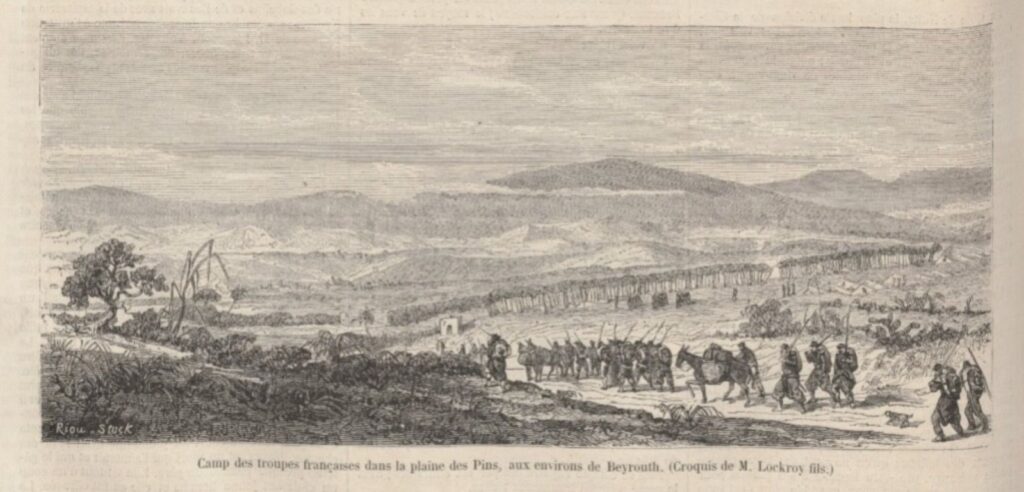
“Camp of the French Troops in the Plain of Pines, near Beirut.” Le Monde illustré, no. 189 (24 November 1860). Paris: Le Monde illustré. Bibliothèque nationale de France (BnF), Gallica.
The second engraving shifts from the displaced to the soldiers sent, ostensibly, on their behalf, a campaign the Second French Empire presented as a humanitarian mission to protect the Christians of the Ottoman Levant. Behind the humanitarian language lay strategic interests: the Suez Canal, begun in 1859, and the raw silk on which the French textile industry depended. The drawing depicts the famous pine forest south of Beirut: lines of French troops drilling and marching beneath the trees, Mount Lebanon again on the horizon.
The choice of site was deliberate. French Staff-colonel Osmont, sent ahead to prepare the expedition’s arrival, reached Beirut on 30 July 1860 and faced the problem of billeting between 6,000 and 12,000 men. He settled on the pine forest two kilometres south of town: it lay on the Damascus road, and offered space, shade, and air. Ottoman troops were already camped there, and Ismail Pasha, commander of the Ottoman forces in Beirut, agreed to accommodate the French.
The expedition itself arrived in stages. By mid-August 1860, a month almost to the day after Fuad Pasha’s arrival, Beirut’s harbour was crowded with some thirty European warships alongside Ottoman vessels, and French General Beaufort d’Hautpoul, sent by Emperor Napoleon III, disembarked with his general staff, light infantry, line troops, and sappers.
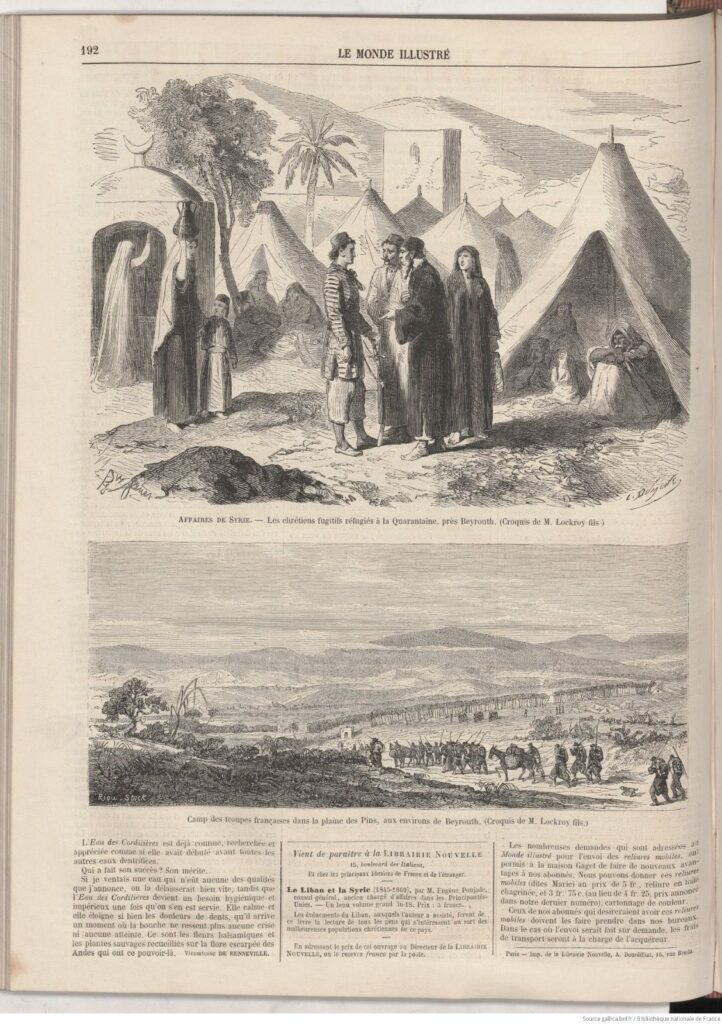
Le Monde illustré, no. 189 (24 November 1860), p. 192, where the two drawings were published. Paris: Le Monde illustré. Source: Bibliothèque nationale de France (BnF), Gallica.
Behind the orderly lines of Lockroy’s drawing lay a quiet contest of sovereignty. Fuad Pasha and Beaufort disagreed over the future of the region: the Ottoman minister envisaged Lebanon reorganized within the empire’s centralizing reforms, while the French favored a return to the semi-autonomous days of the Shihab emirate. The Ottomans had opposed the expedition’s very existence, and once it landed they worked to keep it useful in practical matters and powerless in political ones. Fuad Pasha largely succeeded. The drawing of a disciplined French camp, published for a proud Parisian public, conceals a mission that was already being politically contained.
The two drawings capture the human and political consequences of the events. Their causes run deep, even if, in Lebanon, they are often reduced to their sectarian dimension. It took courage for historians to confront the events as objects of understanding rather than of accusation. Leila Fawaz, in An Occasion for War (1994), reconstructed the crisis in its full social, economic, and diplomatic density, showing how Ottoman reforms, a changing silk economy, peasant revolts, and European rivalry converged. Makram Rabah, in Conflict on Mount Lebanon (2020), traced how 1860 lives on in Druze and Maronite collective memories, shaping identities and fears down to the war of the Mountain in 1983.
Whoever seeks to understand the events will read these scholars, among others; and whoever follows them back to the primary sources will find, in these drawings, an echo of the human suffering itself. Where the narratives of 1860 speak in the name of communities, the drawings speak of individuals: behind the figure of 30,000 refugees stood 30,000 human beings, and Lockroy’s pencil caught a few of them, women carrying water, families waiting, figures who would recognize themselves in any camp on Lebanese soil today..
This July marks one hundred and sixty-six years since the massacres. At a moment when war has once again displaced families across Lebanon, and when Syria carries fifteen years of displacement and sectarian tension, the questions of 1860 are more than academic. This is what is at stake in commemoration: the sources we choose to look at determine the kind of memory we build. Drawings such as Lockroy’s, preserved today in collections like that of the Bibliothèque nationale de France, add one piece to the complex understanding scholars construct, the understanding that gives a society the tools to remember, and to carry on. So, will we remember violence of this magnitude as inherited wounds confirming what each community already believes, or will we study it through every source available, and start giving faces to our history?
Charles al-Hayek is a public historian and the founder of Heritage and Roots.
The views in this story reflect those of the author alone and do not necessarily reflect the beliefs of NOW.