The course is set. Make Iran Great Again.
The decision has been made to bring the Iranian regime to an end; what remains is timing. That timing depends on the stamina of the Iranian people, growing momentum, the widening of popular revolt, the deepening rupture between the regime and society, fractures within the security apparatuses, especially the position of the regular army vis-à-vis the Revolutionary Guard Corps, and real-time intelligence on the ground.
Seen through this lens, President Donald Trump’s declaration that Iran is “looking at freedom like never before and the USA stands ready to help!” and Senator Lindsey Graham’s blunt call for the demise of the ayatollahs’ regime mark a strategic turning point. After nearly five decades of the mullahs chanting “Death to America,” Graham’s words read as political payback, a signal that the era of ideological threats without consequence is ending and that accountability is finally catching up with Tehran’s rulers.
Trump’s more recent revelation, that Iranian leaders reached out seeking negotiations even as events may force action before any meeting, underscores Tehran’s instinctive reliance on brinkmanship. The Islamic Republic has long mastered tactical maneuvers aimed solely at regime survival. Reports are signaling offers to Washington to oust Khamenei and put in place a transitional authority dominated by military commanders alongside Bazaar figures. Yet the protest movement has reached a scale and intensity that might no longer be defused by last-minute deals.
Meanwhile, Israel’s eye, through its assets inside Iran, is closely monitoring the situation to prepare for all scenarios. Regime collapse does not guarantee democracy and could produce worse or interim outcomes. The situation remains opaque, with no clear trajectory, and is being assessed with extreme caution. For now, Benjamin Netanyahu’s approach is to leave the initiative to Washington. That calculus changes only if the U.S. acts first or if the mullahs’ regime makes the “mistake” of directing fire at Israel. In response, Israel would begin launching strikes against the core pillars of Iran’s military power, airports and strategic facilities, missile sites and launch platforms, missile production plants, drone storage hubs, and IRGC command and leadership centers, reducing Iran’s military capabilities to their lowest possible level.
Inside Iran, the pillars of the mullahs’ regime are already reeling under the rhythm of the footsteps and chants of millions of Iranians in the streets. Yet Supreme Leader Ali Khamenei, in a recent televised address, sought to project resolve and permanence, signaling that he has no intention of fleeing. His doctrine is deeply ingrained.
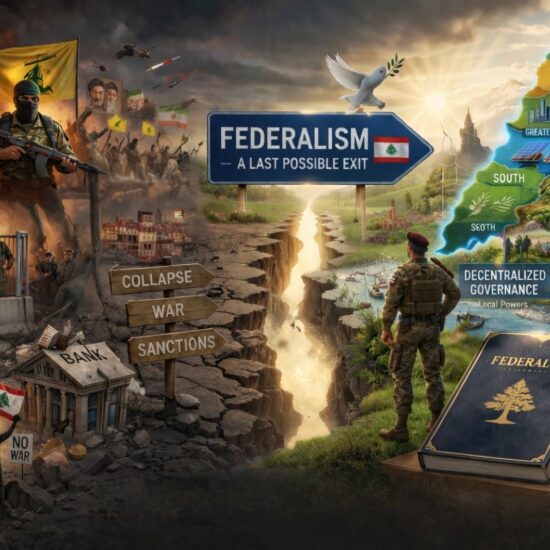
This posture reflects the logic behind the regime’s design from the outset. Tehran starved its own people to feed its proxies, cultivating them precisely for moments like this. That is why Iran created, armed, and invested in Hezbollah for four decades, not merely as an instrument of deterrence, but as a strategic reserve to be activated when the regime itself is under existential threat.
Against this backdrop, Iran’s Foreign Minister Adnan Araghchi’s visit to Beirut at such a critical juncture was anything but benign. Presented publicly as cultural and economic outreach, an olive branch to the deliberately helpless and fragile Lebanese state, the reality is far more sobering. He came to deliver the Supreme Guide’s instructions to Iran’s IRGC-aligned guerrilla force at a moment when Tehran’s margin for maneuver is rapidly narrowing.
The U.S. State Department, in a rare Persian-language statement, captured this reality succinctly: “The United States is concerned by reports that Iran is using Hezbollah terrorists and Iraqi militias to suppress peaceful protests.”
Under mounting internal unrest and intensifying external pressure, Tehran could activate Hezbollah through a binding religious fatwa, pushing it to launch attacks on Israel, ignite sectarian strife in Lebanon, and potentially extend instability beyond in Syria, Iraq, Yemen, and possibly through the reactivation of dormant cells in other regional and even foreign theaters. At the outer edge of escalation lies a far darker calculation, one that comes into play only if Khamenei concludes that the regime’s end is unavoidable.
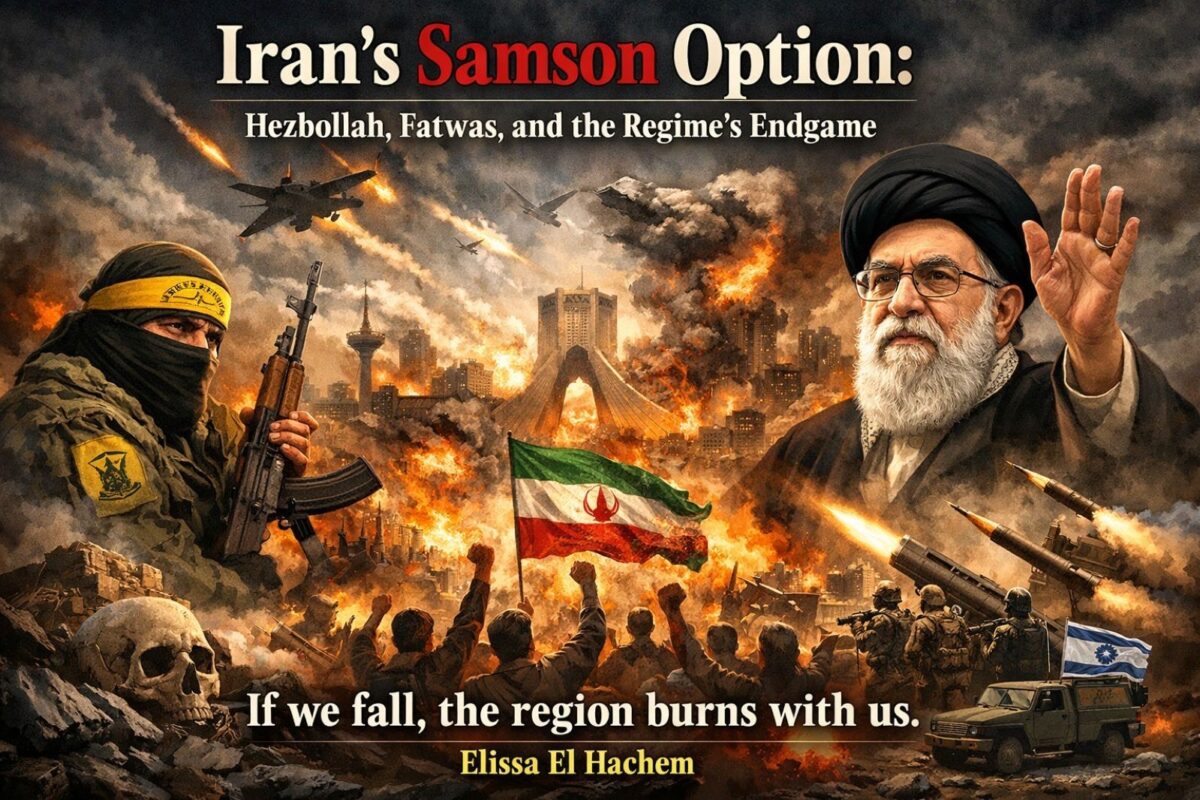
This is where a Samson-like option emerges, not as a declared doctrine, but as a governing mindset. Much like the logic historically attributed to Israel, drawn from the biblical story of Samson who brought down the temple on himself and his enemies, declaring, “Let me die with the Philistines,” the Iranian regime has its own version of a last-resort strategy, one designed to drag the region into chaos and deny its enemies a clean victory. The message would be implicit but unmistakable: if we fall, the region burns with us.
In this framework, Hezbollah and other regime proxies cease to be tools of influence or negotiation and become instruments of final leverage. Their activation would not aim to reverse collapse, but to punish, destabilize, and raise the cost of regime change to intolerable levels for all involved. This is not about winning; it is about ensuring that no orderly post-regime reality can emerge.
Such an option would only be triggered if Khamenei believes death, political or physical, is imminent. At that point, restraint gives way to nihilism, and escalation becomes existential. This is the regime’s true final card and the reason why the closing phase of Iran’s crisis is the most dangerous. When survival is no longer possible, destruction becomes a strategy.
Elissa E Hachem is a journalist and political writer specializing in regional affairs and governance. Former Regional Media Advisor at the U.S. State Department’s Arabic Regional Media Hub, with broad experience in strategic communication across government and private sectors.
The views in this story reflect those of the author alone and do not necessarily reflect the beliefs of NOW