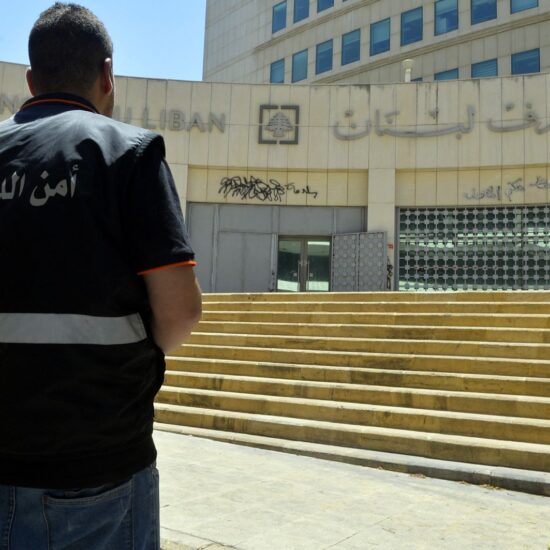
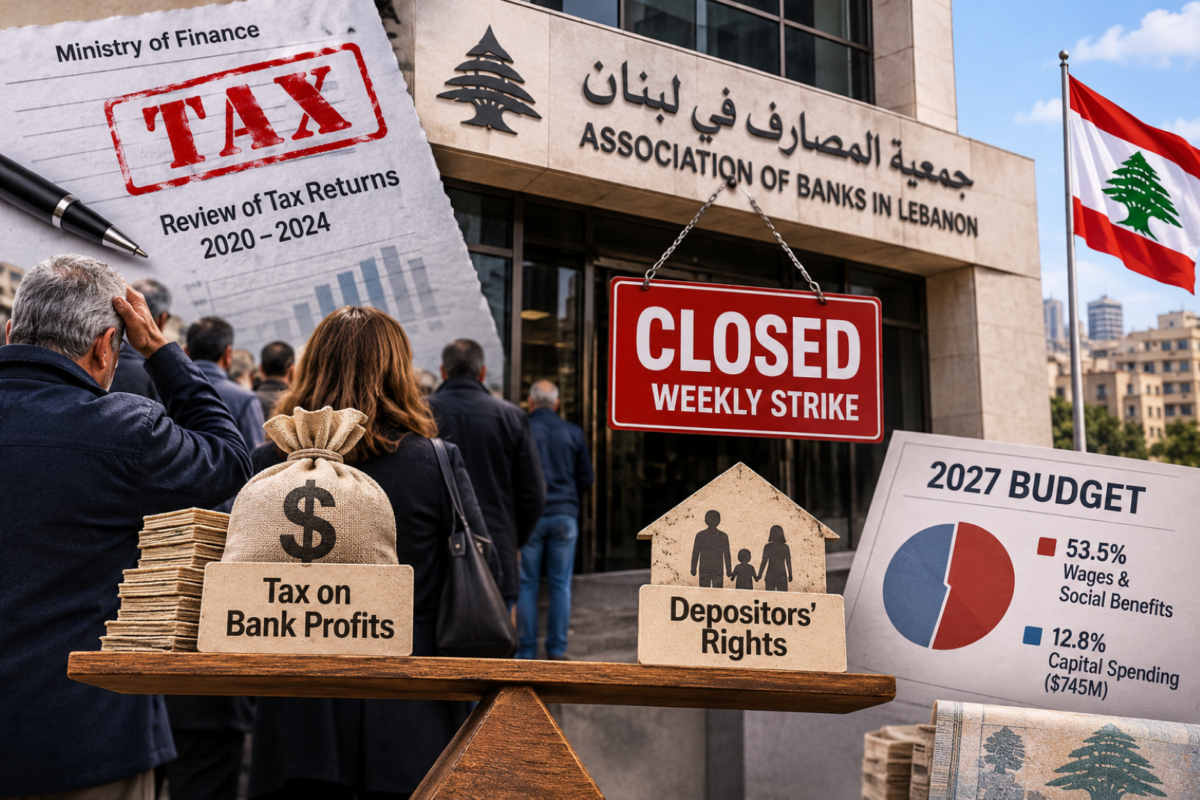
On Wednesday, November 18, Lebanon’s commercial banks closed their branches on the first day of what the Association of Banks in Lebanon (ABL) says will be a weekly strike. For depositors who have been unable to withdraw their dollars without ceilings since 2019, a branch closure was not much of a surprise.
The ABL, founded in 1959, four years before the passage of the Code of Money and Credit that established Banque du Liban and nearly five years before the central bank became operational, is registered under the 1909 Law of Associations. In practice, it is a closed lobby group that advocates for its members’ interests.
The ABL, founded in 1959, four years before the passage of the Code of Money and Credit that established Banque du Liban and nearly five years before the central bank became operational, is registered under the 1909 Law of Associations. In practice, it is a closed lobby group that advocates for its members’ interests. Because Lebanon has no legislation regulating lobbyists, such groups are registered as civil society organizations.
A tax on paper gains
On September 10, the Ministry of Finance asked banks to revise their tax returns for 2020 through 2024. The request covers how banks accounted for gains and losses on their Eurobonds, how they treated gains recorded in Lebanese lira as the currency collapsed, and the provisions they set aside after the state defaulted in March 2020. The ministry’s argument is symmetry. If a bond falls from one dollar to six cents, banks deduct the loss. If it recovers to 25 cents, the recovery is taxable.
The ABL says this taxes unrealized profits and provisions for real losses caused by the state’s own default. It also objects that losses were booked at around 1,500 lira per dollar, while some gains would be calculated at 89,500. The banks put the bill at more than $600 million. The ministry says it has not yet assessed any bank and had already extended the deadline to December 15 at the ABL’s request. The banks went on strike anyway.
Two easy readings
For many, this is another example of bank greed, backed by a political class that has rarely said no to banks. The ABL has used closures as leverage for decades. Others see it through the lens of state authority: a ministry finally standing up to a lobby to protect revenue and repair public finances.
Neither reading addresses the core of the problem. The tax tool itself is not the issue, and a strike that punishes employees, retirees, and businesses deserves no sympathy. The real problem lies in the starting point.
Viable for the tax directorate, zombies for depositors
When the government asks banks to correct five years of tax returns, it treats them as normal banks, as if the crisis never happened. When depositors ask for their money, the same government treats the banks as zombies
When the government asks banks to correct five years of tax returns, it treats them as normal banks, as if the crisis never happened. When depositors ask for their money, the same government treats the banks as zombies. Its own deposit recovery bill, sent to Parliament at the end of 2025, pays up to $100,000 in cash over four years, and the rest in central bank securities maturing in 10, 15 and 20 years. The government has discussed selling part of the gold reserves just to keep the $100,000 promise. The same balance sheet is solid enough to be taxed on a recovery from six cents to 25, but too weak to return a deposit made in 2018.
The ministry of finance is also selective about exchange rates. Banque du Liban says the state owes it $16.5 billion, which the central bank spent in dollars on the state’s behalf. The ministry rejects the debt and, as LBCI reported, argues that it should be recorded at the time of the transaction, regardless of changes in the dollar’s value. Historical rates apply when the state owes; current rates apply when the state collects.
Revenue has a constituency; depositors do not
Is the government more committed to its right to revenue than to depositors’ right to their savings? Look at where the revenue goes. In the draft 2027 budget of around $6.9 billion, wages, salaries, and social benefits account for 53.5%, while capital spending totals $745 million. Salaries are being raised without any public sector reform. Transfers to associations continue. The Ministry of Public Works rolls out road maintenance under the slogan “We Fix the Roads… We Restore Trust.”
These payments are essential to preserving the clientelist networks on which the political elite depends.
Every dollar of tax can become a salary adjustment, a grant to a friendly association, or a paved road with a ribbon and a photograph. These payments are essential to preserving the clientelist networks on which the political elite depends. Repaying all depositors, even gradually, produces none of that. Nobody cuts a ribbon on a returned deposit. At the end of August, public sector deposits at Banque du Liban stood at around $10.26 billion, yet the government has very limited funds for electricity sector investments, the greatest burden on all Lebanese.
The banks are not innocent. They are the depositors’ debtors, not their advocates. For years, they treated depositors’ money as their own, not as a debt they owed
The banks are not innocent. They are the depositors’ debtors, not their advocates. For years, they treated depositors’ money as their own, not as a debt they owed. But the state has to choose. If the banks are viable, tax them and require them to repay depositors faster. If they are not, resolve them. In my last piece, I wrote that every IMF statement since 2019 asks the same question: who pays for the losses? The tax dispute suggests the state has already answered a different one. It knows who pays for the state. Who pays the depositors is clearly not a priority.
Khalil Gebara is an academic and researcher.
The views in this story reflect those of the author alone and do not necessarily reflect the beliefs of NOW.