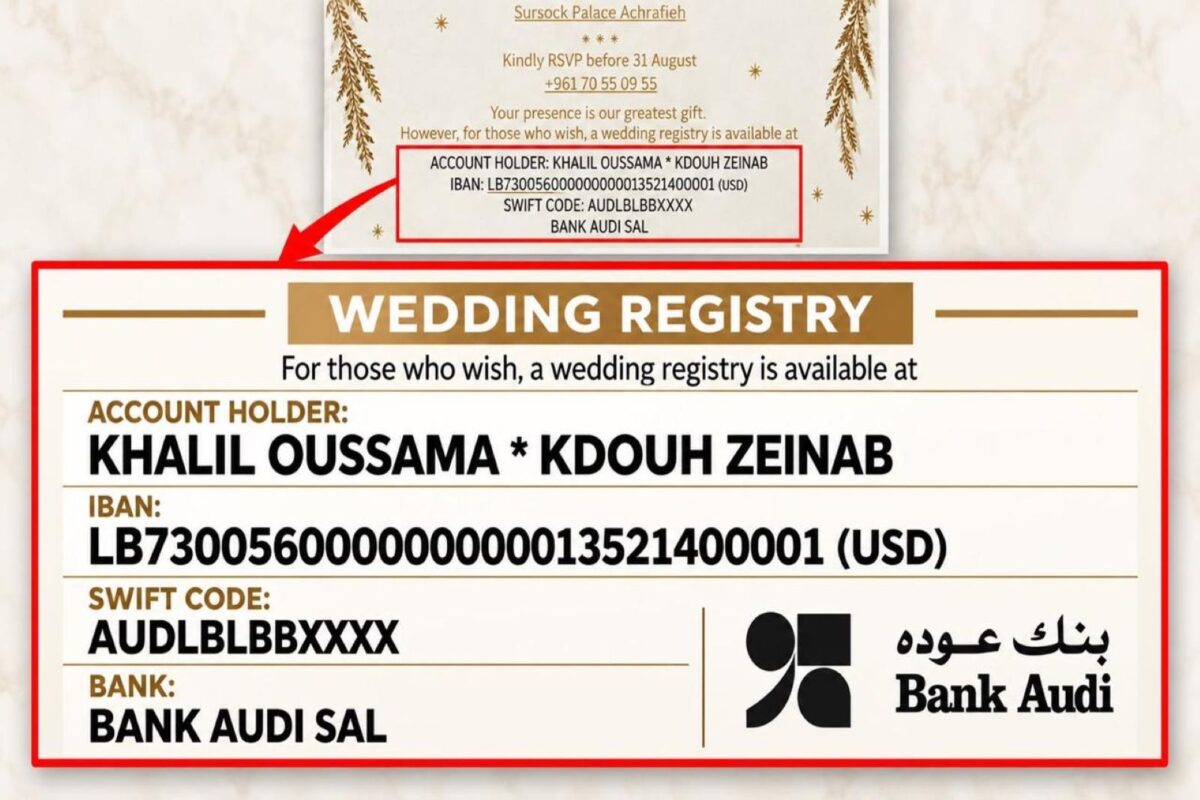
In the wedding invitation for the son of Ali Hassan Khalil, a leading figure in the so-called Movement of the “Deprived,” also known to the public as the AMAL movement, guests might first be struck by the gold embellishments and the setting of Sursock Palace.
But the detail that deserves closer attention appears at the bottom of the invitation: a US-dollar account at Bank Audi, in the names of the bride and groom, for receiving wedding gifts.
The question is not whether the couple has the right to celebrate. Of course they do. The question is about the procedures that allowed this banking relationship to be established—and, more importantly, the level of management that approved it.
The groom’s father was sanctioned by the US Treasury Department in September 2020, which cited his support for Hezbollah and involvement in corruption. This is not an incidental social detail. It is a material fact that should necessarily figure in any assessment of banking risk.
It is true that a father’s sanctions do not automatically extend to his children. But the fact that the son himself is not designated does not settle the question of whether funds or interests belonging to the sanctioned person might be present in the account.
There is a fundamental difference between an independent account belonging to the newlyweds and transactions conducted for the benefit of a sanctioned party.
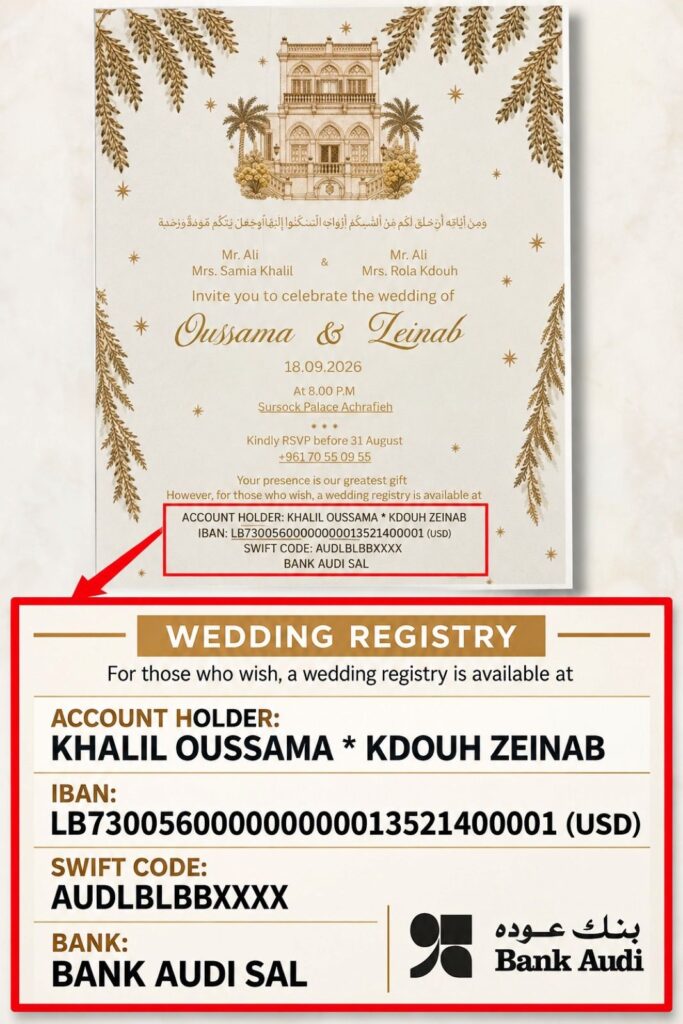
The wedding invitation, by itself, cannot tell us which is the case.
Establishing a banking relationship of this kind, if proper procedures are followed, requires senior-management approval. It is not simply another transaction completed at the counter of a local branch. Banque du Liban’s Basic Circular No. 83 subjects politically exposed persons, their family members and close associates to enhanced measures that include such approval, scrutiny of sources of wealth, and continuing monitoring.
The question, therefore, cannot end with some account of a telephone call.
The public deserves to know who approved the relationship—and on the basis of what assessment.
In practice, financial institutions routinely close accounts or restrict banking relationships in order to avoid risk. Due-diligence requirements extend to the relatives of politicians, not simply to politicians themselves. In Lebanon especially, people with political influence know perfectly well that the category of the “politically exposed person” does not stop at the officeholder. In practice, it extends to family members and close associates when there is a risk that accounts or banking relationships might be used indirectly.
But this is not an argument for punishing the bride and groom because of their parents.
It is an argument about consistency.
Are the same standards applied to everyone? Or do those standards suddenly become more flexible when politics and influence walk through the door?
And the information surrounding this account does not end with the groom’s family.
The information provided for the preparation of this article also contains allegations concerning the bride’s father, “A.Q.,” including claims linking him to fraud cases in Nigeria, that he spent a lengthy period in prison, and that his name appears on what has been described as a “blacklist.”
These remain allegations and should be treated as such unless independently established. But precisely because they are serious allegations, they raise an obvious due-diligence question rather than eliminating one.
In other words, we are looking at a bank account connected, on one side, to the family of a political figure under US sanctions and, on the other, to a family around which serious financial and judicial allegations have circulated.
That alone is sufficient to pose a very straightforward question:
What level of due diligence was applied before this account was opened, and who assumed responsibility for approving it?
What level of due diligence was applied before this account was opened, and who assumed responsibility for approving it?
Naturally, scrutiny moves upward through the bank’s management structure, including toward “H.S.,” one of the bank’s senior executives.
An account of this kind is not opened on the authority of an ordinary employee. It should pass through higher levels of compliance and management.
And if there was a previous professional or political relationship between officials at the bank and the groom’s father, that relationship would not, by itself, constitute evidence of wrongdoing. But it would make questions of transparency and potential conflicts of interest considerably more urgent.
What is striking is that the controversy did not end with the bank account.
Information circulating around the affair indicates that the venue originally expected to host the celebration subsequently cancelled the wedding reception.
But even if the cancellation is confirmed, it does not end the story.
It simply returns us to where the story began.
The wedding can be cancelled.
The venue can be changed.
The account can be closed.
The method of receiving gifts can be changed.
But there is one question that cannot be cancelled:
How was the account opened in the first place, who approved it, and what compliance procedures were followed?
How was the account opened in the first place, who approved it, and what compliance procedures were followed?
And this is where the campaign that emerged in defence of the groom’s father—on the grounds that this is a “private family matter”—becomes part of the problem rather than an answer to it.
There is a profound ethical failure in our understanding of public responsibility when “privacy” becomes a curtain that is pulled shut every time a question approaches those who possess power and influence.
Yes, the bride and groom have a private life.
And no, they should not be held responsible for the actions of their fathers.
But the groom’s father is not an ordinary citizen whose family occasion has been randomly invaded by the press.
We are talking about a public political figure who is subject to US sanctions connected to allegations of corruption and support for Hezbollah. His name has also been at the centre of one of the most sensitive judicial cases in Lebanon: the investigation into the Beirut port explosion, where he faced judicial measures and summons connected to the case.
That alone makes questions about the intersection of political influence and banking institutions legitimate questions of public interest.
A person occupying public office—particularly one surrounded by files of this magnitude—cannot simply invoke privacy when scrutiny reaches areas where power, money and influence directly intersect.
Privacy protects personal life.
It does not eliminate society’s right to scrutinise situations in which political office or influential relationships may have been used.
That is the dividing line the defenders of this arrangement are trying to blur.
Nobody is arguing that a marriage is a matter of public policy.
But when a wedding invitation displays a bank account connected to the family of a sanctioned political figure, the question of whether compliance rules were properly applied becomes a matter of public interest par excellence.
Indeed, defending such matters with the argument of “let people celebrate” reveals something deeper: the desire to transform public influence into private immunity.
And this is precisely what has destroyed the Lebanese people’s trust in their institutions.
Lebanon’s problem has always been here.
The law exists.
The circulars exist.
The regulatory bodies exist.
But the real examination begins when the law arrives at the door of someone powerful.
Does it enter?
Or does it stop at the threshold, out of respect for titles, connections and relationships?
The reported cancellation of the celebration at its intended venue does not answer that question.
Even closing the bank account, if that has happened, would not answer it.
The real question is not where the wedding will take place.
The real question is how the republic works.
Are the rules applied to everyone—or is there always an upper floor where someone can open the doors that remain firmly closed to everybody else?
Are the rules applied to everyone—or is there always an upper floor where someone can open the doors that remain firmly closed to everybody else?
Makram Rabah is the managing editor at Now Lebanon and an Assistant Professor at the American University of Beirut, Department of History. His book Conflict on Mount Lebanon: The Druze, the Maronites and Collective Memory (Edinburgh University Press) covers collective identities and the Lebanese Civil War. He tweets at @makramrabah