
A few days ago, Naim Qasem, Hezbollah’s secretary-general, cited an Israeli “thinker and philosopher” who had supposedly written a scathing critique of the Lebanese negotiating delegation in Washington, published in Yedioth Ahronoth. The quote made the rounds, dutifully amplified by the party’s media machine. Then the trail went cold: no such writer, no such article. It was invented, whole cloth, mid-speech, to lend foreign authority to a domestic attack.
It was déjà vu. As a fellow journalist also remembered, when decades earlier, Hassan Nasrallah cited a letter he attributed to former US Secretary of State Henry Kissinger, laying out an alleged American design to weaken and fragment the region. That letter, too, never existed. It had been penned as an explicitly imagined piece by the veteran Lebanese-American journalist Selim Nassar, a literary exercise, clearly labeled as fiction, before Nasrallah stripped away the disclaimer and presented it as classified American doctrine.
Two secretaries-general, one habit: when the truth is inconvenient, invent a source. But Qasem’s fabricated philosopher is not an aberration. It is the party’s oldest tool, used at every fork in its history to explain away contradictions between what Hezbollah says and what it does. Peel back Hezbollah’s story to its founding, and it is lies all the way down , a Pinocchio track spanning more than four decades.
Act One: The Founding Lie
Hezbollah has always marketed itself as a resistance born of Israel’s 1982 invasion, a shield for a defenseless south. The archival record says otherwise. In an early-1980s recording, Nasrallah himself describes the party’s project in franker terms: extending the Islamic Republic’s system of wilayat al-faqih from Tehran into Lebanon, not liberating land, but exporting a regime. The Islamic Revolutionary Guard Corps trained and financed the nucleus of what became Hezbollah before the “resistance” branding was ever applied. The 1985 open letter that formally announced the party made the loyalty explicit: allegiance to Iran’s supreme leader, not to the Lebanese state.
What followed was not defense but export of Iran’s proxy war: the 1983 bombing of the US Marine barracks and the French paratrooper compound, killing over 350; a decade of Western hostage-taking; airline hijackings. None of it defended a border. All of it served Tehran’s regional leverage. Forty-four years on, the results are in: south Lebanon occupied again, towns flattened, tens of thousands displaced, and the “resistance” that promised protection has delivered exactly the opposite, occupation renewed, land scorched, a state paralyzed. The World Bank tallied the 2023–2024 round alone at $14 billion in physical damage and economic losses, nearly 4,000 dead, and more than a million displaced. The renewed war that opened in 2026 has since pushed Lebanon’s own Finance Ministry to put losses above $20 billion, with officials warning the bill could reach $25 billion the longer it runs: two wars, one invoice, on a four-decade promise of protection. If the founding promise was defense, 2026 is its refutation.
Act Two: The Manufactured Myth
Under Nasrallah, the founding lie metastasized into an entire mythology: social, political, military and national, sold first to the party’s own Shia base as security and dignity, then to the country as untouchable deterrence. The military myth cracked in 2006, when a war Nasrallah later admitted he would not have started, had he known the scale of retaliation, left Lebanon devastated for a “victory” that liberated nothing. The national myth cracked further as the party’s weapons turned inward: the 2008 seizure of Beirut streets at gunpoint, the assassination of Rafik Hariri in which the UN-backed tribunal implicated Hezbollah operatives, the intimidation even assassinations of judges and journalists.
The social myth was perhaps the most cynical: a party that presented itself as guardian of the Shia community while entangling that same community in wars that were never its own, dispatching fighters to prop up Bashar al-Assad in Syria from 2012 onward, training and arming Houthi forces in Yemen, running logistics networks stretching into Iraq and Africa, and building financing operations tied to smuggling and Captagon trafficking that functioned less like a resistance treasury and more like a cartel’s books. Regional reports put the annual revenue from that trade flowing through the former Syrian regime networks, Hezbollah, and other Iran-aligned militias at roughly $2.7 billion, most of it destined for Gulf markets. Years before the current war made Iran’s intentions explicit, that pipeline had already revealed them: the goal was never only the military encirclement of its GCC neighbors now underway, but a slower campaign that began by targeting their societies first. Meanwhile, inside Lebanon, the party didn’t just participate in the state, it hollowed it out from within, planting loyalists in ministries, security agencies, and customs, until the “deep state” it built inside the official one paralyzed the official one’s ability to decide anything, from a government formation to a port explosion investigation, without the party’s sign-off.
Act Three: The Peace Charade
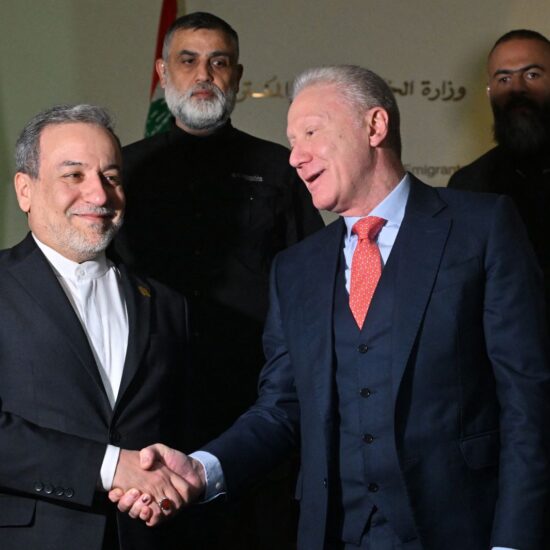
Now to today’s fight over negotiations with Israel. Hezbollah’s official line: principled rejection no normalization, no talks. Its actual objection is narrower: it does not object to Lebanon talking to Israel; it objects to not being the one at the table cashing in the chips. The precedent is inconvenient , Hezbollah set it itself. In 2022, under pressure, Hezbollah shaped and ultimately allowed the signing of the US-brokered maritime border agreement with Israel, claiming the gas-field rights as its own “victory”, even as the deal conceded Lebanon’s own claim to the Karish field, trading away national rights and wealth for the party’s political cover, the same trade it stands ready to make again the moment it is allowed anywhere near the table. It was negotiation with the enemy, dressed up as resistance triumph, so long as Hezbollah controlled the leverage and pocketed the political credit. What it cannot tolerate is the Lebanese state doing the same thing through its own institutions, on its own timeline, extracting its own gains, because a state that can negotiate its own security doesn’t need a militia to do it by proxy.
No Father to Return To
Pinocchio’s story ends in redemption: the puppet, having spun lie after lie, ultimately confesses and asks his father’s forgiveness, and is made real. Hezbollah’s story will not end that way. Pinocchio could repent because the lies were never the point, being a real boy was. For Hezbollah, the lie is the point. The founding myth, the resistance branding, the manufactured victories: strip them away, and there is no organization left to justify the weapons, the parallel economy, or the veto over Lebanese sovereignty. Confession is not redemption for Hezbollah; it is dissolution. That is why Naim Qasem will keep inventing philosophers, and why the pattern set by Nasrallah’s imaginary Kissinger letter will keep repeating: not because the party is bad at lying, but because the lying is the only thing holding the story together. A puppet that admits it was never real stops being useful. Hezbollah knows this better than anyone, which is exactly why it never will.
Elissa E Hachem is a journalist and political writer specializing in regional affairs and governance. Former Regional Media Advisor at the U.S. State Department’s Arabic Regional Media Hub, with broad experience in strategic communication across government and private sectors.
The views in this story reflect those of the author alone and do not necessarily reflect the beliefs of NOW.