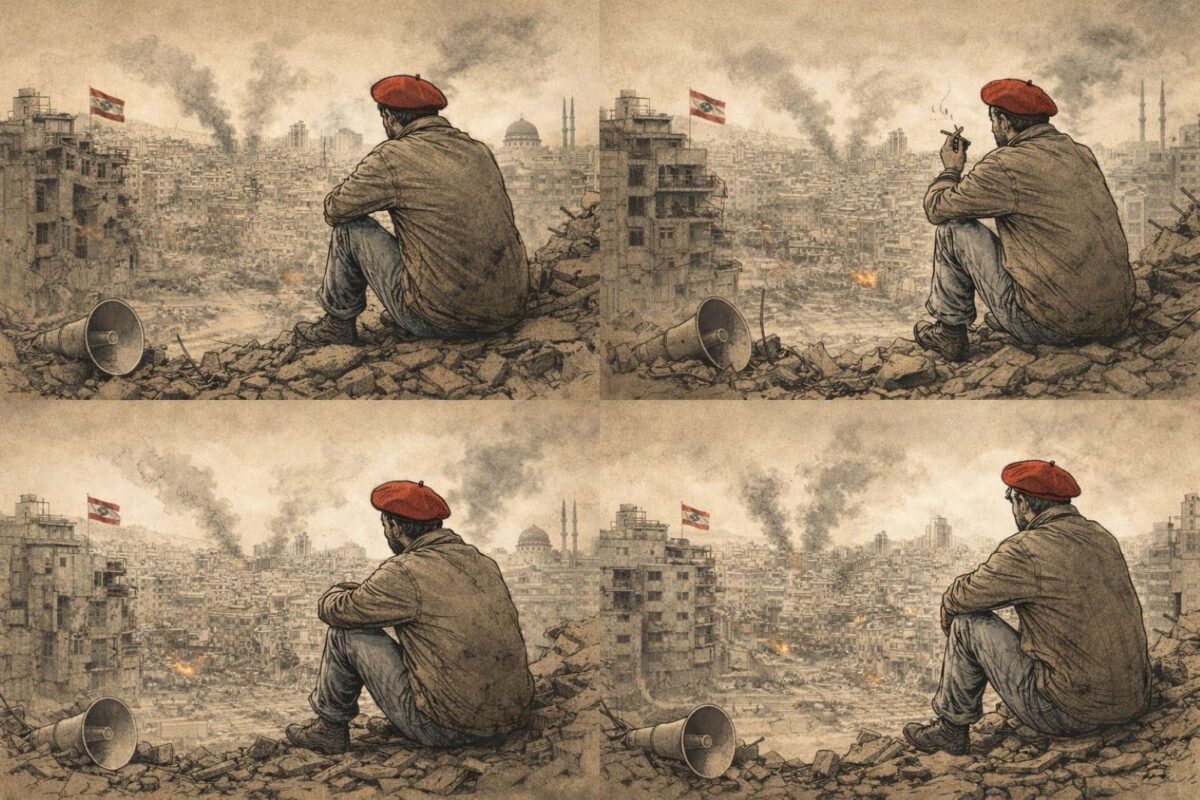
The defeat and ineffectiveness of the Lebanese left has its fundamental root in its unwillingness to think and act from within the conditions of Lebanese society. From its formative decades, the Lebanese left constructed itself not on a rigorous engagement with local conditions but on imported theoretical frameworks, external directions, and causes that were never its own. The USSR provided the theoretical canon, the organizational model, and political direction. Syria provided regional cover and at times direct interference in internal affairs. The Palestinian forces provided a cause that, however legitimate in its own right, was never Lebanon’s to lead, and whose armed presence increasingly substituted for the organic political work the left had failed to do. What the Lebanese left never provided for itself was an honest account of Lebanon as it actually was.
This dependency ebbed and flowed at the level of everyday political specifics, but a macro-perspective reveals its dominant and near-total character. Theory, strategy, tactics, and organizational forms were largely imported rather than developed from a serious engagement with Lebanese class structure, sectarian sociology, and the specific rhythms of capitalist development in a small, highly fragmented, service-based economy. Lebanon’s class relations had their own history, their own contradictions, and their own possibilities. A genuine left would have traced these across short, medium, and long-term horizons and built its political practice accordingly, meaning that whatever tactics and strategies were adopted would have emerged strictly from the necessities of local conditions, not transplanted from foreign contexts where different historical realities demanded different responses. Instead, political direction came from Damascus or Moscow, and the internal work of understanding the local social formation was largely left undone.
This is not an argument against alliances. Alliances, whatever their scope or duration, are a legitimate and rational instrument of politics. What is neither rational nor legitimate is their transformation into dependencies. Any alliance must remain strictly subordinate to locally determined political goals, goals derived from a clear-eyed reading of one’s own historical conditions, and dissolved or renegotiated the moment it ceases to serve them.
Nor is it an argument for nativist authenticity. The call here is not to Islamize or Christianize Marxism, nor to retreat into some notion of cultural originality. Marxism, rigorously applied as a method rather than a doctrine, is fully capable of illuminating the specificities of any social formation. But the point is not exclusive fidelity to any single tradition. Any methodological tool that demonstrates genuine scientific capacity to produce adequate and nuanced understandings of Lebanon’s social, economic, and ideological structures, and crucially the relationships between them, is a legitimate resource. What matters is not theoretical purity but analytical adequacy in service of coherent social praxis, like trade unionism, operating within modernist horizons. Even if the immediate political horizon is social democratic rather than revolutionary, that itself would represent a significant and hard-won advance in Lebanon’s specific context. The problem was never the theoretical tradition itself but the substitution of mechanical importation for genuine analytical work.
The results of this failure were far-reaching. When the USSR disintegrated, when the Palestinian organizations dispersed and weakened, when Syria’s regional role shifted and eventually imploded, the Lebanese left had no autonomous foundation to fall back on. The external pillars had substituted for internal construction, and when they collapsed, they left behind what can only be described as political melancholia: a left that had lost its foundations because it had never fully developed its own.
What followed was a fragmentation into three broad tendencies, each in its own way a symptom of the same underlying failure. One part of the leftist intellectual and partisan milieu migrated toward identitarian politics. Islamism attracted some; Christian sectarian movements absorbed others; ethnic and communal nationalism provided refuge for still others. The political energy that should have sustained a class-based, anti-sectarian project was redirected into precisely the identitarian frameworks that a serious left would have sought to dismantle.
The second tendency moved in the opposite direction, toward postmodern theoretical frameworks that effectively displaced class analysis and syndicalist politics from the center of left practice. Questions of discourse, representation, and cultural identity came to dominate where questions of labor, capital, and state power should have remained primary. The result was a left-like force increasingly legible in academic and cultural spaces but increasingly absent from the terrain of organized social and economic struggle.
The third tendency operated through a different but equally paralyzing logic: an intransigent revolutionism that treated any reformist activity, any patient work of party-building or union organization, as ideological betrayal. This maximalist posture, which mistook political impatience for radicalism, produced its own mirror image. Those who could not sustain the impossible standard of “permanent revolution” simply withdrew from political work altogether, justifying their resignation on the grounds that engagement with institutions that did not withhold such maximalist positions was inherently compromised. Revolutionary purism on one end, complete political abdication on the other, with nothing in between capable of doing the slow, unglamorous work of building durable organizations: in practice, both positions served the same function and vacated the field to those already in power.
The broader political consequence was a vacuum across two inseparable fronts. The first was the social-economic front, where the absence of a serious left meant that class relations went uncontested in any organized sense. Syndicates and labor unions, far from becoming autonomous institutions capable of articulating working-class interests independently of confessional loyalties, remained weak, fragmented, and largely colonized by the sectarian networks they should have opposed. The financial architecture that eventually produced the 2019 collapse was constructed without meaningful resistance, and neoliberalism deepened precisely because no durable force existed to challenge it. The second front was that of modernity itself: secularism, rationality, and personal rights and freedoms. A credible left would have been the primary carrier of a modernist horizon in Lebanese public life, pressing against the confessional organization of politics, law, and social relations. In its absence, these questions were either abandoned, captured by purely cultural discourses detached from political organization, or left entirely to the logic of sectarian accommodation. Neoliberalism and confessionalism thus reinforced each other across decades, and when the economic catastrophe arrived, there was no structured force capable of translating popular rage into sustained political pressure on either front.
The melancholia, then, was not an accident of history. It was the predictable result of a left that outsourced its thinking and its politics, and paid the full price when its creditors went bankrupt.
Yet the situation is not without foundation for renewal. A locally rooted left committed to modernity and social justice is not in contradiction with Lebanon’s post-independence heritage; it may in fact be its most coherent development. Lebanon, for all its fractures, carried within it a genuine modernist possibility: a tradition of relative openness, cultural pluralism, and civic energy that distinguished it within its regional context. A serious left would not need to import this horizon from abroad; it would find it already partially present in the Lebanese experience itself, waiting to be organized into durable political form.
This is precisely what the influential Syrian thinker and partisan Yassin al-Hafiz captured in his 1978–1979 autobiography, reflecting on what Lebanon had meant to his own political and intellectual formation:
“In Lebanon, and through it, I partially reached another station of advancement in my ideological – political – social consciousness […] More than that: thanks to Lebanon, I came into close contact with modern culture; I learned how to deal in an increasingly less Eastern manner with my wife and children; I learned how to be organized in work and how to master time. In the West I had gained a direct idea of modernity, and in Lebanon I tried to achieve it, though I cannot claim I succeeded, living as I do within a pressured Eastern society, to practice it and make it a way of life. […] And Lebanon’s catastrophe was gratuitous. The root and direct causes that drove Lebanon toward burning are many, but it seems to me that this fate was inevitable, because Lebanon was a window onto democracy, however flawed and tainted. This open window, from which the breezes of modern culture flowed and which made Lebanon a laboratory for the Arab world, and Beirut its cultural and political capital, was undoubtedly a deliberate target.”
What al-Hafiz recognized in Lebanon was not a finished modernity but a living laboratory: imperfect, pressured, and ultimately devastated, yet real. The task of a renewed Lebanese left is to take that inheritance seriously, to build patiently and without illusions the organizational and intellectual tools adequate to Lebanon’s specific conditions, and to make of that modernist possibility something durable enough to withstand the forces that have so far succeeded in destroying it.
Boghos is a researcher in political economy, social history, and intellectual history, with a focus on the modern Levant. He holds a BA in Political Science from Haigazian University and is currently a graduate student specializing in Middle Eastern Studies at the American University of Beirut. His work examines capitalist transition in Mount Lebanon, the intellectual history of the Levantine Left, and the social and historical conditions that gave rise to liberalism in Lebanon, including its structural features, its relationship to Christian communities, and its embeddedness in the socioeconomic transformations of the nineteenth and twentieth centuries.
The views in this story reflect those of the author alone and do not necessarily reflect the beliefs of NOW.