Venezuela, for me, is not just another country in South America being fought over by Putin and Trump, nor merely a state ruled by a gang of thieves led by Nicolás Maduro. It is my mother’s homeland, the birthplace of my uncles, and the country that once brought prosperity and riches to my decent grandfather, who—like many of his generation—emigrated in the mid-twentieth century in search of a good life.
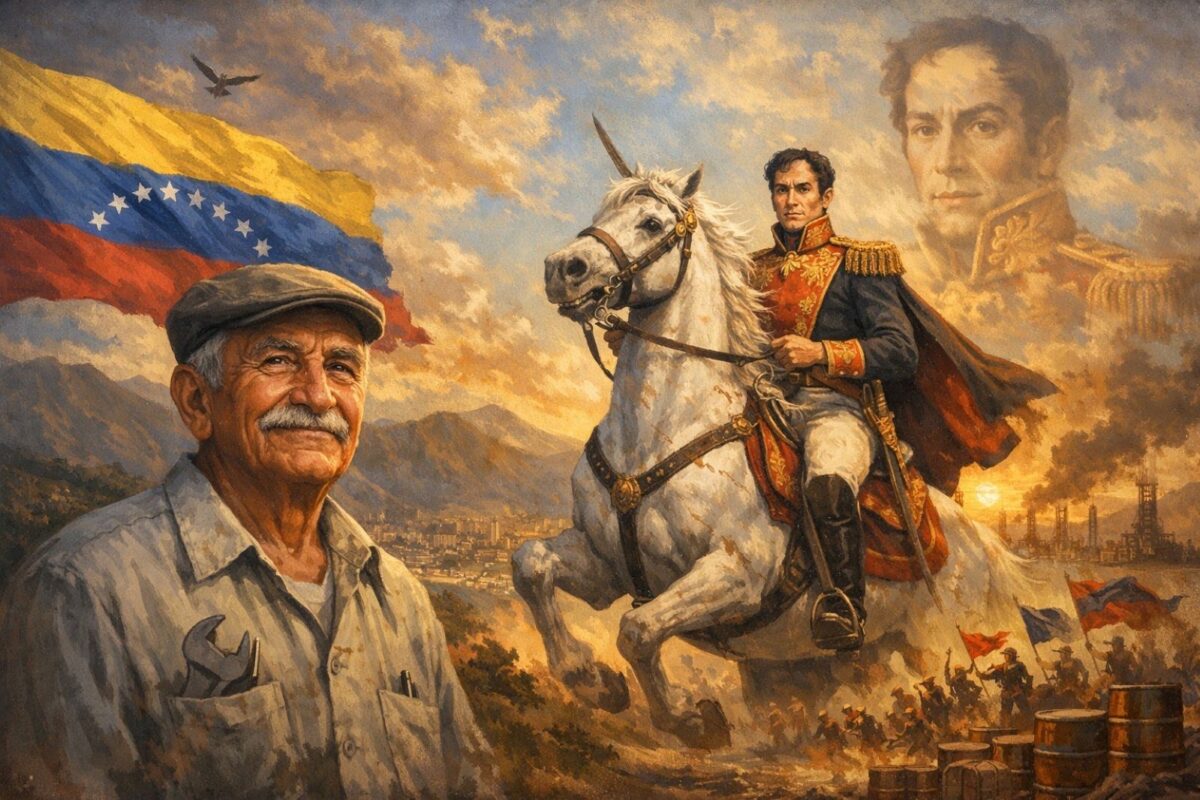
My grandfather, a hardworking mechanic who had been denied a formal education, was nevertheless wise, possessing the curiosity and precision of a meticulous scholar. He educated himself, and through him I absorbed lessons that have stayed with me to this day. In my grandfather’s home, I first encountered Simón Bolívar, the liberator and founder of Venezuela and several Latin American states freed from Spanish colonial rule. Bolívar’s portrait, which adorned our family living room, images of his white horse Palomo, and the many stories of his exploits made me revere this hero. My grandfather used to describe him as al-qabaday wal-ādami—brave and humane—and insisted that Venezuela owed its very existence to this man, repeating that Venezuela was “a land of goodness and generosity.”
Recent events in Venezuela—the humanitarian and political crisis afflicting my second homeland—and the divisions within the Arab world over the suffering of the Venezuelan people have brought my grandfather’s words back to me. I have found myself asking, again and again, what his position would have been had he still been alive. Would he have sided with what is called American imperialism, accused of seeking to destroy the so-called “Bolivarian Chavista experiment” embodied by Maduro? Or would he have supported the democratic opposition, which rejects policies of starvation and subservience to Cuba, Russia, and Iran?
Venezuela—an oil-rich country endowed with vast mineral resources—has reached a perilous moment in its history. Poverty and hunger now dominate the lives of more than ninety percent of its people. Studies describe a population losing an average of ten kilograms in body weight annually due to the near-total disappearance of food and medicine, amid inflation exceeding one million percent, with projections that it could surpass ten million percent by the end of the year.
Supporters of the so-called “axis of resistance” argue that the Venezuelan people’s suffering is solely the result of U.S. economic sanctions, imposed, they claim, to seize oil wealth and undermine a country aligned with Iran, Cuba, China, and Russia. Yet many of Maduro’s Arab supporters are the same voices that defend Bashar al-Assad and his chemical weapons, the infiltration of Iran’s Revolutionary Guard, and a brand of chauvinistic militancy they insist is aimed at “liberating Palestine.” They imagine that the road to Jerusalem runs through Caracas, and that Venezuelans and Arabs share a single mission: the destruction of the “Great Satan,” the United States.
In reality, Maduro’s regime provides political and security cover for Iranian militias that exploit Latin America as a hub for money laundering through arms and drug-trafficking networks—channels that have grown even more vital under renewed sanctions on Iran.
The tragic irony is that proponents of this logic of evasion believe their economic and political failures are always the fault of foreign interference. They claim that, were it not for Western intervention in Venezuela and the Middle East, their ideology would have produced modern states offering prosperity and—perhaps most importantly—dignity.
Yet wherever the merchants of false “resistance” have gone, they have destroyed economies and hollowed out democratic systems. Lebanon, Iraq, and Syria stand as clear evidence. They fail to grasp a simple truth: you cannot force people to choose between food and dignity. The hungry and the oppressed in capitals ruled by self-proclaimed socialists can scarcely find toilet paper on empty shelves because their leaders looted the public purse and obsessed over exporting revolution instead of building states governed by law.
Had my grandfather still been alive, he would have openly supported the popular and parliamentary movement led by Juan Guaidó—not because he believed in exporting an American version of democracy, but because Maduro, his cronies, and their thuggish allies are the very people who dragged both Lebanon and Venezuela into the abyss. They hijacked their peoples’ futures in the name of Simón Bolívar and populist socialism, while ignoring Bolívar’s own warning: “When injustice becomes law, resistance becomes duty.”
May you rest in peace, Grandfather.
This article appeared originally in Arab in the Kuwaiti Daily al-Rai in January of 2019.
Makram Rabah is the managing editor at Now Lebanon and an Assistant Professor at the American University of Beirut, Department of History. His book Conflict on Mount Lebanon: The Druze, the Maronites and Collective Memory (Edinburgh University Press) covers collective identities and the Lebanese Civil War. He tweets at @makramrabah