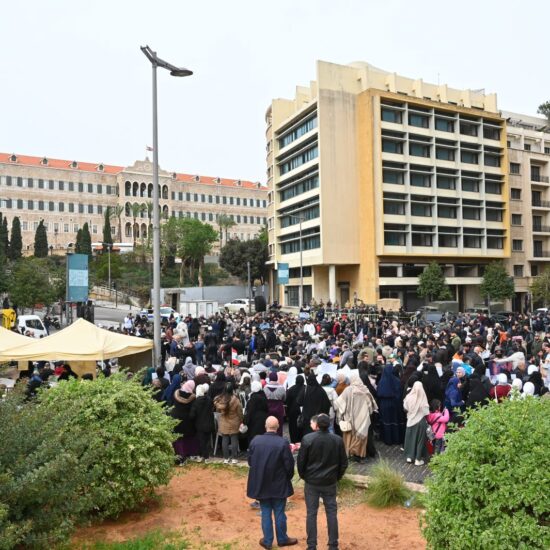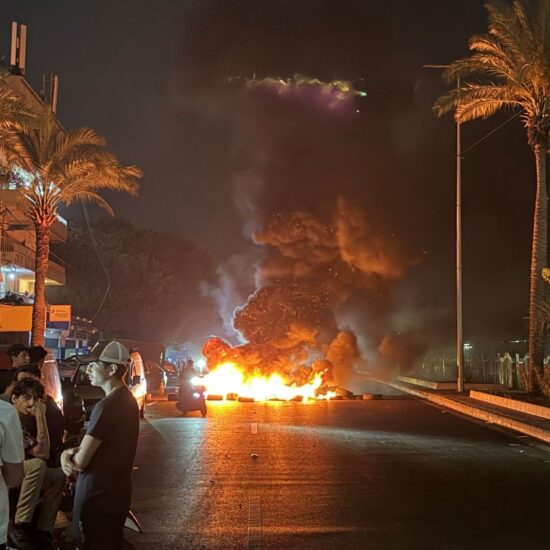
Sometimes you feel the Lebanese are on an existential quest to prove that history repeats itself. Every essential moment in the present must have a historical precedent, and if it doesn’t, we will find one. So when Lebanon and Israel signed a framework agreement in Washington on June 26, with the United States serving as mediator and co-signatory, the country did not debate the fourteen points of the text. It debated the year 1983.
Opponents of the framework resurrected the entire script of 1983 and 1984: how the militias backed by the Assad regime not only prevented parliament from ratifying the agreement but also split the institutions, fractured the army along communal lines, and left the presidency of Amin Gemayel governing little more than the palace grounds. For years, we have been told the lesson is that agreements signed under Israeli guns and American sponsorship do not survive Lebanese reality.
Here is the problem with the analogy. History is not repeating itself because we never actually left it. Two of the local partners who brought down May 17 remain in power today: Nabih Berri and Walid Jumblatt. The same men, in the same country, face another agreement with Israel,brokered by another American administration, forty-three years later. This is not a precedent. It is a continuation. But if it always takes two to tango, this time the two are dancing alone. There is no Syrian regime to lean on, and Iran, emerging from a war that ended with a memorandum of its own, cannot play the role Damascus did in 1983.
Three camps, one of them invisible
The Lebanese are divided on the framework, and the division neatly falls into three groups.
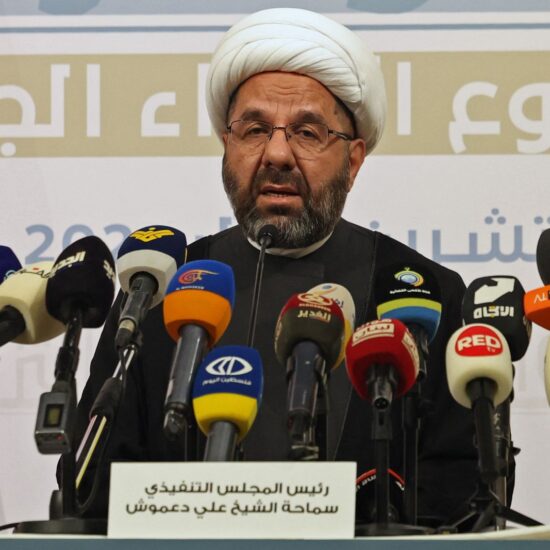
The first is pro-peace, or at least pro-ending-the-war, and says so openly. The second is ideologically anti-peace: Hezbollah rejected the framework outright, called it humiliating and a surrender of sovereignty, and declared it null and void. Whatever one thinks of this position, it has the virtue of clarity. You know where they stand because they say so.
The third group is the most interesting. It has not taken a position on the agreement. Instead, it has chosen to criticize it on technical grounds. The sequencing is flawed. The guarantees are weak. The mediator is not neutral. Article 13 of the framework gives Israel a clean slate on past violations. The verification mechanism is vague. All of which may be true, and none of which answers the only question that matters: are you for ending the state of war with Israel or against it? This group, with its solid academic background and polished vocabulary, always manages to avoid stating its real position and to pull the discussion into technicalities, wrapped in the language of the high moral ground.
We saw a lot of this after October 7, 2023. Iran, Hamas, and Hezbollah are portrayed as anti-imperialist, anti-colonial forces, certainly not religiously driven movements. The spike in energy and food prices that crushed poor countries in the Global South was caused by US-Israeli aggression against Iran, not Iranian attacks on the Gulf or the closure of Hormuz, which sent prices through the roof. The analysis is always sophisticated, the vocabulary always progressive, and, by some remarkable coincidence, the conclusion always lands on the side of the Iran axis.
When do countries make peace?
This brings us to a more serious question: when do countries actually decide to make peace? Let’s consider these three examples.
The first is military defeat. Versailles in 1919 is the model. Germany signed because it had lost the war and had no other option. The peace was imposed, the loser never accepted it, and twenty years later Europe was at war again.
The second is calculation. Anwar Sadat’s visit to Jerusalem in 1977 was not forced on Egypt. After succeeding Jamal Abdel Naser, Sadat looked at the map, decided the war option had run its course, and decided Egypt’s future ran through Washington rather than Moscow. He moved first. He decided to go to war in 1973 to sign peace later. He paid for it with his life, and Egypt got Sinai back. Peace as a cold decision made by a leader who did the math.
The third factor is exhaustion combined with a shift in the global balance of power. That was Oslo in 1993. The PLO was nearly broke, isolated after backing Saddam in the Gulf War, and had just lost its Soviet patron. It did not sign because it was defeated on the battlefield or because it made a confident calculation. It signed because of necessity. It was running out of money, friends, and time in a world that had changed around it.
So which one is Lebanon in June 2026? The framework can be read two ways. Either it reflects a shift in the balance of power, with a weaker Iran and a post-October 2023 environment in which Hezbollah’s deterrence no longer exists, or it reflects exhaustion, a state telling the militias, after fifty years of wars decided by others and paid for by everyone, that enough is enough. Both readings can be true at the same time. But neither is available to Hezbollah. If it believes it has won so far, or that it was not defeated, the framework can only look like one thing: surrender. That is the whole debate. The technical objections about sequencing and guarantees rest on this unstated premise, and no redrafting of any paragraph will resolve it.
The real question was never whether the text was perfect. It was whether the Lebanese state should have signed at all. Signing was an opportunity for the state to assert its sovereignty, to be the party that negotiates, delivers, and collects, for the first time in decades. The alternative was to wait for Iran and Hezbollah to reach their own arrangement with the US and/or Israel over Lebanon’s head, with the state standing on the periphery, watching others decide, as it did in the US-Iran memorandum that mentioned Lebanon the way one mentions a shared driveway.
The elite and the can
Which brings us to the final point: the day after. Aside from the President, the entire political elite is sending mixed signals. The ambassador in Washington signs the framework, and you get the feeling she represents a personal initiative rather than the state. The government endorses it in one statement and uses a but in the next. The speaker of parliament is against it. Still, nobody resigns, nobody commits, everybody positions.
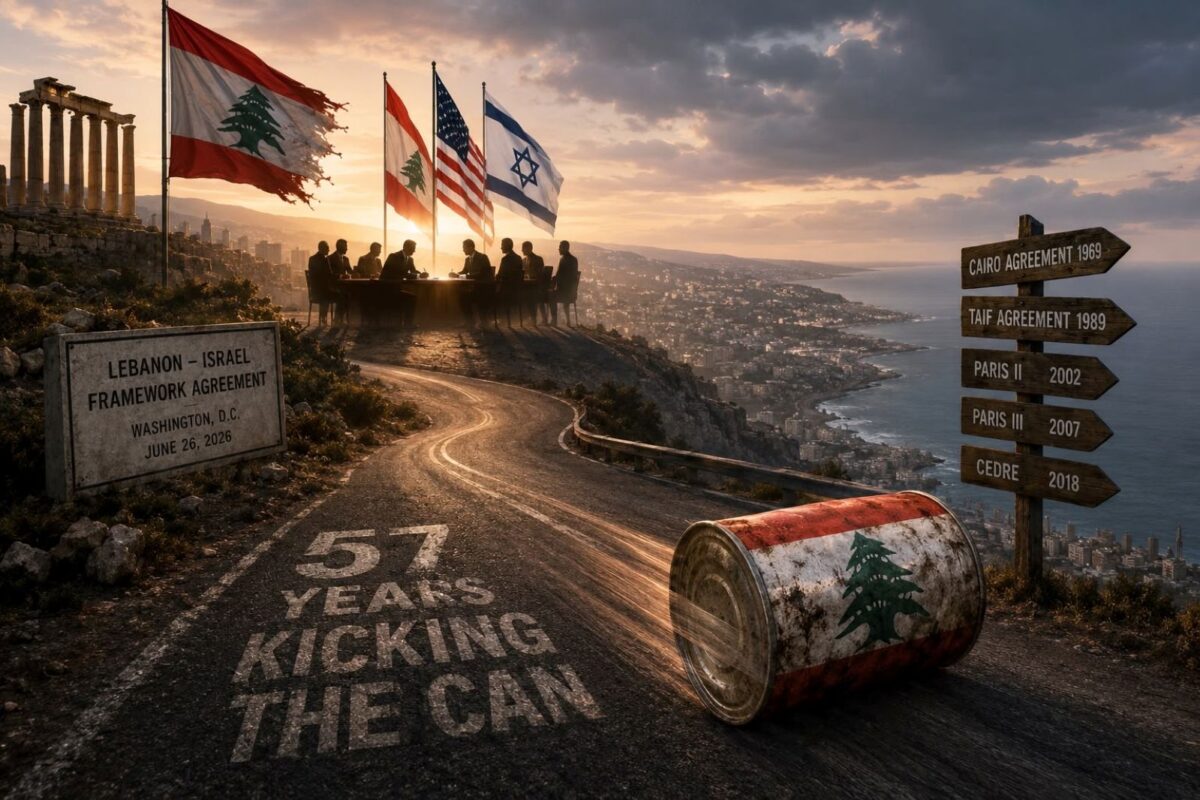
And here lies the real concern. This is a political elite that did not merely kick the can down the road. It turned it into a way of governing. The Cairo Agreement of 1969 kicked the Palestinian weapons question down the road. Taif kicked the political reforms question down the road. Paris II, Paris III, and CEDRE kicked the economic model down the road until the road ended in 2019. Each was announced as a historic turning point. Each turned out to be a mechanism for buying time with either other people’s money or other people’s patience.
The question about the June 26 framework is not whether it resembles May 17. It is whether the elite sees it as a real start or as the latest, most polished kick of the can. After El Alamein in 1942, Churchill told the British it was not the end, not even the beginning of the end, but perhaps the end of the beginning. At the signing ceremony in Washington, the U.S. Secretary of State offered the Lebanese a more cautious version: the beginning of the beginning. When even the mediator hedges his optimism, you understand the size of the road ahead. The text itself cannot answer whether this is a start or a kick. No text can. The track record answers it for us. And the troubling detail about kicking a can for fifty-seven years is that the road has not been flat for years. It has been sloping downward for a long time now, and the can keeps picking up speed.
Khalil Gebara is an academic and researcher.
The views in this story reflect those of the author alone and do not necessarily reflect the beliefs of NOW.