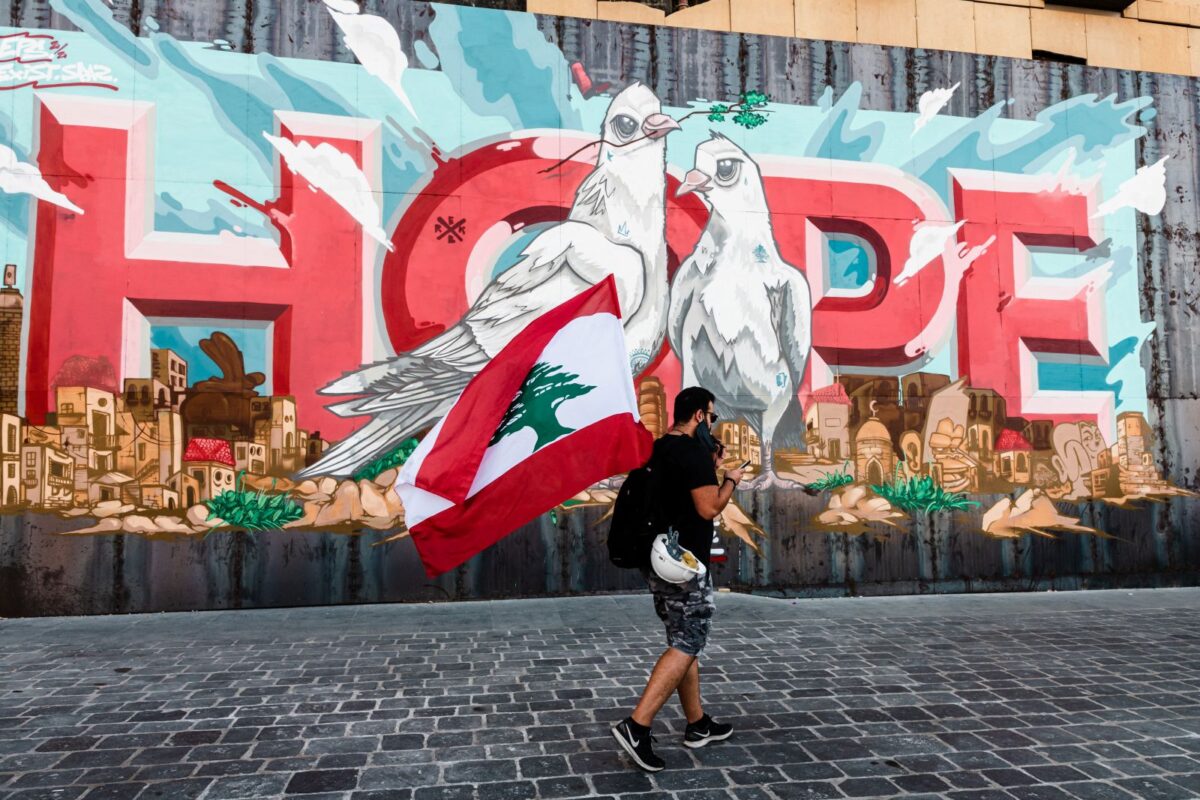
A demonstrator walks past a street art painting depicting two doves with “Hope” written on it. Beirut, October 17, 2020. Karine Pierre / Hans Lucas. AFP
From the moment a government in Lebanon is announced, the clock starts ticking. The first question is almost always the same: how long will it last? Governments expected to survive only a couple of months have lasted a couple of years, while others formed with every expectation of longevity have collapsed within months. In Lebanon, a government’s lifespan rarely matches what was expected when it was formed. Calculate the expected lifespan, and you understand why every Lebanese government behaves like a man who has been told his rent expires soon and is unsure whether the landlord will renew.
No government dies of old age
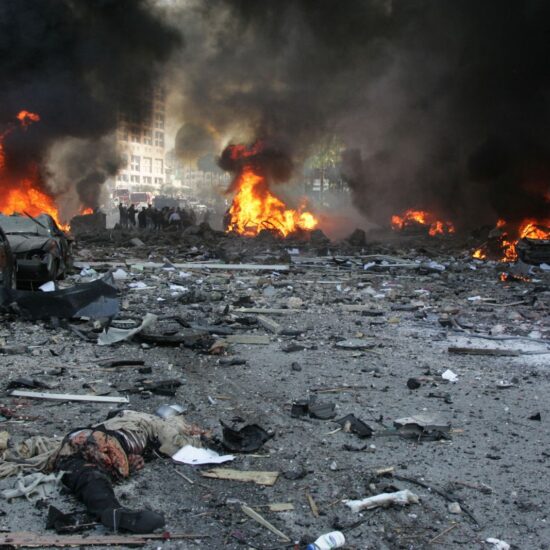
Since 2005, Lebanese governments have expired in three ways. The first is collapse. PM Saad Hariri’s first government lasted fourteen months before the March 8 ministers walked out in January 2011, while he was on an official visit to the White House, to paralyze the Special Tribunal for Lebanon, which was investigating the assassination of PM Rafik Hariri. His January 2019 government lasted nine months before the October protests ended it. PM Hassan Diab’s government lasted seven months and ended with the Port of Beirut blast, one of the largest non-nuclear explosions ever recorded. PM Najib Mikati’s second government lasted twenty-one months before he resigned in March 2013, a polite collapse. These are rarely accidents. They are engineered exits, designed to halt a specific judicial or political process or to prepare for a political coup.
The second is a parliamentary election. The cabinet does not fall. It becomes a caretaker and remains in that role. After the 2018 elections, PM Saad Hariri took nine months to form a new cabinet. After the 2022 elections, PM Najib Mikati’s third government remained in that state for nearly three years.
The third is the vacuum. The Lebanese Constitution stipulates that, in the event of a presidential vacuum, the President’s powers are to be transferred to the government. PM Fouad Siniora’s first government governed for twenty-eight months and then, after Emile Lahoud’s term expired in November 2007, spent six months running the country without a head of state. PM Tammam Salam’s government had a president for three months in 2014 and then governed for two and a half years without one.
Average it all out, and you land at roughly fifteen months. That is the working lifespan of a Lebanese government since the assassination of PM Rafik Hariri and the Syrian army’s withdrawal in 2005. Fifteen months might be enough time to form committees, commission studies, and distribute patronage. It is not enough time to modernize infrastructure, pass a budget grounded in a real macroeconomic framework, or finalize a list of sectoral reforms. It is not enough time to fix anything, especially electricity. But it is conveniently short enough to avoid being blamed for anything.
PM Nawaf Salam formed his government on 8 February 2025. It is now nineteen months old, already unusual. On 9 March 2026, parliament voted to postpone the elections due in May by two years. So this government has been spared all three deaths at once. No election will turn it into a caretaker government, because parliament postponed the election. No vacuum will hollow it out, because we have a President. And nobody has managed to bring it down. In principle, it can hold full powers until May 2028, which is thirty-nine months, compared with an average of fifteen.
Regardless of what one thinks of the current government, the PM, or the ministers, if this government remains in power until May 2028, the famous Lebanese excuse, “they did not let us” or “ma khallouna,” will not hold. This government will have enough time not only to form committees and commission studies but also to implement what they produce. That is how the PM and each minister should be judged. After listening to the Ministry of Energy explain why electricity keeps getting worse, it is hard to be optimistic. The excuses still point backward and do not convince the Lebanese of what has been done in the nineteen months it has had.
Normalizing the war
To be fair, there has been no normal month in Lebanon since October 8, 2023, when Hezbollah unilaterally dragged the country into Hamas’s war and the Iranian adventure that we all know ended badly. But the war has now lasted longer than most Lebanese governments have been in office. It is no longer an interruption of normal conditions. It is the condition. A government cannot claim credit for governing under a permanent condition while using that condition as the reason it governed so little.
The trade we kept making
Past governments treated the absence of sovereignty, Hezbollah’s weapons, and the use of Lebanon as an operational base for Iranian regional adventures as an exogenous factor beyond the capacity of the Lebanese authorities to handle. The weapons were regional, to be decided in Tehran, Washington, or any influential capital. The Grand Serail was to be shielded from all of it, which was convenient, since these were national unity governments in which Hezbollah and its allies held veto power over every decision, from how Lebanon should vote on Kosovo’s recognition to the appointment of forest guards.
So past governments promised to look inward instead, for better services, growth, and prosperity. They deferred sovereignty in exchange for economic delivery. We all know how that ended. We got neither. The currency collapsed, deposits evaporated, and the weapons stayed.
So past governments promised to look inward instead, for better services, growth, and prosperity. They deferred sovereignty in exchange for economic delivery. We all know how that ended. We got neither. The currency collapsed, deposits evaporated, and the weapons stayed.
The current government reversed that trade and did so in writing. Its ministerial statement dropped the phrase “armed resistance” for the first time since the Taif accord and committed to sovereignty and reform, using language no cabinet had used before. Then came decisions, not just promises. On 2 March 2026, the cabinet banned Hezbollah’s military and security activity and ordered the surrender of its weapons. It also banned the Iranian Revolutionary Guards’ activities in the country. On 24 March, the foreign ministry withdrew the accreditation of Iran’s ambassador-designate, Mohammad Reza Sheibani, and declared him persona non grata. On 9 April, the government ordered the army to enforce the state’s monopoly on weapons in Beirut.
Then the record stops being flattering. Sheibani is still in Beirut, now as an ordinary Iranian citizen. The framework signed in Washington on June 26, in which Lebanon committed to the complete and verified disarmament of all non-state armed groups, was never discussed in cabinet and reads more like a personal initiative by the Lebanese ambassador in Washington than a decision by the Lebanese state.
The part nobody can defend
On the economy, aspiration far exceeded delivery. Parliament passed the amended bank restructuring law in August 2026, and that is the end of the good news. There is still no IMF program, no credible plan to get Lebanon off the FATF gray list, and no measure that stops Hezbollah’s Al-Qard al-Hassan from operating. The 2027 draft budget, at 6.87 billion dollars, with more than half going to wages, continues the pattern of every budget that preceded it.
The main change may be that clientelism shifted from political to personal. Political loyalty used to decide who got the job. Now it is personal relationships.
No one can defend the record on governance. We watched appointments follow the same old path, despite promises of transparency and a serious appointments mechanism. The main change may be that clientelism shifted from political to personal. Political loyalty used to decide who got the job. Now it is personal relationships. As for service delivery, Lebanese today work to pay the generator bill and the water truck, with barely anything left over for the rest of their lives.
The political test
Sometimes we hear about wishes or plots to topple the government or replace a few ministers. Is its record sufficient to justify changing or reshuffling the government? As economists like to say when they do not want to commit, it depends.
I believe this government achieved something real, and that deserves to be said plainly. It succeeded in delegitimizing the state within the state. For many, that is not enough, because the objective is not only to delegitimize it but also to dismantle it. But we have come a long way, and you cannot dismantle a state within a state before you delegitimize it. That was the essential first step.
This should be the starting point for anyone seeking to replace the government. If a new PM and government continue down this path and move from delegitimizing the non-state to concrete measures that restore the state’s authority, there is an argument for change. If replacing the government means retreating from what has already been achieved and reopening questions that should by now have been settled in the name of national unity or communal solidarity, there is little reason to do so.
This should be the starting point for anyone seeking to replace the government. If a new PM and government continue down this path and move from delegitimizing the non-state to concrete measures that restore the state’s authority, there is an argument for change. If replacing the government means retreating from what has already been achieved and reopening questions that should by now have been settled in the name of national unity or communal solidarity, there is little reason to do so.
However, a broader conclusion emerges from all this.
For years, we were told that Lebanon needed technocratic governments and ministers with strong technical backgrounds, international experience, and impressive CVs to manage the executive and address the country’s chronic problems. The past few years should have taught us the opposite: depoliticizing government in a country whose most fundamental problems are political is a grave error of judgment.
Lebanon has never lacked economists, engineers, bankers, consultants, or ministers with foreign expertise. It has lacked the will to make political decisions and, more importantly, to enforce them.
Lebanon has never lacked economists, engineers, bankers, consultants, or ministers with foreign expertise. It has lacked the will to make political decisions and, more importantly, to enforce them.
If Lebanon needs a new government, the argument should not be that we need better technicians, stronger sectoral expertise, or a more sophisticated technical debate. It should be that the executive needs to inject new political blood capable of pushing further to reclaim the state, restore its sovereignty, and turn decisions made on paper into authority enforced on the ground.
After all, any success this government can claim is primarily political. It cannot claim an economic reset. It cannot point to transformed public services or a fundamentally different model of governance. Its strongest achievement is shifting the political terms of the debate over the state, sovereignty, and weapons.
Any government that replaces it should therefore be judged on its ability to advance that project. The state was not lost for lack of technical expertise. It will not be reclaimed by better CVs.
Khalil Gebara is an academic and researcher.
The views in this story reflect those of the author alone and do not necessarily reflect the beliefs of NOW.