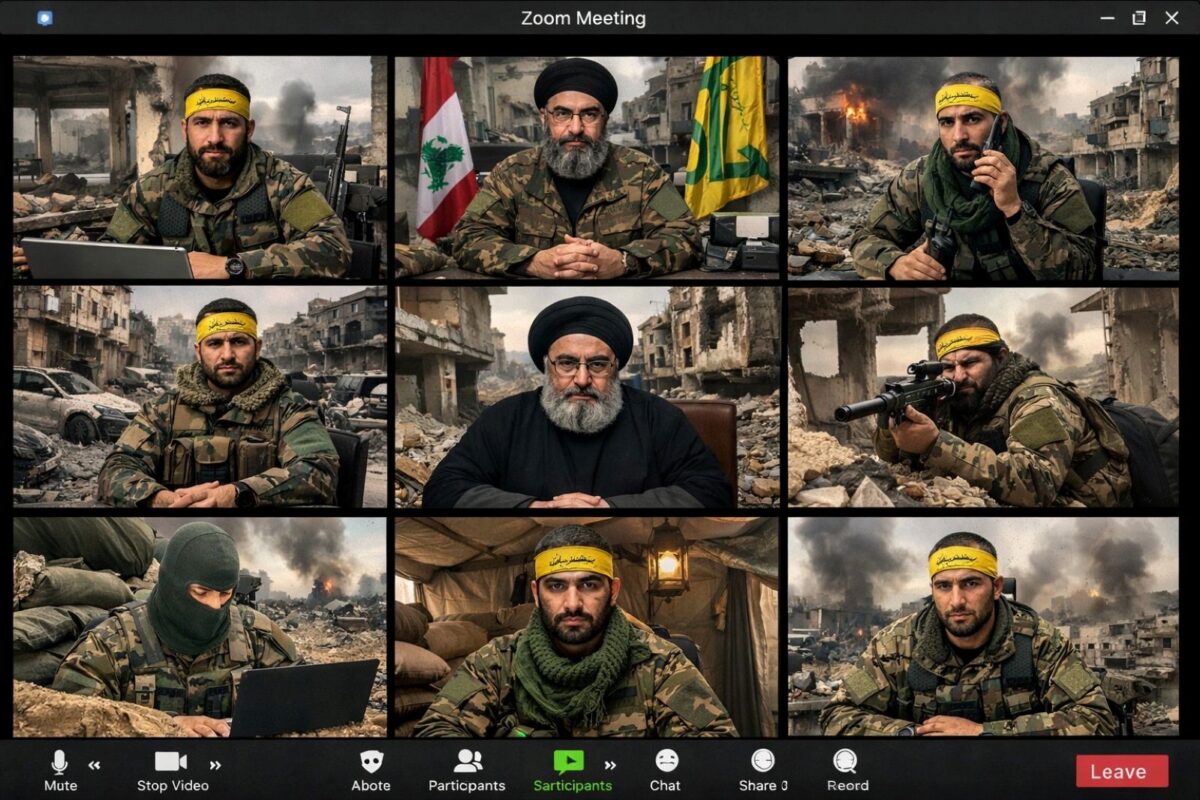
Meeting Title: Operation “We Did Know”
Platform: Zoom
Date: Wednesday, 8 April 2026 | 2:00 p.m.
Status: Secure. Allegedly.
Attendees:
Senior Political Council Members
Representatives of the Resistance Bloc
Security Liaison Units
Media Coordination Office
Hezbollah Leadership Figures
Hassan Nasrallah (deceased)
Imad Mughniyeh (deceased)
Hashem Safieddine (deceased)
- Opening Remarks
The session begins in a familiar register: confidence, urgency, and the kind of strategic optimism that usually appears five minutes before a catastrophe.
The premise is simple. Control the narrative, control the state. Lebanon, once again, is treated less as a country than as a technical inconvenience.
The chair opens by stressing the gravity of the situation. The government under Nawaf Salam is deemed “unsustainable,” not because it has failed, but because it continues to display the dangerous habit of existing outside the organization’s preferred monopoly on force. Immediate action is therefore required. Reverse state decisions. Reinstall the Army, People, and Resistance trilogy. Pretend this is normal governance.
- Strategic Objective
Primary Goals:
Sideline Nawaf Salam politically
Engineer his replacement with Najib Mikati
Restore pre-war governing dynamics favorable to the “axis”
Discussion Notes:
Participants agree that Salam’s occasional insistence on state authority, however symbolic or limited, poses a structural threat. The solution is not negotiation, persuasion, or constitutional procedure. The solution is pressure. Political pressure. Media pressure. And, if all else fails, the kind of pressure Lebanon has learned to recognize on sight.
There is also broad agreement that Hezbollah ministers and Amal affiliates are already embedded within the government. This contradiction is not viewed as embarrassing. On the contrary, it is regarded as efficient: control from within, destabilize from above, deny both, then blame someone else.
- Narrative Engineering
Approved Talking Points:
The destruction of the South is Nawaf Salam’s fault
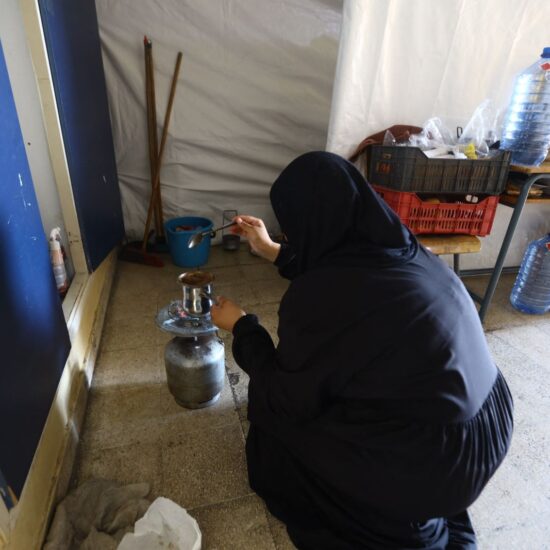
Displacement, now exceeding 1.5 million, is the result of government failure
The “Resistance” is protecting the population, not endangering it
Any call for demilitarization will be framed as betrayal
Internal Note, Unspoken but Understood:
The same actors blaming Salam are, of course, the ones who operationalized the war, stored weapons among civilians, and converted entire neighborhoods into military infrastructure with the usual promise that this was all somehow for everyone’s safety.
- Political Maneuvering
When Salam refuses to comply with back-channel pressure, the discussion matures, or at least changes shape.
Proposal:
Float the idea of a demilitarized Beirut
Present it as moderation
Use it to maintain dual messaging: reassure international actors while preserving operational flexibility everywhere else
Observation:
Several ministers express discomfort. They then immediately agree, not out of conviction, but out of long national training. In Lebanon, duplicity is not considered a flaw in governance. It is practically a constitutional tradition.
- Security and Military Measures
Operational Considerations:
Maintain readiness for targeted intimidation
Expand surveillance of political opponents
Prepare contingencies for street mobilization, coded reference: May 7 scenario
Historical References Raised:
The events of May 7, 2008 are cited as “proof of concept”
The attempted escalation in Ain al-Remmaneh is described as a “miscalculation,” not a failure
The lesson remains unchanged. When politics does not produce the desired result, force is invited to finish the sentence.
- Cybersecurity, or the Lack Thereof
A brief but illuminating segment.
Discussion:
Strong confidence in encrypted channels
Routine use of VPNs and anonymized access points
Mild contempt for the possibility of external interception
Reality Check:
The very security measures designed to protect the meeting may have created the kind of digital footprint that signals to any half-competent intelligence service: please look here.
Let us be honest. VPNs may be useful for pirated films, disappearing from your internet provider, or pretending you live in Amsterdam. They are not a shield against state-level surveillance. A man hiding under a tablecloth is not invisible merely because he cannot see the room.
The Interruption
The meeting does not adjourn. It is interrupted.
Not by dissent.
Not by conscience.
Not by a late rediscovery of republican virtue.
By a strike.
Israel detects movement: unusual, coordinated, dense. Whether it fully grasped the political dimension is almost beside the point. What mattered was that something significant was happening, and it looked worth hitting.
So it did.
Post-Strike Assessment
Was the strike meant to stop a coup?
Probably not.
Was it meant to degrade operational capacity?
Almost certainly.
But it also exposed something more humiliating than physical vulnerability: the illusion of competence.
The same organization that has built its mythology on discipline, secrecy, and control managed to reveal a level of amateurism that made interception, exploitation, and catastrophe seem less like misfortune than procedure.
Final Note
To call this scenario far-fetched is to suffer from selective memory.
From May 7 to repeated attempts at internal coercion, the record is clear. The fantasy of a managed political overthrow is not new. It is embedded in the method. The only novelty lies in the setting.
The population is exhausted and displaced.
The state is hollowed out, but not entirely gone.
The adversary is watching, patient and alert, for movement, signals, density.
These “minutes” may be fictionalized, but the structure, the instincts, and the operating logic are painfully familiar.
Lebanon today is not merely navigating another crisis. It is confronting a system that insists on operating above the state while continuing to masquerade as one of its organs. The country woke up to the possibility of peace under the mistaken impression that the Iran-U.S. ceasefire somehow included Lebanon. Hezbollah, instead of asking how the displaced might return to their homes, appears to have moved directly to the more urgent national priority of toppling a government still invested in ending the bloodshed.
And perhaps the most revealing moment in all of this is not the strike itself, but the possibility that somewhere in that virtual room, amid the encrypted bravado and revolutionary nostalgia, someone genuinely believed that no one was watching.
Makram Rabah is the managing editor at Now Lebanon and an Assistant Professor at the American University of Beirut, Department of History. His book Conflict on Mount Lebanon: The Druze, the Maronites and Collective Memory (Edinburgh University Press) covers collective identities and the Lebanese Civil War. He tweets at @makramrabah