Beirut, Lebanon,
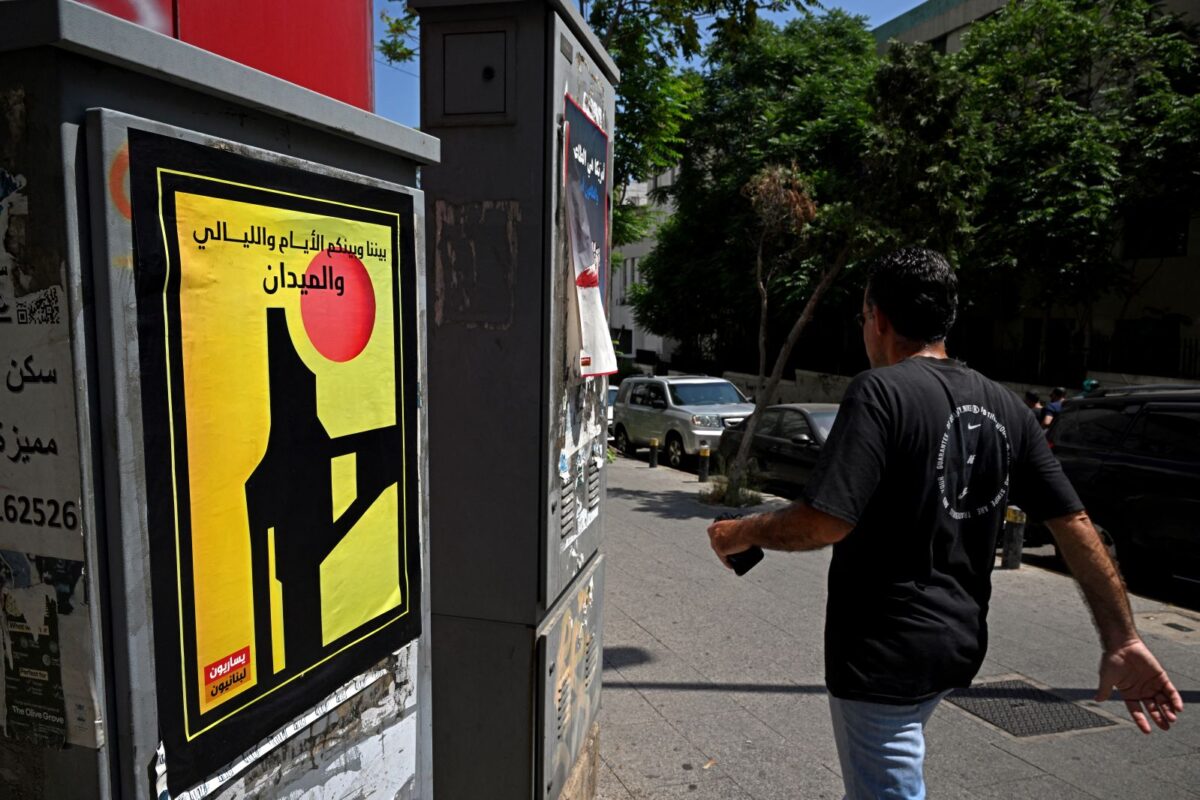
Photo by JOSEPH EID / AFP . A man walks past a placard pasted on an electricity booth in Beirut on June 10, 2026, depicting the logo of Hezbollah military media with Arabic wording that reads 'Days, nights and the field between us'.
Iran has insisted any deal to end the war must include a truce in Lebanon, which was drawn into the conflict when Iran-backed Hezbollah militants within its borders fired rockets at Israel on March 2.
At what point does a survival narrative stop describing reality and start producing it?
That question lies at the heart of Lebanon’s debate over Hezbollah today.
Political psychology has a name for what happens when movements outlive the conditions of their creation. Collective traumas do not dissolve when circumstances change. They calcify into identity. The historical memory of threat becomes almost as politically potent as threat itself, sometimes more so, because memory can be managed in ways that reality cannot.
Communities continue to interpret present events through the grammar of past suffering. Political leaders invoke yesterday’s dangers to justify today’s structures. Entire generations inherit fears they never personally experienced and inherit them as fact.
This is not a pathology unique to Hezbollah. It operates across movements, across societies, across histories. But it is particularly consequential in Lebanon today, where the gap between the narrative of existential threat and the actual nature of the threat has grown so wide that it demands honest examination.
Every serious political movement is built on a real grievance. That is what makes them serious.
Hezbollah is no exception. The movement’s critics – and there are many – often make the mistake of treating its rise as a product of Iranian engineering alone, as if a population with no legitimate fears was simply recruited into a foreign project. This is not history. It is ideology dressed as analysis.
The fears that contributed to Hezbollah’s rise were real. For decades, Lebanon’s Shia community endured political marginalization, economic neglect, repeated Israeli invasions, and the near-total absence of state protection. In large parts of the South and the Bekaa, the Lebanese state did not fail its citizens; it was never really there. Under those conditions, the emergence of an armed resistance movement was not merely predictable. It was almost structurally inevitable.
Hezbollah did not become powerful because it had weapons. It became powerful because it offered what the state could not: protection. Its founding message was simple and, for many Lebanese Shia, experientially true: the state cannot protect you, but we can.
That was the origin. The question for 2026 is whether it remains the reality.
The Hezbollah of the 1980s emerged in response to a specific, concrete reality. The Hezbollah of 2026 operates in a country where the political landscape has been fundamentally altered by the 2006 war, by Syria, by October 7th, by the collapse of its Iranian supply chain, by the decimation of its senior leadership, and by the catastrophic toll of a conflict that took far more from Lebanon’s Shia community than it returned. The movement’s military deterrence, the pillar on which its entire legitimacy rested, has been severely degraded.
And yet the discourse remains unchanged: catastrophe is imminent, enemies are circling, only perpetual mobilization guarantees survival.
This is what makes the current diplomatic moment more significant than it appears. The ongoing negotiations over southern deployments, ceasefire implementation, and the Lebanese Army’s expanded role are not, at their core, military questions.
They are psychological ones.
The real negotiation, the one that will determine Lebanon’s trajectory, is not happening in Washington or Tel Aviv. It is happening in the minds of Lebanese citizens who must decide, for themselves, whether they believe that security can still only come from a political party, or whether it must now come from a state.
For decades, Hezbollah’s legitimacy rested on the demonstrable failure of Lebanese institutions. Every state collapse, every political betrayal, every episode of sectarian cowardice by the political class strengthened the argument that only Hezbollah stood between the community and catastrophe. The state’s dysfunction was not incidental to Hezbollah’s power.
It was foundational to it.
But Lebanon in 2026 faces a different kind of catastrophe.
Not an invading army.
A dissolving society.
The country is hemorrhaging its youth, its professionals, its intellectual capital, and what remains of its institutional memory. Public trust is not merely low; in many domains, it has ceased to exist as a social phenomenon. National cohesion is a phrase politicians use at funerals.
The deepest irony of this moment is that the narrative architecture built to protect a community may now be one of the structural obstacles to building the state that community, and every Lebanese community, desperately needs.
The question before Lebanon is therefore not whether Hezbollah still has weapons.
Weapons are a symptom.
The question is whether the fear that once justified those weapons still reflects the country as it actually exists, or whether it reflects a past that has become more useful as memory than it ever was as reality.
That question belongs to every Lebanese.
And the refusal to ask it honestly is itself a form of answer.
Ramzi Abou Ismail is a Political Psychologist and Senior Research Fellow at the Institute for Social Justice and Conflict Resolution at the Lebanese American University.
The views in this story reflect those of the author alone and do not necessarily reflect the beliefs of NOW.