Beirut, 24 July 2026 – A new study proposes a simple tool that could warn a country about an economic downturn before it happens: a regular survey of young people.
The study titled A Youth Sentiment Index as a Leading Economic Indicator appears in the Journal of Economic and Social Measurement, published by the prestigious American academic publisher Sage, founded in New York in 1965, now based in California, and today one of the world’s leading independent publishers of peer-reviewed research, with more than 1,000 journals to its name.
The study, titled by Jihad El Hokayem of Rethinking Lebanon, the American University of Beirut and Saint Joseph University of Beirut, argues that the mood of the young is an early signal of where an economy is heading. Young people move in and out of jobs more often than anyone else, so they feel a slowdown first.
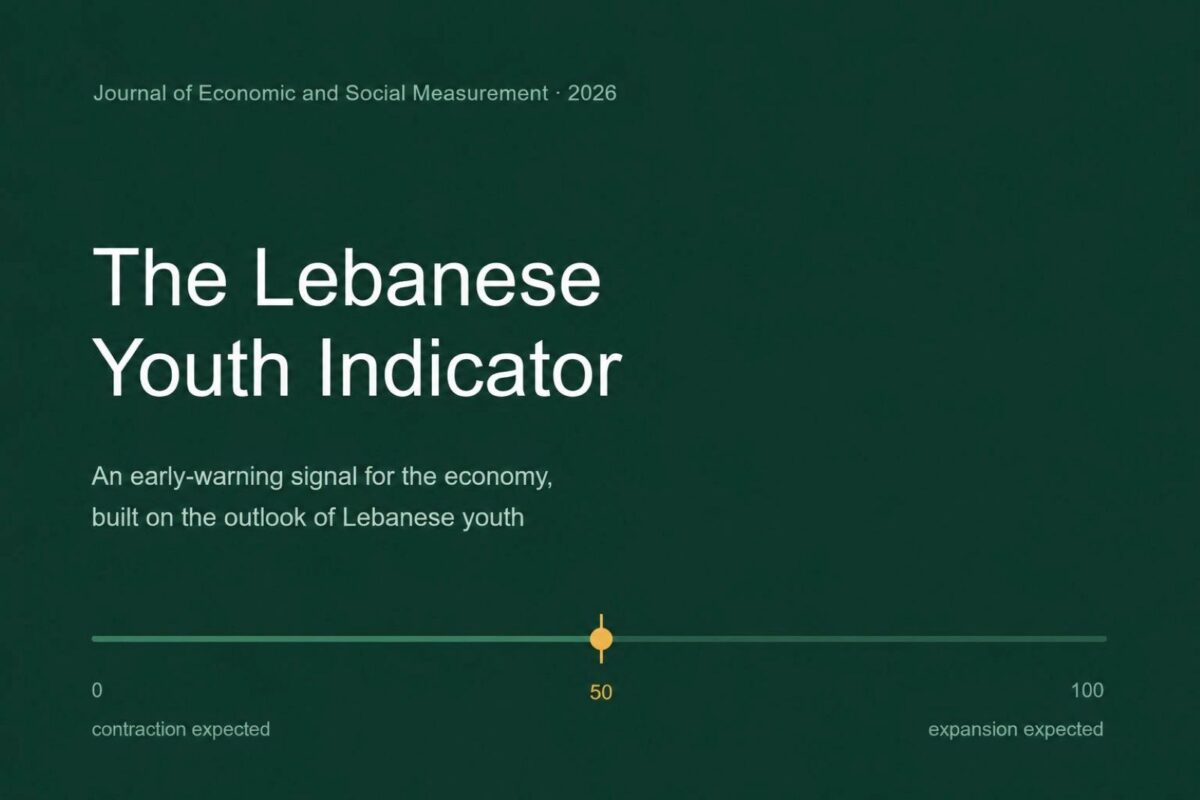
The proposal is to adopt it in Lebanon under the name the Lebanese Youth Indicator.
How it works
A purposive sample of Lebanese youth, both those living in Lebanon and those living abroad, answers a questionnaire covering a wide range of areas: living conditions, jobs, government performance, the state of the economy, safety, trust in institutions, and more. Among them is the question that carries the most weight for the future: do they expect their country to do better or worse in the years ahead?
For each question they choose only one of three answers: better, worse, or no change.
The answers become a single number between 0 and 100.
Above 50: young people are more hopeful. The economy is likely to improve.
Below 50: young people are more worried. Trouble is likely ahead.
It is the same scale used by the well-known Purchasing Managers’ Index, so the two can be read side by side.
Why it matters for Lebanon
Lebanon has lost much of its economic data since 2019, and the numbers that remain arrive late. This survey is quick, and can be run by Rethinking Lebanon in collaboration with a leading university or a public office without heavy funding.
Including young Lebanese abroad matters too. Emigration has been one of the country’s defining economic facts, and the survey records whether each respondent is a resident or part of the diaspora. How the young abroad see the future at home says as much about the direction of the economy as any financial figure.
The study suggests a clear rule: if the score falls below 45 for two periods in a row, the government should formally review its economic and social policies.
A first of its kind
Surveys of young people already exist, and consumer confidence surveys sometimes break their results down by age. But no country appears to publish a regular economic warning index built only on the views of the young. On the available evidence, this is the first.
The index has been fully designed and is ready to be tested. The author invites Lebanese institutions, universities and international partners to collaborate with Rethinking Lebanon to run a first round.