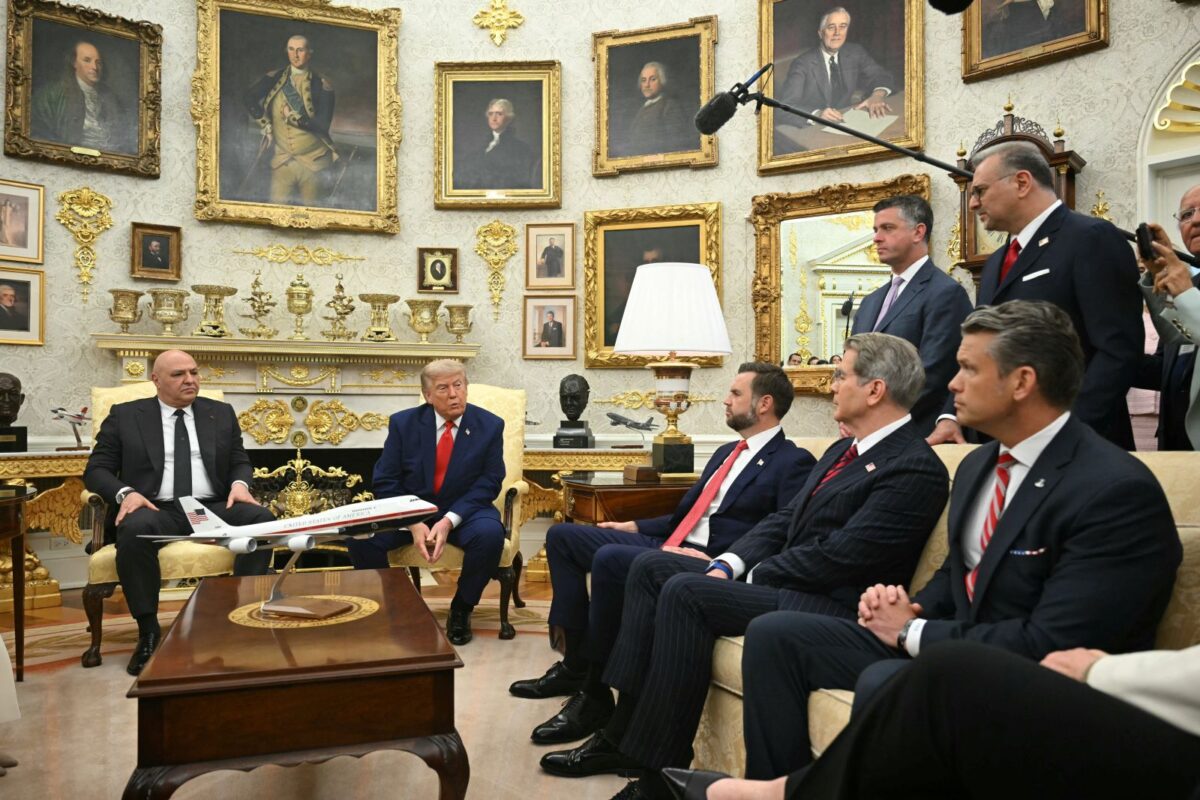
US President Donald Trump speaks during a meeting with Lebanese President Joseph Aoun in the Oval Office of the White House in Washington, DC, on July 21, 2026 as Defense Secretary Pete Hegseth (R), Treasury Secretary Scott Bessent (2nd R) and Vice President JD Vance (3rd R) look on. (Photo by SAUL LOEB / AFP)
President Trump praised President Joseph Aoun, voiced sympathy for a country he called mistreated, and announced the return of direct American flights to Lebanon. None of it was the point. The sixty minutes behind closed doors were, and what emerged was less a meeting than a checklist, with Lebanon’s next steps doing the work.
A Warm Welcome With a Price Tag
Trump did not hide his affection for Lebanon, saying it had been treated “like a whipping post” because of Iran and Hezbollah, and admitting he was “a little prejudiced in favor of Lebanon” over his many Lebanese friends. That translated into policy: U.S. carriers can now resume direct flights to Beirut, ending a suspension of roughly four decades, a signal, beyond aviation, that Washington judges the airport at least free of Hezbollah’s grip, even as questions remain over the group’s hold on surrounding areas and Beirut’s own disarmament. This was not a free gift; it was a down payment.
Behind Closed Doors: Security, Sovereignty, Reform
Public remarks were cordial by design; what was said behind closed doors appears sharper. A list of conditions attributed to the U.S. administration has circulated reflecting Washington’s expectations: dismantling Hezbollah’s arsenal for good; full sovereignty with no non-Lebanese armed component; prosecuting officials who looted the state; handing over individuals wanted under U.S. terrorism and corruption sanctions; and Lebanese accession to the Abraham Accords. These are reported priorities, not confirmed outcomes, but strikingly consistent with Washington’s public messaging.
The American Roadmap: Peace as a Regional Framework
Publicly, U.S. officials tie further support to measurable steps: extending state authority across Lebanese territory, implementing international commitments, institutional reform, accountability for corruption, and strengthening the Lebanese Armed Forces. None of it is new, except how directly it was delivered: a pointed message from Secretary of War Pete Hegseth, in Aoun’s presence, on what Washington will do if Hezbollah is not disarmed.
Of everything said in the Oval Office, this may be the line Lebanon needs to read most carefully. Trump did not float Lebanon’s potential accession to the Abraham Accords as an aside , he framed it as inevitable. “The Abraham Accords have been, I think, a tremendous success,” he said. “I think you’re going to see a lot of countries joining pretty soon.” Then, turning to Lebanon specifically: “As you know, we have our original group, and it’s so successful for them. Economically successful. It’s been that nobody left even during this time of conflict. So, I think Lebanon has a very important place.”
That is not incidental praise. It is the architecture underneath everything else discussed behind closed doors. Every condition raised in that meeting, disarmament, sovereignty, reform, accountability, reads differently once you see what they are conditions for. Washington is not simply asking Lebanon to clean its own house. It is offering Lebanon a seat in a regional order it is actively building, one already reshaping Gulf investment, reconstruction financing, and the terms of Saudi-Israeli normalization. The reforms are the entry price. The Accords are the destination. This is the deal Trump actually wants, and everything else in this piece is the fine print.
Regional Signals Beyond Washington
The timing is not incidental. Saudi Arabia secured a civilian nuclear deal with the Trump administration, followed by calls between Trump and Crown Prince Mohammed bin Salman, then Vance and the Crown Prince. Mohammed bin Salman also spoke with Aoun while he was still in Washington, inviting him to visit the Kingdom. Two capitals capable of funding and protecting implementation, Washington and Riyadh, asked Beirut for the same thing in the same week.
Aoun’s Public Messaging, and Its Silences
Aoun’s own remarks in Washington drew scrutiny. He praised Speaker Nabih Berri and credited him with rebuilding the South. Was that praise a rescue or a trap? Crediting one man for a reconstruction effort actually paid for by the Lebanese public and foreign donors: tax revenue, state borrowing, and Arab and international grants channeled through state institutions after 1993, 1996, the 2000 withdrawal and the 2006 war, not the Speaker’s largesse. The harder question the “sovereigntist” framing avoids is how many times the South was rebuilt with public money only to be destroyed again by Amal and Hezbollah’s own military adventures, and who now collects the political credit for reconstruction Lebanese citizens and foreign donors actually paid for.
Furthermore, how many have died for decisions the Chiites’ leadership made without ever asking the people footing the bill? Who decided these wars were worth fighting? Who insists that Resolutions 1559 and 1701 are now ancient history, irrelevant to today’s Lebanon? If Berri is to be called “the builder of the South,” the same standard should require an honest accounting of Amal’s military and political role, a role that has, for three decades, moved in near-perfect step with Iran’s regional agenda. Reconstruction is not a debt of gratitude owed to a patron. It is a bill Lebanon keeps paying, on repeat, for wars it did not choose.
Aoun also reaffirmed publicly and despite all doubts confidence in Army Commander Rodolphe Haykal, ruled out any army confrontation with Hezbollah, avoided direct language on disarmament, positions sitting uneasily next to what Trump reportedly wants. Whether public and private messaging matched remains unverifiable.
Reconstruction, Security, and International Support: Opportunity with Responsibility
Implementation mechanisms are already framed around Resolution 1701’s paragraph 14, affirming Lebanon’s right to request international assistance enforcing 1559, 1701, and the November 27, 2024 ceasefire, with the Lebanese Army, backed by the U.S., positioned to carry it out. The state holds the instrument, the army, and interested sponsors. What remains is execution, and whether Lebanon’s political forces unite against Hezbollah rather than let the plan be sabotaged.
The White House visit opened a potentially significant chapter in U.S.-Lebanon relations. Washington has tied further engagement to implementation, not declarations; regional developments, starting with Riyadh’s nuclear deal, give Lebanon an opening and a test. The meeting itself was significant. But significance is not success. What decides whether this moment succeeds is not what was said in Washington. It is what we do, and how we behave, in the weeks ahead.
Elissa E Hachem is a journalist and political writer specializing in regional affairs and governance. Former Regional Media Advisor at the U.S. State Department’s Arabic Regional Media Hub, with broad experience in strategic communication across government and private sectors.
The views in this story reflect those of the author alone and do not necessarily reflect the beliefs of NOW.