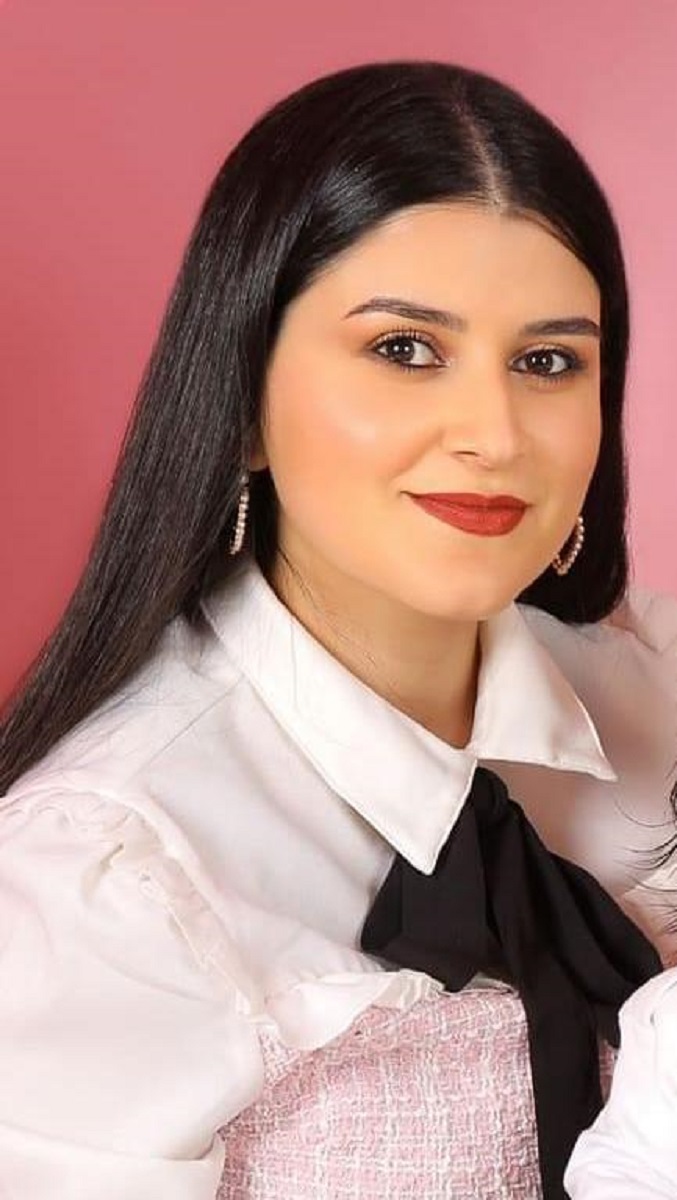
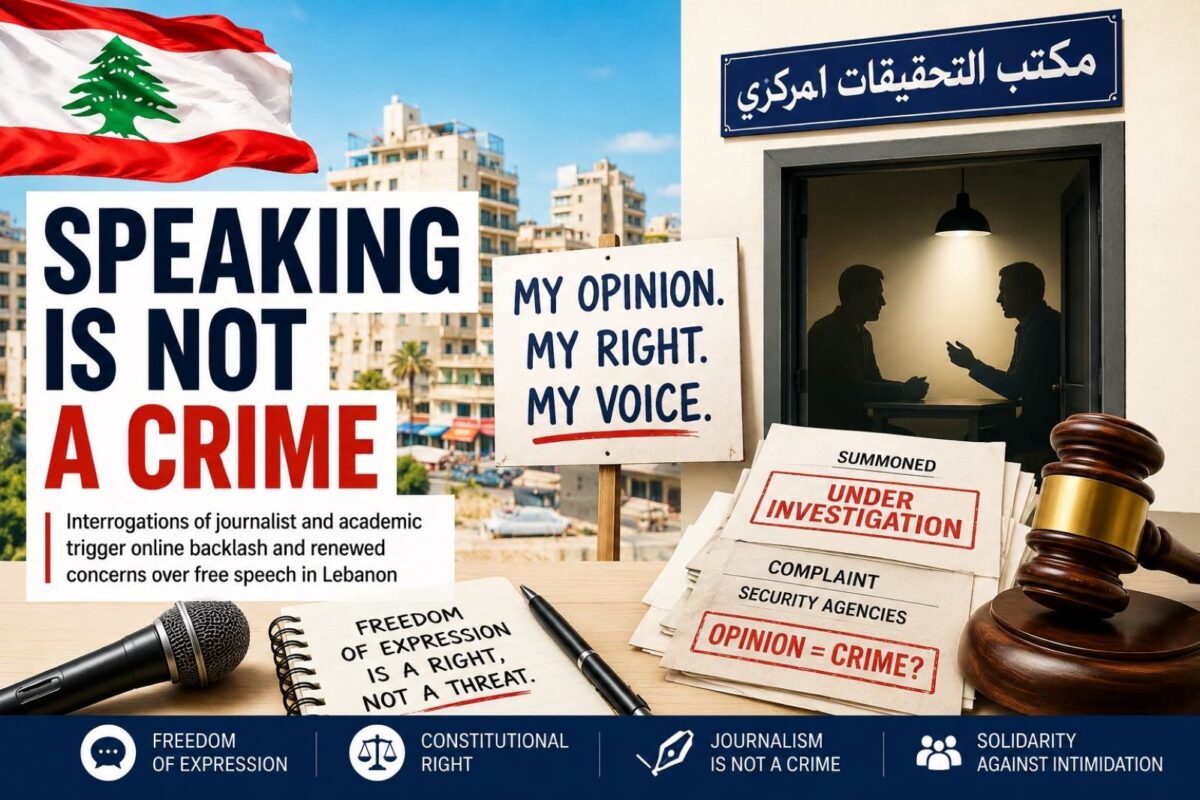
Within days of one another, journalist Sawsan Mhanna and academic Dr. Zeina Mansour were called in for questioning by Lebanese security agencies over political views they had publicly expressed, reigniting debate over freedom of expression in the country.
Their summonses have reignited debate over freedom of expression in Lebanon, prompting criticism from journalists, academics, politicians and civil society groups who argue that political speech is increasingly being handled through security and judicial channels rather than protected as a constitutional right.
The cases also sparked a wave of solidarity online, with social media users condemning the summonses as attempts to intimidate critics and warning against what they described as a narrowing space for dissent.
From online posts to interrogation rooms
Sawsan was summoned by the Central Criminal Investigations Office after the Union of Municipalities of Beirut’s Southern Suburbs filed a complaint over a post she shared on X discussing alleged infrastructure damage in the southern suburbs and criticizing Hezbollah.
“I was called by the criminal investigators and told that there was a complaint against me because of a post on X,” Sawsan told NOW. “At first, I didn’t even know which post they were referring to.”
She stressed that the content had already been published by several media outlets and online platforms.
“It wasn’t something I created or invented,” she said. “It had already been published elsewhere.”
According to Sawsan, investigators questioned why she had described the issue as “a Hezbollah crime.”
“I told them that this is my political opinion, and I am free to express it,” she said.
Zeina’s experience was different in its details but similar in its outcome.
Zeina, a university professor and political commentator known for her outspoken support for federalism, peace with Israel and political reform, said her summons came without any prior explanation of the allegations against her. She later learned that the questioning had been requested by the Military Court and carried out by General Security.
While the interview itself was brief and conducted in the presence of her lawyer, Zeina believes the case reflects a wider effort to discourage independent political voices from participating in public debate.
“I believe I was called in for purely political reasons because of my views and stance on peace,” she told NOW, arguing that the summons was linked to her longstanding advocacy for federalism, her criticism of Lebanon’s political establishment and corruption, and her activism within the Druze community, where she has publicly promoted what she describes as an independent voice in support of peace and political reform.
“I wasn’t given any official documents explaining the complaint or who had filed it.”
She later learned that the questioning had been ordered by the Military Court.
“The investigation lasted around half an hour, my lawyer was present throughout, and the case was then closed.”
Questioning the legal procedure
While neither woman described being mistreated during questioning, both questioned why cases related to political opinion were being handled by investigative and security bodies.
“The legal procedures shouldn’t work this way,” Sawsan said.
“When it’s a case related to opinion, the Public Prosecutor’s Office shouldn’t handle it. It should immediately be referred to the Publications Court.”
Zeina voiced similar concerns.
“Sending free speech cases to security agencies weakens people’s trust in public freedoms,” she said.
“It blurs the line between genuine national security crimes and the basic right to criticize those in power.”
She also pointed to Article 13 of the Lebanese Constitution, which guarantees freedom of expression, and argued that Lebanon’s Publications Law clearly establishes the Publications Court as the competent authority for publication-related cases.
Were they being targeted?
Both women believe their cases extend beyond routine legal procedures.
Sawsan questioned why she had been singled out when many others had circulated the same information online.
“Many people shared the same post, yet I was the one summoned,” she said. “I feel I was specifically targeted.”
She added that she has faced online abuse and threats since the war began.
“I’ve been called an Israeli agent, a Zionist and received repeated threats. That intimidation started long before this summons.”
Zeina likewise believes the investigation carried a broader political message.
“I believe the message is meant to silence every voice that is independent, neutral, free from outside control and non-partisan,” she said.
She argued that independent voices expressing alternative political views particularly within the community of the Druze had become increasingly vulnerable to pressure.
“There was an attempt to punish independent, free and non-partisan voices.”
For many observers and online users reacting to the cases, the issue is no longer limited to two individuals, but to the broader question of how far public speech can go in Lebanon’s increasingly polarized political environment.
They have also revived debate over whether opinion-related cases belong before security agencies or the Publications Court, and what that means for freedom of expression in Lebanon.
“When it’s a case of opinion, the Public Prosecutor’s Office shouldn’t handle it. It should immediately be referred to the Publications Court.” Said Sawsan.