AI GENERATED IMAGE
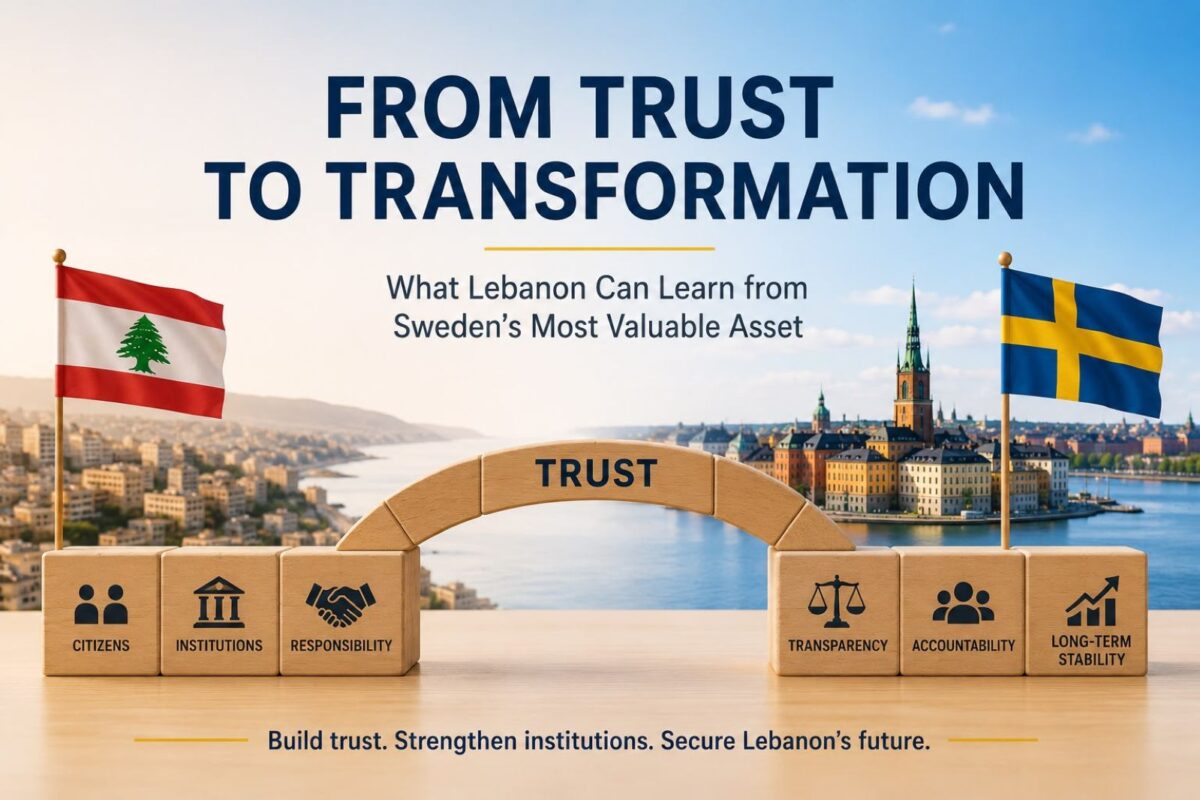
When observers seek to explain Sweden’s success, they often point to innovative companies, a strong welfare system, high-quality education, or effective public administration. These factors are undoubtedly important. Yet they are, to a considerable extent, the products of something deeper and less tangible: a society characterized by a high degree of trust.
Trust is rarely discussed in the same way as economic growth, infrastructure, or political reform because it is difficult to quantify and often invisible when it functions well. Yet trust may be one of the most powerful assets a nation can possess. It shapes how citizens interact with one another, how institutions function, how businesses operate, and how societies respond to crisis. While technology can be exported and infrastructure can be built, trust represents a form of national capital that influences nearly every aspect of social and economic development.
This insight is particularly relevant for Lebanon.
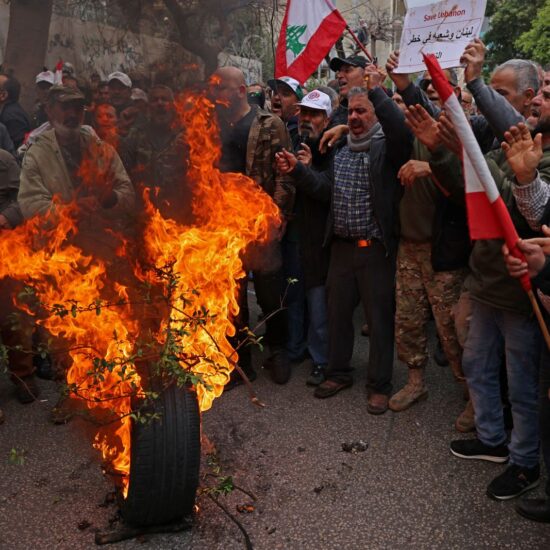
For years, discussions about Lebanon’s difficulties have focused on economic collapse, political paralysis, corruption, regional conflict, and institutional weakness. These challenges are real and deserve serious attention. However, they are also connected by a common thread: a profound deficit of trust. Trust in political leadership has weakened. Trust in public institutions has deteriorated. Trust in the state’s ability to provide services, enforce laws fairly, and represent the interests of citizens has increasingly eroded. As confidence declines, citizens look elsewhere for security, support, and opportunity.
The consequences reach far beyond politics.
Trust functions as a form of societal infrastructure. Just as roads facilitate transportation and telecommunications networks facilitate communication, trust facilitates cooperation. In societies where citizens generally believe that institutions operate fairly and predictably, economic and social interactions become significantly more efficient. Businesses can invest with greater confidence. Citizens are more willing to comply with regulations and contribute through taxation. Governments can plan for the long term because they can reasonably expect public support and institutional continuity.
In such environments, valuable resources are directed toward development rather than protection against uncertainty. Economic actors focus on innovation instead of constantly managing risk. Public institutions devote their attention to improving services rather than defending their legitimacy. Citizens engage with one another through a presumption of cooperation rather than suspicion.
The inverse is equally important.
When trust declines, social and economic life become more expensive and more complicated. Individuals increasingly depend on personal relationships rather than institutional guarantees. Networks become more important than rules. Connections become more valuable than procedures. The result is not simply inefficiency but a gradual transformation of how society functions.
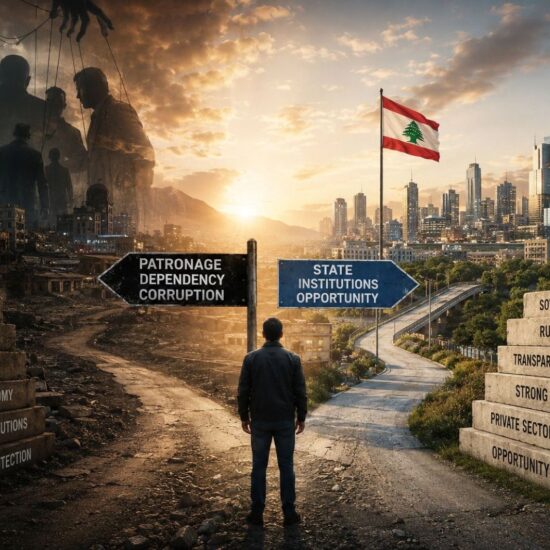
Under such conditions, corruption is often misunderstood. It is certainly an ethical and legal problem, but it is also a symptom of institutional distrust. When citizens believe that formal systems will not serve them fairly, they seek alternatives. Patronage networks emerge where institutions are weak. Personal loyalty replaces confidence in public processes. Access to opportunity becomes tied not to merit but to proximity and affiliation.
Few countries illustrate these dynamics more clearly than Lebanon.
Over the past decades, Lebanese society has demonstrated extraordinary resilience in the face of war, economic crises, political instability, and institutional failure. Yet resilience should not be confused with institutional strength. In many respects, Lebanese citizens have survived precisely because they learned how to navigate around the state rather than through it.
Families, sectarian organizations, political movements, local communities, and personal networks have frequently assumed responsibilities that functional public institutions would ordinarily perform. These informal systems have often provided support during periods of crisis and should not be dismissed. However, they have also contributed to a fragmented landscape in which trust remains concentrated within specific groups rather than extending across society as a whole.
As a result, citizens may trust their family, their community, or their political network while remaining deeply skeptical of national institutions. This creates a cycle that becomes increasingly difficult to break. Weak institutions reduce trust, and declining trust further weakens institutions.
It would be a mistake to view this challenge as uniquely Lebanese. Throughout history, many societies have struggled with low levels of institutional trust. The question is not whether such challenges exist but how they are addressed.
This is where the Swedish experience offers valuable lessons.
Sweden did not become a high-trust society because it lacked political disagreement, economic tensions, or social divisions. Like all democracies, it has experienced periods of significant debate, reform, and conflict. The strength of the Swedish model lies not in the absence of disagreement but in the existence of institutions capable of managing disagreement without undermining public confidence in their legitimacy.
Citizens can accept political outcomes they dislike because they generally trust the process through which those outcomes are produced. Businesses invest because they expect regulations to be applied consistently. Taxpayers contribute because they believe public resources are, in broad terms, managed responsibly. Public officials are expected to serve institutions rather than political patrons because institutional integrity is considered a foundational principle of governance.
Over time, this creates a virtuous cycle. Effective institutions strengthen trust, while trust further strengthens institutions. The relationship is mutually reinforcing.
Lebanon, by contrast, has often found itself trapped in the opposite dynamic. Political reforms are proposed, elections are held, governments are formed, and new policies are announced. Yet many reforms struggle to generate lasting confidence because citizens remain uncertain whether institutions will apply rules consistently, operate transparently, or prioritize the public interest over competing political agendas.
This helps explain why technical solutions alone are rarely sufficient.
A country can adopt new laws without transforming political culture. It can establish new institutions without generating public confidence. It can implement reforms without rebuilding legitimacy. Sustainable development depends not only on formal structures but also on the willingness of citizens to place trust in those structures.
Trust, however, cannot be produced through rhetoric.
Nor can it be legislated into existence.
It emerges gradually through repeated experiences of fairness, competence, accountability, and consistency. Citizens learn to trust institutions when institutions demonstrate that they are worthy of trust.
This process begins far earlier than most political debates acknowledge.
It begins in schools.
Education plays a critical role not only in developing human capital but also in developing social capital. Schools help shape how future citizens understand authority, responsibility, cooperation, and collective belonging. They influence whether young people learn that rules apply equally to everyone or only to some. They influence whether public institutions are viewed as shared assets or as instruments of competing interests.
The societies most likely to thrive in the twenty-first century will not necessarily be those with the largest armies, the greatest natural resources, or even the most advanced technologies. Increasingly, success will belong to countries capable of fostering trust across diverse populations and sustaining confidence in common institutions.
For Lebanon, this may be among the most important lessons that Sweden offers.
The country’s future will depend on more than economic recovery plans, foreign investment, constitutional reforms, or international assistance. Important as these measures may be, none can substitute for the gradual reconstruction of trust between citizens and the state. No economic strategy can succeed indefinitely if citizens do not trust institutions. No democratic system can flourish if legitimacy remains weak. No national development project can endure if social fragmentation continues to shape political life.
Sweden’s success was not built solely through technological innovation, economic management, or administrative efficiency. Those achievements were largely made possible by something deeper: the gradual cultivation of trust as a national resource.
Lebanon’s challenge is therefore not simply to rebuild what has been damaged. It is to rebuild the foundations upon which lasting development becomes possible.
In the long run, trust is not a byproduct of successful societies. It is one of the conditions that make their success possible. Lebanon has repeatedly demonstrated an extraordinary capacity for endurance. The greater challenge now is to create the conditions for prosperity.
That journey begins when trust is no longer viewed as a soft value or a cultural luxury, but as what it truly is: one of the most important forms of national infrastructure a society can possess.
Mostafa Geha is a Lebanese-Swedish school leader with roots in southern Lebanon. He writes on the role of education in preventing radicalization and strengthening long term social cohesion in post conflict societies. A member of the National Board of the Swedish School Leaders’ Union, he lectures widely on education, democratic resilience, and developments in Lebanon and the Middle East.
The views in this story reflect those of the author alone and do not necessarily reflect the beliefs of NOW.