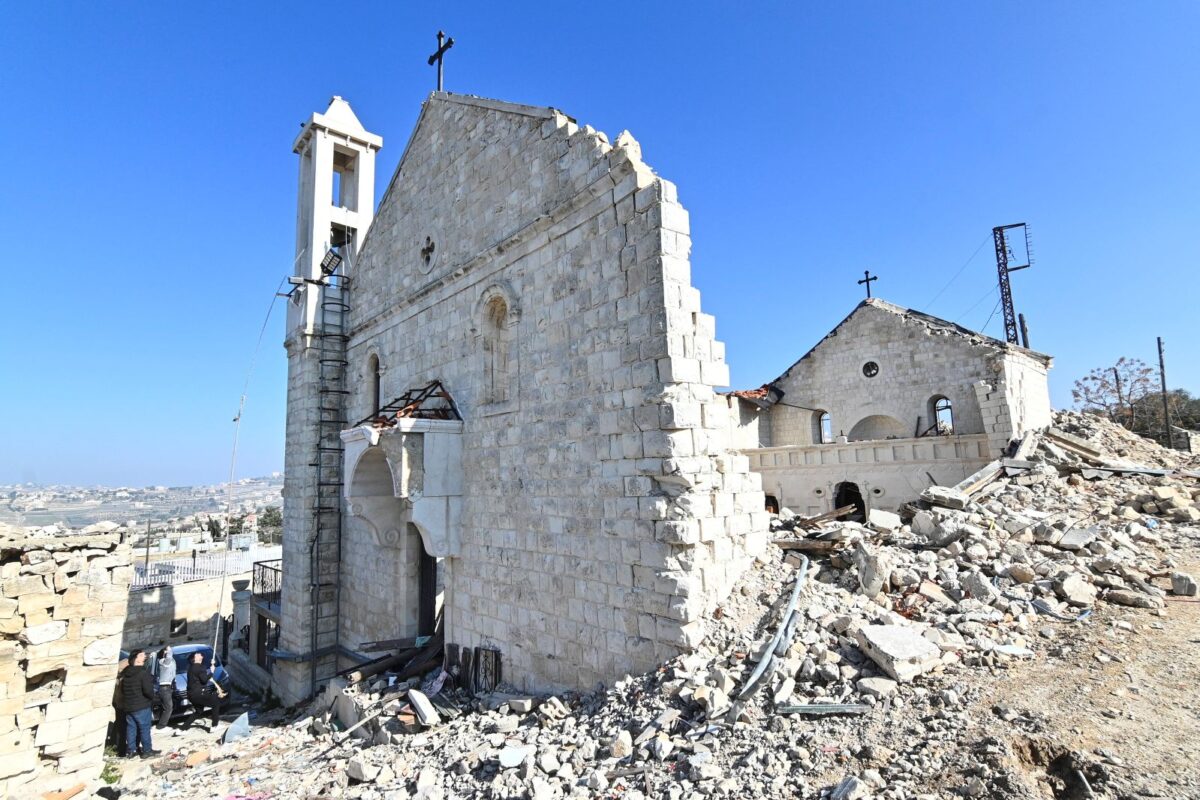
Photo by FADEL ITANI / NURPHOTO / NURPHOTO VIA AFP
In Yaroun, Lebanon, on December 25, 2025, faithful attend Christmas mass at St. Georges Church in the town of Yaroun, a Christian-populated area in southern Lebanon near the Lebanon-Israel border.
“For the violence done to Lebanon will overwhelm you, and the destruction of beasts will terrify you; because of the blood of man and violence to the earth, to cities and all who dwell in them.” Habakkuk 2:17
More than twenty-six centuries ago, the prophet Habakkuk issued a warning that has echoed far beyond its time and place. Addressing the great imperial powers of his era, he declared that Lebanon would not be erased through violence without consequence. Empires could pass through its land, cut its cedars, and reshape its cities, but Lebanon itself, its meaning, symbolic weight, and its place in the moral imagination of history, would outlast them all.
Violence against Lebanon, in this vision, is never the conclusion of history; it is the beginning of a longer reckoning that those who wield it rarely anticipate.
History has repeatedly confirmed this pattern. Empires have risen with confidence in their permanence only to dissolve into memory. Assyria disappeared from the map of power. Babylon collapsed. Persia yielded to new orders. Rome declined into fragmentation. The Ottoman Empire dissolved. Colonial mandates ended. Armies entered Lebanon and eventually withdrew from it. Yet Lebanon remained, not as a symbol of stability, but as a symbol of endurance through instability, a country repeatedly fractured yet never fully erased.
Lebanon has never existed outside the imagination of empires and kings. It has always been named, used, and contested by rulers who understood its strategic and symbolic significance.
In the biblical tradition, King Solomon imported the famed cedars of Lebanon through his alliance with Hiram, king of Tyre, using its timber to build the First Temple in Jerusalem. In this memory, Lebanon is already more than geography; it is material permanence, sacred construction, and the substance of continuity itself.
Across later imperial histories, from Assyrian campaigns through Babylonian expansion and into Roman provincial governance, Lebanon appears again and again not as a marginal frontier but as a valued and contested space whose mountains, forests, and ports carried enduring strategic importance.
And yet, across all these epochs, one paradox remains constant: Lebanon was never reduced to simplicity. It remained complex where empires demanded uniformity, plural where they demanded absorption, and fragmented where they demanded control.
It has always been too significant to ignore and too intricate to dominate. That paradox continues to define the present.
In a recent interview, Israeli Prime Minister Benjamin Netanyahu claimed that Christian villages in southern Lebanon had requested annexation by Israel in exchange for protection from Hezbollah. The claim was immediately rejected by Lebanese local authorities, and firmly denied in a joint statement issued by fifteen Christian villages that reaffirmed their commitment to Lebanon’s sovereignty, identity, and unity.
But the real importance of the episode does not lie in the claim itself. It lies in the condition that allows such a claim to enter public imagination at all: the erosion of confidence in the state as the guarantor of security and belonging.
When citizens begin to contemplate protection outside their own state, it is never the beginning of a political project; it is the symptom of a political vacuum. When the state ceases to guarantee security equally to all its citizens, communities gradually shift from the language of belonging to the language of survival. Once survival becomes the dominant logic, even ideas that were previously unthinkable begin to enter public discourse.
These are not ideological transformations in the classical sense; they are survival responses to the absence of a functioning state.
It is here that Father Michel Hayek offers one of the most penetrating readings of Lebanon’s very idea.
Writing in 1979, in the midst of the Lebanese Civil War, Hayek argued that for a Maronite Christian, coexistence was not simply a political preference but a theological and historical obligation. Rooted in the Christian faith, the believer is called to step beyond oneself toward others, embracing the risk of encounter in order to live communion and coexistence.
He saw this not as an abstract ideal but as the very history of the Maronite community: a people that had lived among Greeks, Syriacs, Arabs, Latins, Druze, Sunnis, and countless others, forging covenants across cultures while preserving its own identity.
For that reason, Hayek insisted, abandoning this project was inconceivable. The Christian vocation in Lebanon was never annexation to another state, nor separation from Lebanon itself. Only if extermination became the only remaining alternative, could withdrawal, partition, or isolation even be contemplated. Become even selfish. Such a choice would not represent a political ideal but an act of sheer self-preservation.
Hayek therefore distinguished between two ideas that Lebanese political discourse has too often confused: the Covenant (al-Mithaq) and the constitutional Formula (al-Sīgha).
The Covenant is Lebanon’s enduring project, the freely embraced commitment of diverse communities to share one homeland without erasing one another’s identities. The Formula, by contrast, is the constitutional and institutional arrangement through which that commitment is expressed. It belongs to the realm of politics and governance; like all political systems, it can evolve, adapt, and be reinterpreted over time.
The distinction is essential. Constitutions may change. Political arrangements may be revised. Institutions may be rebuilt. But the Covenant cannot be abandoned, because it represents the very reason Lebanon exists as a nation. From this perspective, Hayek argued that the constitutional Formula established in 1943 was never sacred. It was an attempt shaped by its historical moment, and experience revealed its shortcomings. Its deeper flaw was not merely political but philosophical: it failed to define clearly the fundamental principles upon which coexistence rested, principles connected to identity, culture, and religion.
In doing so, it contradicted the very logic that makes plural societies possible: “Distinguish in order to unite.” Instead of recognizing difference as the foundation of a shared civic life, it gradually transformed differences into hardened sectarian categories. In ordinary language, as Hayek expressed it, it was as though barriers had been erected between neighbours.
The lesson remains strikingly relevant today. Lebanon’s constitutional arrangements may evolve, as every political system eventually must. But the Covenant cannot be abandoned.
Lebanon’s Christians have historically been among the strongest defenders of this Covenant precisely because they understood that their presence in the region was inseparable from the preservation of a shared national space in which difference is protected rather than erased.
The Maronite experience was shaped not by rejection of others but by encounters with others and the many communities with whom they shared the mountains, villages, and cities of Lebanon. Their identity was built upon the conviction that distinct communities could inhabit one homeland without dissolving into one another.
Yet today, that confidence is under strain. Many Lebanese increasingly feel that the state which is meant to embody this Covenant has retreated from its most fundamental obligation: ensuring equal protection for all its citizens. When that obligation weakens, trust begins to fracture, not only between citizens and the state, but between communities and the very idea of the state itself. The responsibility, therefore, rests not on communities themselves but on the state: to ensure that no group ever feels compelled to choose between survival and coexistence.
This is the most dangerous stage in the life of any nation. Not war. Not invasion. But the slow erosion of trust in the state as the guarantor of security. Because once that trust is lost, societies do not collapse suddenly; they gradually reorient themselves toward alternative sources of protection and identity. That is how states dissolve from within long before they disappear from maps.
Yet Lebanon has been declared finished too many times to be taken seriously as a case of disappearance. It has survived civil war, invasion, occupation, economic collapse, political paralysis, and repeated regional upheavals that should have overwhelmed it. Each time, it has re-emerged altered but intact. Habakkuk’s warning still echoes through this history: violence against Lebanon never concludes its story.
Lebanon is not merely a republic. It is a Covenant. Its political system may one day be reimagined, and its constitutional arrangements may be rewritten. But Lebanon itself endures.
The Formula may change. The Covenant cannot.
This country has absorbed every attempt to simplify it, divide it, or absorb it into someone else’s logic.
It has never been finished. And it will not be finished now.
So too will its Christians remain, not as remnants of a fading past, but as a living and inseparable part of Lebanon’s identity, memory, and future. Their belonging is not conditional upon political convenience, nor dependent upon the protection of another power. Their story is written into the history of Lebanon itself.
Habakkuk’s ancient warning still stands across the mountains of this land: those who seek to destroy Lebanon may shape its suffering for a season, but they will never write its final chapter.
Lebanon remains.
Elissa E Hachem is a journalist and political writer specializing in regional affairs and governance. Former Regional Media Advisor at the U.S. State Department’s Arabic Regional Media Hub, with broad experience in strategic communication across government and private sectors.
The views in this story reflect those of the author alone and do not necessarily reflect the beliefs of NOW.