Photo by HASSAN IBRAHIM / POOL / AFP
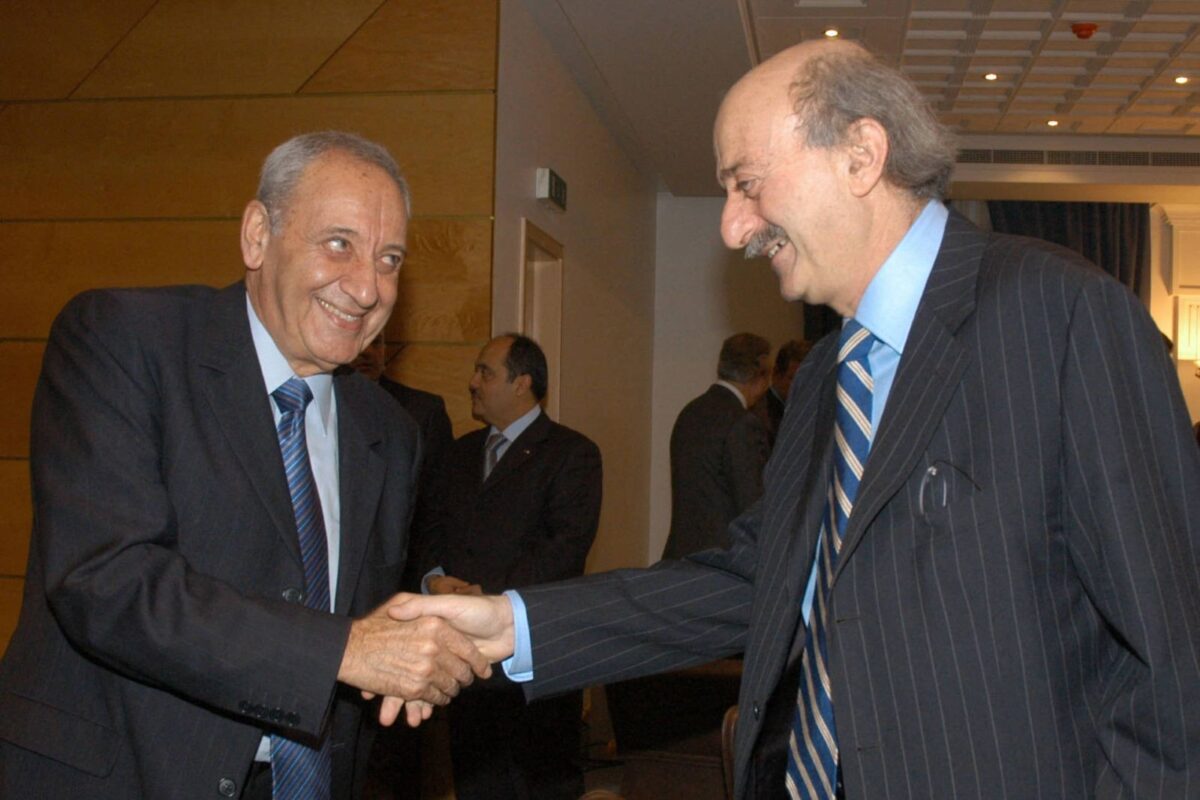
Lebanese parliament speaker Nabih Berry (L) shakes hands with Druze leader Walid Jumblatt at parliament in Beirut where national dialogue round table discussions resumed 03 April 2006 after a six-day break.
One of the more amusing spectacles in Lebanese politics is watching those who spent decades driving the country into a ditch suddenly lecture others on the proper technique of steering.
Ever since the framework arrangement between Lebanon and Israel was announced, the familiar chorus of the Lebanese political establishment has returned with remarkable confidence. The negotiating team, we are told, lacked experience. The state was naïve. The diplomats were amateurs. Had the matter been left to the seasoned veterans of Lebanese politics, the country would supposedly have secured a better outcome.
One is tempted to ask: better than what? Better than forty years of managed collapse?
If experience is indeed the criterion by which we judge political performance, then Lebanon has been governed by the most experienced class in the modern Middle East. Nabih Berri has occupied the pinnacle of political power for more than three decades. Walid Jumblatt has influenced virtually every major political settlement since the end of the civil war. Around them revolves an entire political class that prides itself on its pragmatism, its realism, and its unrivalled understanding of the Lebanese game.
The problem is that this game has only one consistent loser: Lebanon.
These are the same men who perfected the art of describing paralysis as consensus, extortion as compromise, and surrender as wisdom. They cultivated a political culture in which avoiding difficult decisions became a virtue, while postponing every national crisis was celebrated as statesmanship.
These are the same men who perfected the art of describing paralysis as consensus, extortion as compromise, and surrender as wisdom. They cultivated a political culture in which avoiding difficult decisions became a virtue, while postponing every national crisis was celebrated as statesmanship.
Their greatest achievement was convincing generations of Lebanese that the state could permanently coexist with an armed organization more powerful than itself.
This was presented as sophistication.
It was, in reality, abdication.
When Hezbollah gradually transformed itself from a militia into a parallel military, financial, and political authority, Lebanon’s so-called experienced leaders did not resist the process. They managed it. They rationalized it. They normalized it. Every concession was marketed as temporary. Every retreat was described as necessary. Every surrender was wrapped in the language of national unity.
Experience, apparently, meant knowing precisely how much sovereignty could be traded without admitting that sovereignty was being traded at all.
Experience, apparently, meant knowing precisely how much sovereignty could be traded without admitting that sovereignty was being traded at all.
The culmination of this remarkable expertise arrived in 2016.
The election of Michel Aoun was not an unfortunate accident forced upon reluctant politicians. It was a deliberate political settlement, embraced by many of those who today claim superior negotiating credentials. It institutionalized Hezbollah’s dominance over the Lebanese state, completed Iran’s political penetration of Beirut, and accelerated Lebanon’s estrangement from its natural Arab environment, particularly the Gulf states that had historically invested politically and economically in the country’s stability.
The consequences are no longer debated.
They are measured.
Measured in financial collapse.
Measured in diplomatic isolation.
Measured in sanctions.
Measured in emigration.
Measured in more than a million Lebanese displaced by wars they never chose.
Yet somehow, after producing this extraordinary record, the architects of Lebanon’s decline now insist that the country’s principal problem is that its current negotiators lack sufficient experience. Perhaps they are right.
Perhaps the negotiators lacked experience in mortgaging national institutions one ministry at a time.
Perhaps they lacked experience in transforming constitutional offices into instruments of sectarian bargaining.
Perhaps they lacked experience in allowing an armed party to dictate questions of war and peace while pretending that the state remained sovereign.
Perhaps they lacked experience in confusing personal survival with national interest.
If so, Lebanon should consider itself fortunate.
There are moments in history when inexperience becomes an advantage.
Diplomats who have not spent decades trapped inside Lebanon’s machinery of managed failure may actually recognize that negotiations exist to defend the interests of the state rather than the privileges of the political class. They may approach the table without the accumulated habits of concession, fear, and transactional politics that have defined the post-war republic.
Diplomats who have not spent decades trapped inside Lebanon’s machinery of managed failure may actually recognize that negotiations exist to defend the interests of the state rather than the privileges of the political class. They may approach the table without the accumulated habits of concession, fear, and transactional politics that have defined the post-war republic.
For years, Lebanon’s foreign policy was not designed in Beirut but constrained by the calculations of Tehran through Hezbollah’s veto. Successive governments accepted this arrangement while insisting that nothing fundamental had changed. The result was predictable: Lebanon drifted away from its Arab partners, alienated international supporters, and gradually surrendered its capacity to make sovereign decisions.
The framework arrangement did not create this reality. It attempts, however imperfectly, to begin reversing it.
No negotiation conducted by a weakened state emerging from decades of institutional capture will ever produce perfect terms. That is the price of arriving late to reality. But the relevant comparison is not between this agreement and some imaginary ideal negotiated by political geniuses who never existed. The relevant comparison is between a sovereign Lebanese state attempting to reclaim decision-making and the alternative offered by its critics: the endless continuation of a status quo that brought only war, bankruptcy, isolation, and dependency. The irony is difficult to miss.
Those who complain that Lebanon’s negotiators lacked experience are themselves living monuments to experience—experience in postponing reform, experience in accommodating armed domination, experience in sacrificing state institutions for political convenience, and experience in mistaking survival for leadership.
Lebanon does not suffer from a shortage of experienced politicians.
It suffers from an excess of politicians whose experience has been measured by the longevity of their careers rather than the success of their country.
Sometimes the most dangerous people at the negotiating table are not the novices.
They are the veterans who spent decades negotiating away the republic long before they ever sat across from Israel.