Photo by ANWAR AMRO / AFP
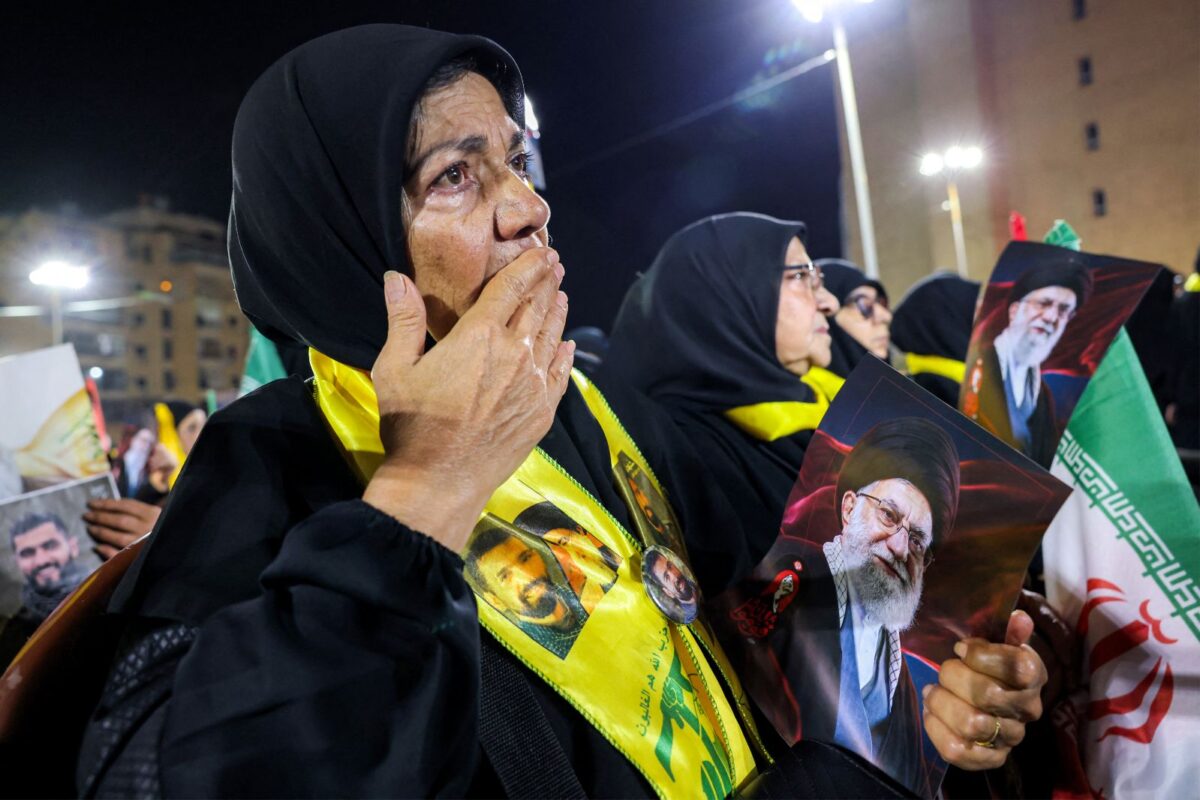
Supporters of Lebanese Shia movement Hezbollah attend a memorial ceremony mourning Iran's slain supreme leader Ali Khamenei in Beirut’s southern suburbs on July 8, 2026.
This is not an attempt to commemorate Lokman Slim. People who are murdered for saying what murderers cannot bear to hear do not return through sentimental tributes or commemorative essays alone.
At most, this piece borrows something from Lokman’s language: the sharp edge, the smile that never quite became laughter, the irony that always carried the weight of an indictment. Less a eulogy than a charge sheet. Lokman, who was assassinated in southern Lebanon, was murdered in a land where occupations now compete for ownership: an Iranian occupation in the name of “resistance,” an Israeli occupation in the name of “security,” and, trapped between them, a Lebanon forever carrying its own coffin, waiting to be buried.
Anyone seeking to understand what has become of Hezbollah—not merely its military decline, but the corrosion of its very soul—does not need battlefield maps, intelligence reports, or triumphant communiqués from operations rooms that seem to awaken only to explain another strategic setback. They need only look at those Lebanese who travelled to Tehran to stand before the grave of Ali Khamenei, beneath his portrait, or beside his coffin, mourning as though they were attending the funeral of what remained of their own political independence.
What unfolded there was not simply an Iranian funeral. It was, in many ways, a Lebanese burial as well: the burial of dignity, of political judgment, and of the old lie that weapons existed to protect the people. Instead, the people of southern Lebanon became human shields for an ideology, only to become reluctant witnesses to its collapse. Entire villages were sacrificed so that “resistance” could preserve its mythology, while dignity itself seemed to require an airline ticket to Tehran and a carefully choreographed place from which to weep before television cameras.
There is nothing shameful about tears. Grief is among the few human responses that require no justification. What deserves scrutiny is where those tears are shed.
There is nothing shameful about tears. Grief is among the few human responses that require no justification. What deserves scrutiny is where those tears are shed. It is difficult to ignore the contrast between eyes that overflow before Khamenei’s grave and remain dry before the ruins of Mays al-Jabal, Taybeh, or countless other devastated Lebanese villages. The sorrow becomes boundless when the deceased is Iran’s supreme leader, yet strangely restrained when the victims are Lebanese families who have lost everything.
Some wept publicly, and for that one might almost be grateful. At last, the so-called Axis of Resistance appeared to rediscover the function of the tear duct. Yet the obvious and almost indecently simple question remains: where were these tears when more than one and a half million Lebanese were displaced from their homes? Where was this public grief when families were reduced to carrying their lives in plastic bags, when villages became rubble, when southern Lebanon was transformed into a landscape of exclusion zones and military maps? Where were these mourners when Lebanese Shiites were once again treated not as citizens with homes, memories, orchards, and ordinary ambitions, but as expendable raw material in the manufacture of martyrdom?
Displacement is not merely a statistic. In Lebanon, statistics have become one of the more sophisticated forms of moral evasion. One and a half million displaced people does not simply mean one and a half million individuals. It means one and a half million house keys with no doors left to unlock. One and a half million memories deprived of place. One and a half million citizens who were repeatedly told they constituted the “environment of the resistance,” only to discover that, in Hezbollah’s political vocabulary, an environment is not a community of human beings but a landscape deemed suitable for military sacrifice.
The villages themselves, long deployed as moral scenery in speeches celebrating liberation, were ultimately abandoned to their fate. Stones do not vote. Walls do not issue objections. Olive groves do not hold press conferences. Villages can therefore be destroyed while others continue speaking in their name. Their inhabitants can be displaced while being thanked for their patience. Their ruins can become cinematic backdrops in propaganda videos while the homeless are expected to applaud because defeat has not yet been officially acknowledged.
In Tehran, grief was meticulously choreographed. And choreographed grief, in authoritarian systems, often resembles a military parade more than a funeral
In Tehran, grief was meticulously choreographed. And choreographed grief, in authoritarian systems, often resembles a military parade more than a funeral. Everything occupied its assigned place: the delegations, the banners, the slogans, the cameras, the carefully ordered proximity to the coffin. Even the tears appeared disciplined, synchronized to the rhythm of the axis.
Lebanon, by contrast, offered something far less orderly and infinitely more authentic. A mother searching for the remains of her son. A man struggling to identify where his home once stood. A child slowly learning that homeland is no longer a place but a breaking-news headline. Villages uncertain whether they will return to being Lebanese communities or become security annexes to yet another regional arrangement.
Perhaps one of the defining pathologies of our politics is that “loyalty to the blood of the martyrs” has become less a moral commitment than a profession. Loyalty to blood, as Lokman Slim might well have observed, becomes another form of extortion once blood itself is converted into political currency. Lebanese blood is invoked when useful, ignored when inconvenient, and traded across regional markets whenever the price of resistance rises. The Supreme Leader’s blood—or, more precisely, his image and his grave—belongs to an entirely different economy, one sustained by ceremonies, delegations, anthems, and tears seemingly manufactured for export.
Those who gathered at Khamenei’s grave were not merely consoling Iran. They were apologizing to it because Lebanon had not died completely. Through their presence, their expressions, and their tears, they conveyed a single message: that the destruction of southern Lebanon had altered nothing essential about their loyalties; that shattered homes remained secondary to the preservation of the Supreme Leader’s legacy; that displaced families could wait because the burial of the leader always took precedence over sheltering the people.
Those who gathered at Khamenei’s grave were not merely consoling Iran. They were apologizing to it because Lebanon had not died completely. Through their presence, their expressions, and their tears, they conveyed a single message: that the destruction of southern Lebanon had altered nothing essential about their loyalties; that shattered homes remained secondary to the preservation of the Supreme Leader’s legacy; that displaced families could wait because the burial of the leader always took precedence over sheltering the people.
The scene requires remarkably little interpretation. In Lebanese politics, a footprint reveals its owner, and tears reveal their true allegiance. Those who weep in Tehran but remain silent in Taybeh, who bow before Khamenei’s grave yet cannot bow before a Lebanese woman standing where her home once stood, who raise banners of “loyalty” above ruins they themselves do not inhabit, require no political opponents. Their own faces are indictment enough.
They travelled to mourn the Supreme Leader while leaving behind villages with no one to mourn them, people with no one to ask about them, and homes still waiting for a single tear that does not first pass through Tehran.
For not every tear cleanses the face. Some tears expose it.
This is not simply a story about mourning. It is a certificate of political death. When a Lebanese citizen sheds more tears at the grave of Ali Khamenei than over the ruins of his own village, he is not merely bidding farewell to a foreign leader. He is burying his own moral judgment alongside him.
Borrowing, with apologies, from my wicked friend:
history has a cruel sense of irony. Or perhaps merely an excellent memory. There is something profoundly fitting that the burial of Ali Khamenei should become, for some Lebanese, yet another rehearsal for burying Lebanon itself.
history has a cruel sense of irony. Or perhaps merely an excellent memory. There is something profoundly fitting that the burial of Ali Khamenei should become, for some Lebanese, yet another rehearsal for burying Lebanon itself.
This article originally appeared in Elaph.
Makram Rabah is a lecturer at the American University of Beirut, Department of History. His forthcoming book Conflict on Mount Lebanon: The Druze, the Maronites and Collective Memory (Edinburgh University Press) covers collective identities and the Lebanese Civil War.