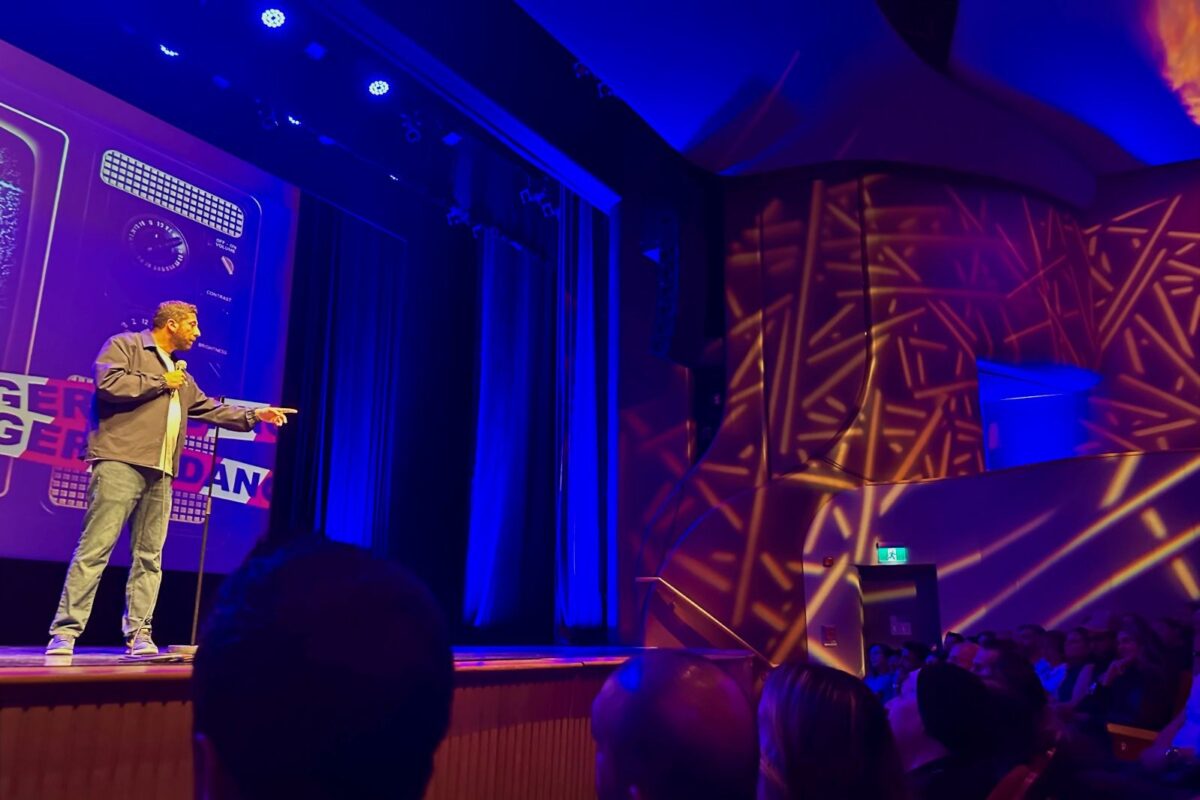
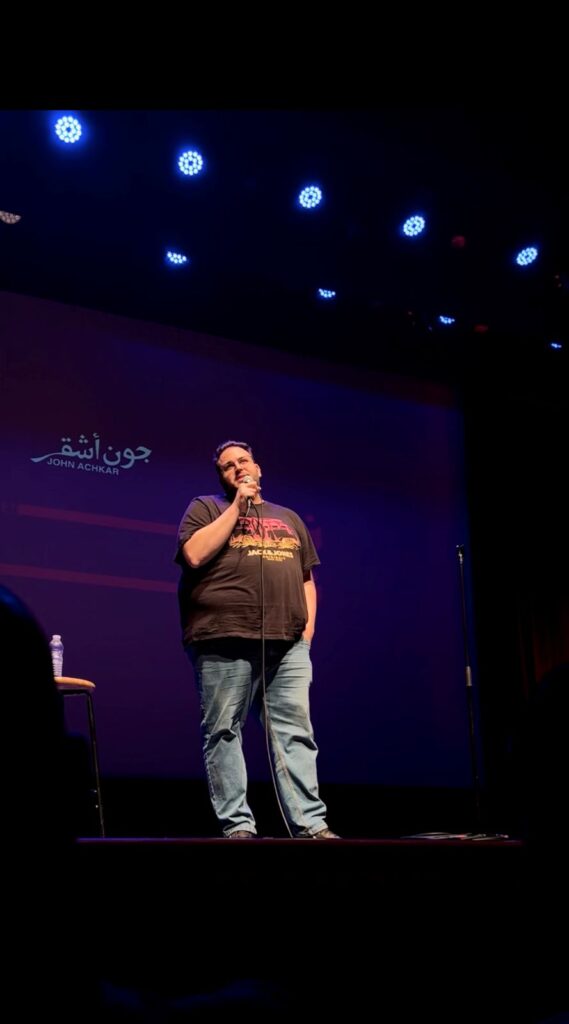
John Achkar jokes with familiar faces as he recognizes them during his “Feena Nehke?” – “Can We Talk?”- Ottawa show.Achkar is known for his Arabic-language comedy, and this is his fifth stand-up special. [Photo © Celine Mousleh]
A voice announcing in Arabic the entrance of Lebanese stand-up comedian John Achkar echoes through the theatre at the Canadian Museum of History on Jun. 2.
“Please welcome Jooohn Achkaaar!”
Upbeat electronic music layered with the sound of a darbuka, a Middle Eastern goblet drum,fades in. Blue, purple, and white lights flicker to life, adding an ambience of excitement in the room. Clapping, cheering, and whistles break out as people wait in anticipation for Achkar’s appearance.
He bursts onto the stage with arms open wide, lifting the crowd’s energy and filling the room with one feeling: joyfulness. Holding on to the microphone stand, he dramatically shakes his right hip to the drumming of the darbuka, laughs and welcomes people: “Ottawaaa… keef l 7ames lal lailiii?” – “Ottawa… how are we feeling tonight?”
Asking about the nationalities present among the audience, he greets each group differently.
“Tunisia… as usual, there’s going to be a lot of jokes you won’t understand because of the context… no problem, please write them down on a piece of paper and we’ll pay you back for what you didn’t get… Ahla w sahla”
He looks to his left and sees familiar faces. He jokes with them as he recognizes their regular attendance at his shows and open-mic night in Ottawa.
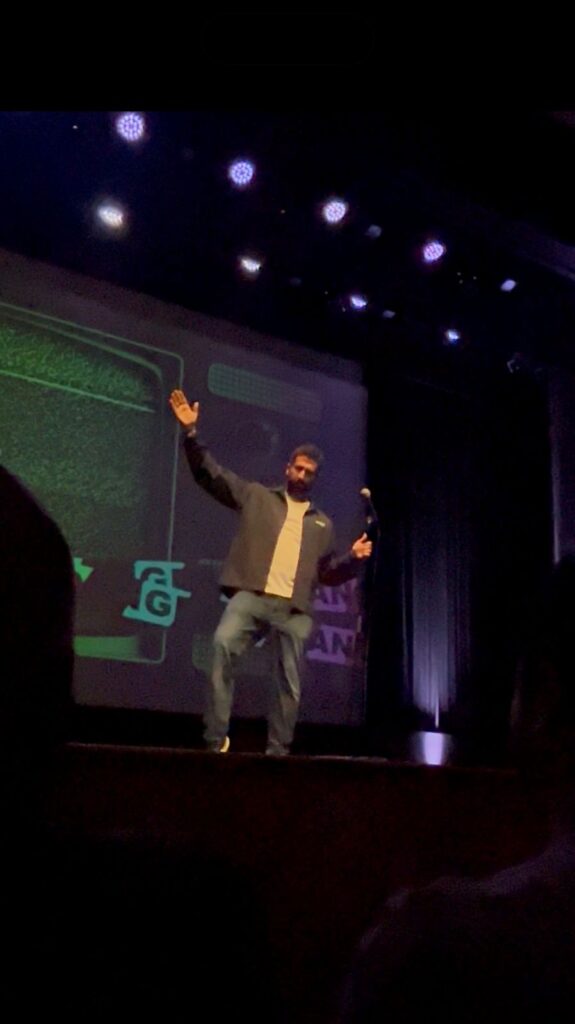
Achkar hypes up the crowd with his entrance. [Photo © Celine Mousleh]
“Madam?! What are you doing here? You’re literally going to hear the same jokes!”
For an hour, Achkar allowed his audience to peek inside different chapters of his life. Through the story he performed, he took them from his hometown,Arayah, to Beirut, Tyre, Nahr Al Bared refugee camp, and even France.
Surprisingly, these chapters are not uniquely his own, but he shares them with his audience as they mirror the realities of Lebanese people: leaving home in search of a future, moving between cities only to discover how little they know about people who share the same country, coping with political and economic hardship, and navigating family relationships across changing stages of life.
“The people are in the stories that I perform on stage, but they don’t know – it takes them time to understand,” said Achkar as his eyes wandered. “I sometimes receive messages two weeks after the show telling me, “John, we just got this.””
“It feels like you’ve stepped into a movie from the moment he begins. And by the time it’s over,it feels like you’ve just walked out of a film instead of a stand-up,” said Mario Yazbeck, an aspiring Lebanese Canadian comedian based in Montreal.
Despite the chaotic history of Lebanon – a history that the Lebanese deserved but never got because of political disagreements – and the uncertain present that Lebanese people are living today, Achkar said he wants to push through and build hope for Lebanon.
“It’s impossible for someone to convince me that our fate is to suffer and die our whole lives,” he said.
To symbolize his hope, he returned to Beirut after the de-escalation of the war, and within ten days, on Jun. 16, launched his comedy club: Hidden Cellar.
Not only will Achkar be performing there, but he will be hosting comedians in Lebanon and from the diaspora, such as Yazbeck. The shows vary between stand-up specials, workshops, and open mic nights.
“The comedy scene should grow, not the names. We’re all the same, and we should all be rotating,” he said, recalling ‘past mistakes’ within Lebanese stand-up.
He added that he aims to offer new talents a space to get comfortable on stage and build a place that connects people.
When the war broke out in Lebanon early March, Achkar had already arrived in Montreal. Unable to go back home and move forward with his plans, he found himself experiencing the conflict from abroad, like thousands of Lebanese in the diaspora.
However, instead of stepping away from the stage and people, Achkar leaned closer to them.
“It’s very absurd what we’re going through in Lebanon – people think there’s no way out,” he said. “I’m trying to talk to people and tell them that there is a way out and it’s not true that we’re in a paralyzed situation.”
Achkar continued performing at open mic shows, discussed the war with his audience without boundaries, kicked off from Toronto his fifth Arabic-language stand-up special “Feena Nehke?” – meaning “Can We Talk?” – and carried on preparing for his first English-language show at Edinburgh Festival Fringe in August.
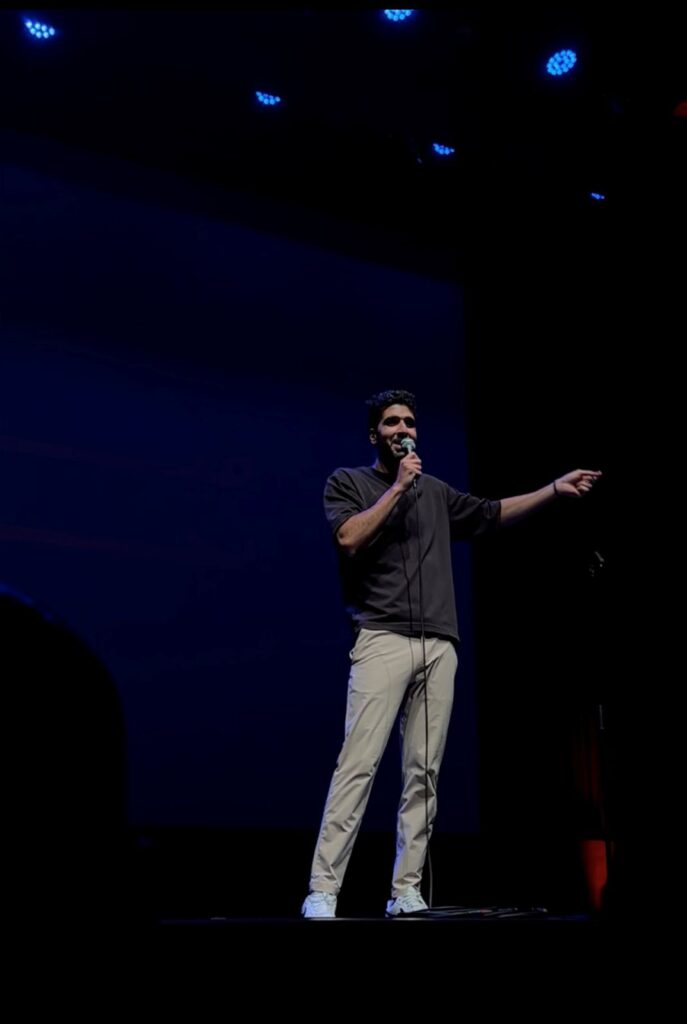
Comedian Mario Yazbeck opening Achkar’s show along with Fouad Abdelnour [Photo © Celine Mousleh]
“When John came to Montreal, he gave us a big push,” Yazbeck said. “We first used to have one open mic show every two weeks; with John, we started doing two shows every week!”
He explained that he is part of Mood De7ek, an Arabic-language stand-up comedy organization in Montreal founded and managed by the Syrian Canadian comedian Fouad Abdelnour. He said that this platform is for comedians who are just starting to test their jokes.
“In three months, we all improved more than we would in a year because of the John effect in Montreal,” he continued.
Achkar invited Yazbeck and Abdelnour to be the opening acts for his shows in Ottawa and Montreal.
He said that the show’s title is inspired by the communication dynamics of the Lebanese people and the subjects they avoid voicing bluntly.
He further explained that these difficult circumstances in particular are what made him more determined to visit the diaspora everywhere and pursue shows.
“We all talk about our truth and reality over WhatsApp groups but not on stage, but maybe it’s about time that we start opening up.”
Achkar added that he believes many conflicts could be resolved by simply talking about them and being open to hearing someone else’s opinion that differs from their own.
Despite the criticism he faces online for stating his political views openly, audience members of opposing opinions continue to attend and engage with him.
“I find him very funny and realistic,” said Joanna Chlenk, an audience member, with a smile as she finished her line. “He talks about everything happening in reality, even if sometimes I don’t approve of his jokes.”
“He’s an artist!” said Désiré Estephan-Saliba, another attendee, in French. She added that she accepts all Achkar’s jokes because he has his own way of approaching people and could feel a trust between them.
Achkar emphasized that comedians should not create tension with the audience. He said that comedy is not just ‘harj w marj’, or mindless entertainment, but a deeper form of art with a greater purpose. The real work in the comedy industry is how comedians can build a good relationship with people on the principles of trust and community building.
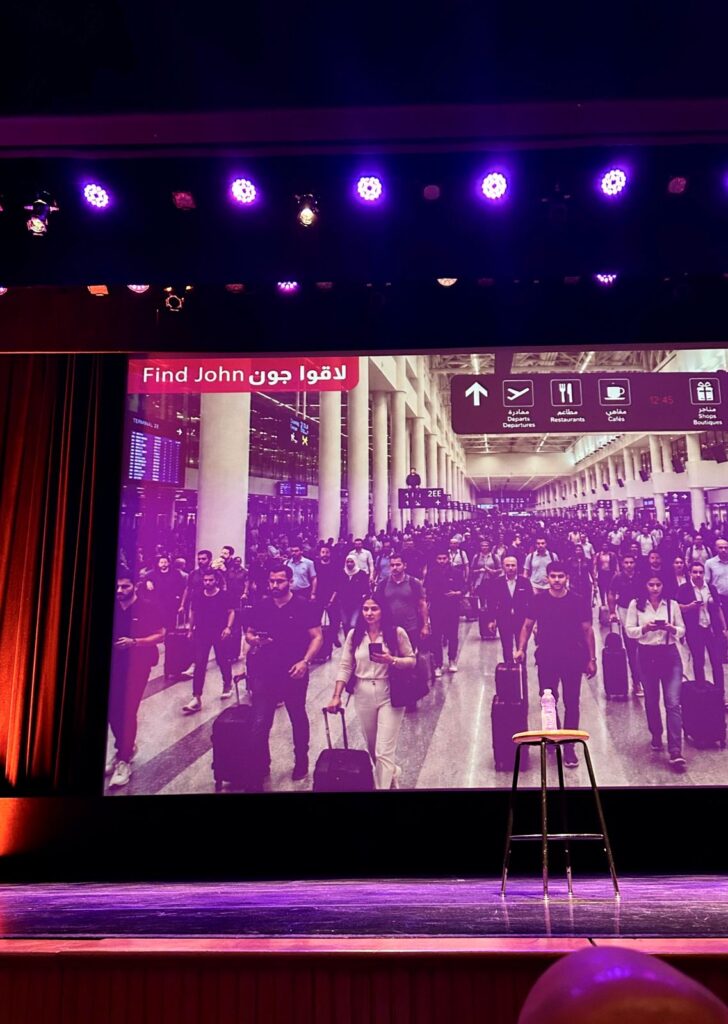
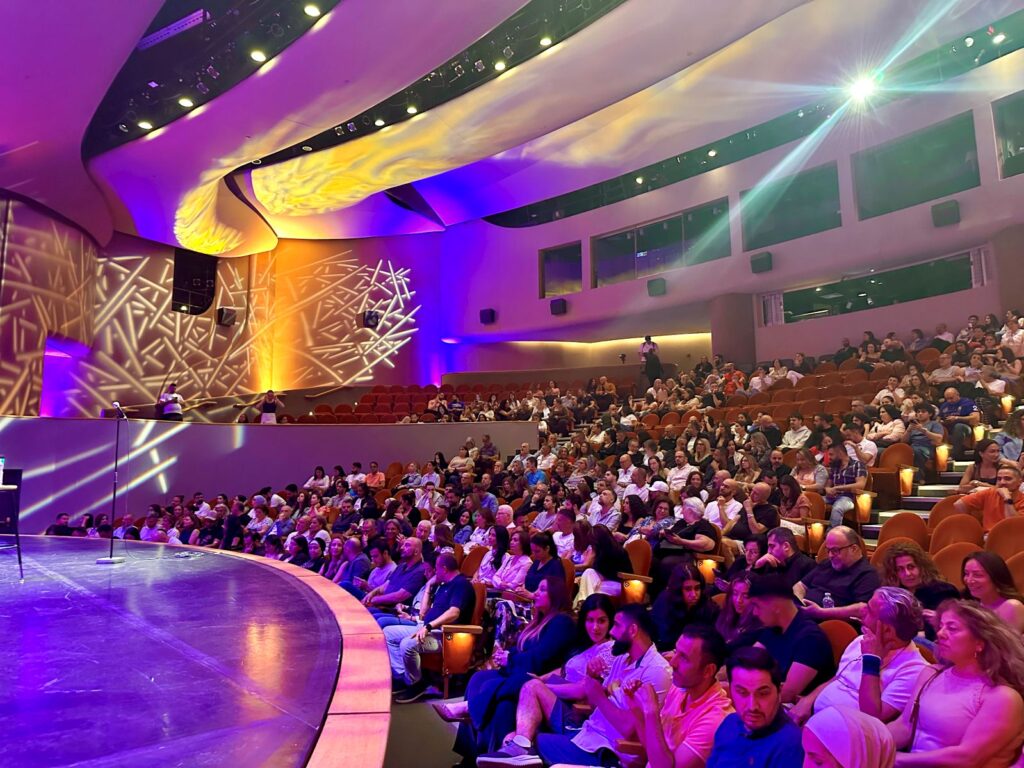
Audience members fill the theatre while a ‘Find John’ game is projected on the screen, inviting them to count how many faces of the comedian they can spot. [Photo © Celine Mousleh]
He suggested that his relationship with his audience could protect him from harsh reactions – referring to other comedians who got cancelled – because people recognize that his comedy does not come from a place of ill intent.
“People who know me trust my intentions are genuine.” Achkar continued, “They understand why I do what I do, and they know that John would never hurt them, which makes me really emotional.”
He added: “I am extremely biased to this idea of building trust and connection because there is no other way to send the proper message of our work.”
He said that negative feedback usually comes from new followers or people who haven’t been to his shows before.
“There’s no way you can imagine the scene without a community,” Achkar said. “When we say community building, we underestimate how much it can lead to beautiful places in the future.”
Looking back on his journey and beginnings, Achkar shared how he came to understand what the purpose of comedy is.
He said that he had to do a lot of self-reflection and ask himself the big questions, which led him to the answers.
“It turned out that the messages I receive from people after they leave the room, telling me ‘We’re still reflecting on what you said two weeks ago – or we were at work discussing your show,’ are what give me validation and move me.”
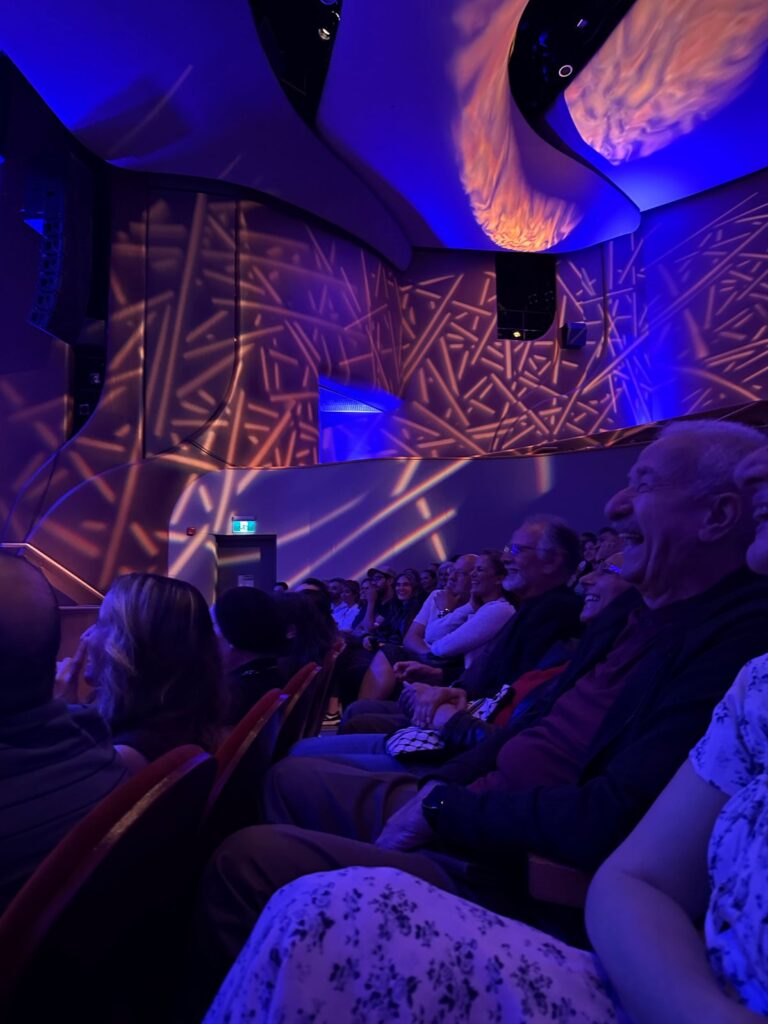
Audience engages with John Achkar in Ottawa on June 2. [Photo © Celine Mousleh]
Achkar explained that this is how he became aware that people don’t attend his shows just to laugh, and from here he wanted to deepen the impact of his art and carry the message further.
“It’s not about meaningless jokes anymore, but about storytelling in which people can see themselves in it,” he added.
Daad Estephan, who attended the show with her daughter, Désiré Estephan-Saliba, described Achkar as genuine and close to the heart. She explained that these kinds of shows help teach her children to preserve Lebanon’s heritage.
Estephan-Saliba continued to explain why coming to the show matters to her and to the generation that was born and raised outside Lebanon.
She said, “I visit Lebanon, but it’s not the same as being raised there. So, my only connection to Lebanon is the Lebanese (artists) that come here, and one of them is John.”
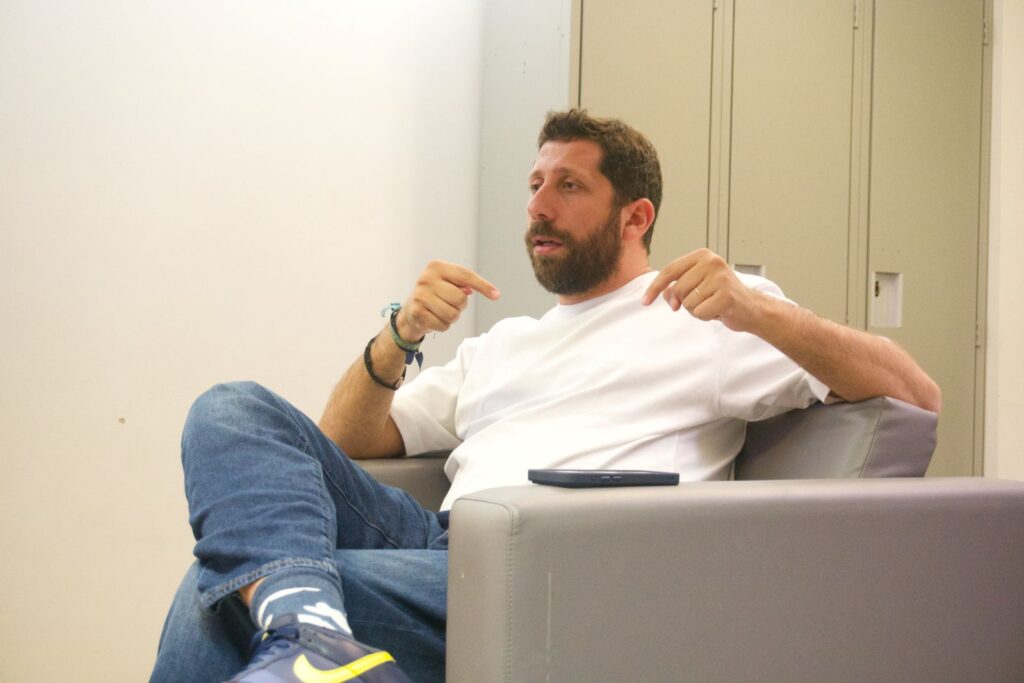
John sits down for an interview, an hour before his show in Ottawa, while keeping an eye on a screen in front of him, monitoring the preparations and making quick calls for last-minute adjustments. “There’s no talent that could succeed without good entrepreneurship,” he said. [Photo courtesy Celine Mousleh]
“John has his own school. He has been teaching us that the comedy we offer people should be a story and not only a bunch of jokes,” said Yazbeck. “This way, we shift our thinking from stressing over when people will start laughing to focusing on bringing people inside our personal life.”
Since his life feels aligned, Achkar said he wants to focus on his long-term goal: social and political change through comedy.
“Through comedy, I could change the world,” he said.
“It will be a long process – I see it as a relay race; figures such as Samir Kassir, Gebran Tueni, Bassel Fleihan and many others who devoted their lives for Lebanon, passed down the baton to me,” he continued. “Writing was what they used; I use comedy and will be passing on the same
baton to future generations.”
Celine Zaher Mousleh is a Lebanese Canadian journalist completing her Master’s of Journalism at Carleton University in Ottawa. Her work explores stories on the Lebanese diaspora, politics, culture and identity.
The views in this story reflect those of the author alone and do not necessarily reflect the beliefs of NOW.