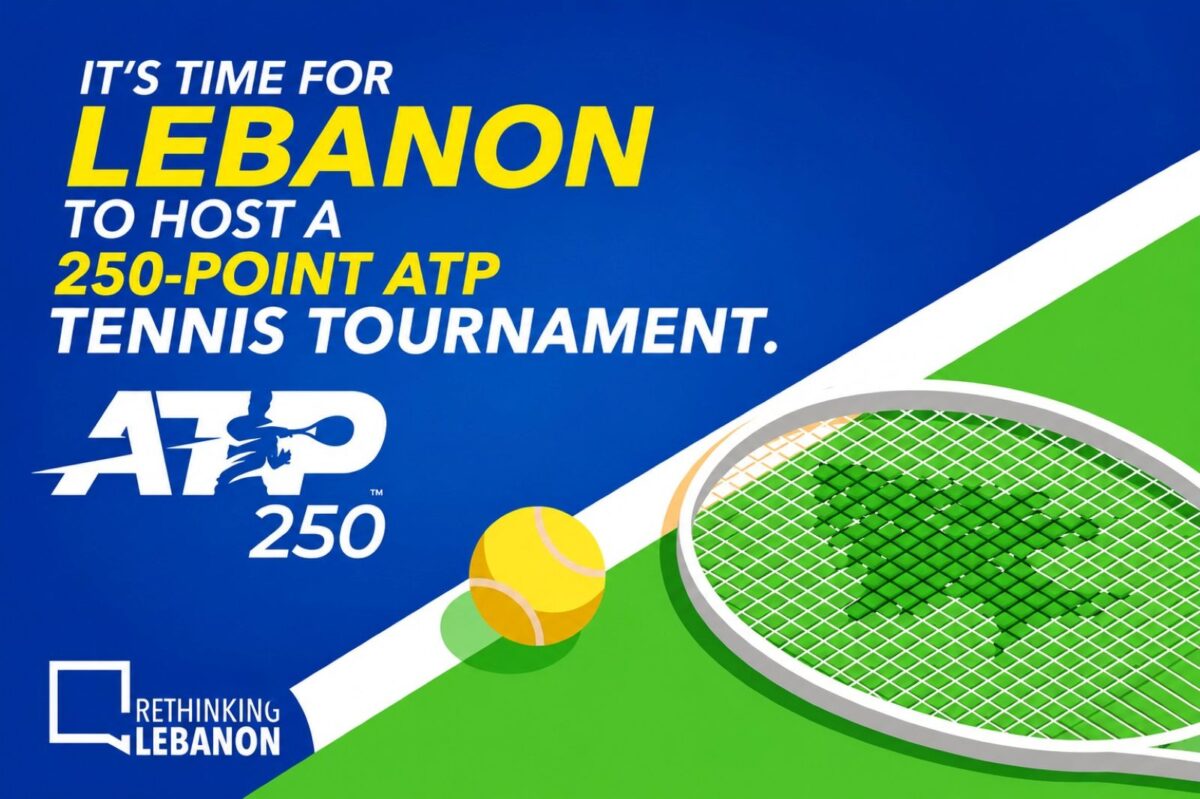
More than a year and a half has passed since Rethinking Lebanon called for Lebanon to host a 250-level professional tennis tournament, on the men’s ATP Tour and, equally, on the women’s WTA Tour. The idea has not yet had the echo it deserves. It is worth asking why, and what it would honestly take to make it real.
The most sobering answer comes from the sport itself. According to the president of the Lebanese Tennis Federation, the main conditions are clear and, for now, largely unmet. The war has to stop. Lebanon should begin lower down, at Challenger level, before aiming at the main tour. And there has to be real money behind it: sponsors and enough funding to meet the sport’s requirements. These are not obstacles anyone invented to discourage the country. They are the ordinary price of entry.
What hosting a 250-level tournament requires
A 250 is the entry level of the professional tour, but “entry level” is relative. There are only about thirty ATP 250 events in the world in a season, and the women’s WTA 250 category, created in 2021 to mirror the men’s, is a similar size. A place on either calendar is scarce and valuable. Winning one rests on a few concrete conditions, and they are broadly the same for both tours.
First, a licence. A place on the ATP or WTA calendar is a sanctioned membership. A new host has to acquire or be granted one and then satisfy the governing body that it can meet the tour’s standards. These places rarely sit empty; usually an existing licence changes hands. A country wanting both a men’s and a women’s event would pursue two licences, though they can share one venue and much of the same organisation.
Second, money, in several forms: prize money set by the tour, fees payable to the ATP or WTA, and the cost of staging the event. Because top players choose where to play, promoters of 250 events may also pay appearance fees to attract a star name. All of it must be in hard currency.
Third, a venue that meets the tour’s specifications: a centre court with proper seating, extra match and practice courts, and the infrastructure around them. Fourth, insurance at the levels the tour sets. Fifth, the operational backbone the television audience never sees, from security to accommodation, transport and hospitality.
Underneath all of these sits the condition the federation named first: stability. A professional tour will not send its players into a country at war. Safety is the ground the others stand on.
Prepare now, so it can begin the moment peace allows
Here is the key point, and it is where the argument turns from complaint to plan. None of this has to wait for the war to end. The preparation can start now.
Lebanon can begin building towards Challenger events, court by court. It can seek sponsors and assemble the funding today. It can study the licensing route, identify a venue, and line up the operations in advance. If the groundwork is laid while we wait, then the day the situation stabilises, things can move quickly rather than starting from zero. Waiting until peace arrives to begin thinking is how opportunities are missed. Preparing during the hard years is how a country is ready when the good ones come.
There is reason to believe the appetite and the capacity exist. Lebanon has a strong sporting tradition, basketball chief among it, and in stable periods it has hosted international competition and drawn crowds that few countries its size can match. War has repeatedly interrupted that life, pausing leagues and forcing national teams to play abroad. But the interruption is the point: the demand does not disappear, it waits. Tennis can be readied to take its place in that same tradition.
Why a youth movement keeps making a big ask
Rethinking Lebanon is a youth movement and non-profit founded in 2016, working to empower young people and reposition the country internationally. The tennis call follows its usual logic: name an ambition the state is not pursuing, so that others with the means can take it up.
That logic is economic, not only sporting. Sport creates jobs, draws visitors, fills hotels and restaurants, and puts a country’s name on screens around the world. For the individual, taking part in sport is linked over time to better health, employment and earnings. Hosting the women’s game alongside the men’s adds something more: visible professional women athletes are among the strongest encouragements for girls to take up sport and stay in it. A country that treats sport as a sector, not a pastime, is investing in its economy and its young people at once.
Sport in the digital age: the next step
Rethinking Lebanon will carry this argument forward where it can act directly. At the fourth edition of its Digital Youth Leaders (DYL) International Forum, it will host a workshop on sport in the digital age, looking at how technology and data are reshaping sport, and how sport can drive economic activity and growth.
Launched in 2023, in the wake of the global AI revolution driven by the rapid rise of generative AI and following Lebanon’s 2019 economic crisis, Digital Youth Leaders (DYL) was the first AI and digital innovation conference of its scale to be held in the country. Since then, it has emerged as one of Lebanon’s leading forums, bringing together international experts, industry leaders, academics, policymakers, and youth from around the world to advance dialogue, foster collaboration, showcase innovation, and help restore Lebanon’s place on the global digital map.
A 250-level tournament, for men or for women, will not arrive because Rethinking Lebanon asked for it. It will arrive, if it does, because the war ends, the money is found, the courts are built, and the work was done in advance. Lebanon has surprised the world before. With peace, patience and a plan started today, the racket on the poster may yet meet a real ball.
Jihad El Hokayem is an Economist and Leading Financial Market Strategist.
The views in this story reflect those of the author alone and do not necessarily reflect the beliefs of NOW.