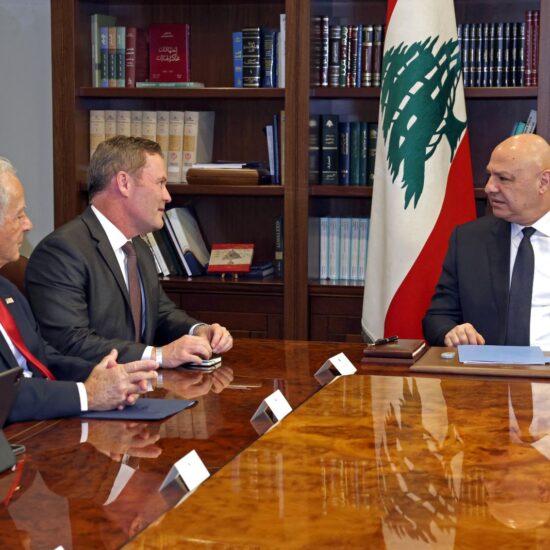
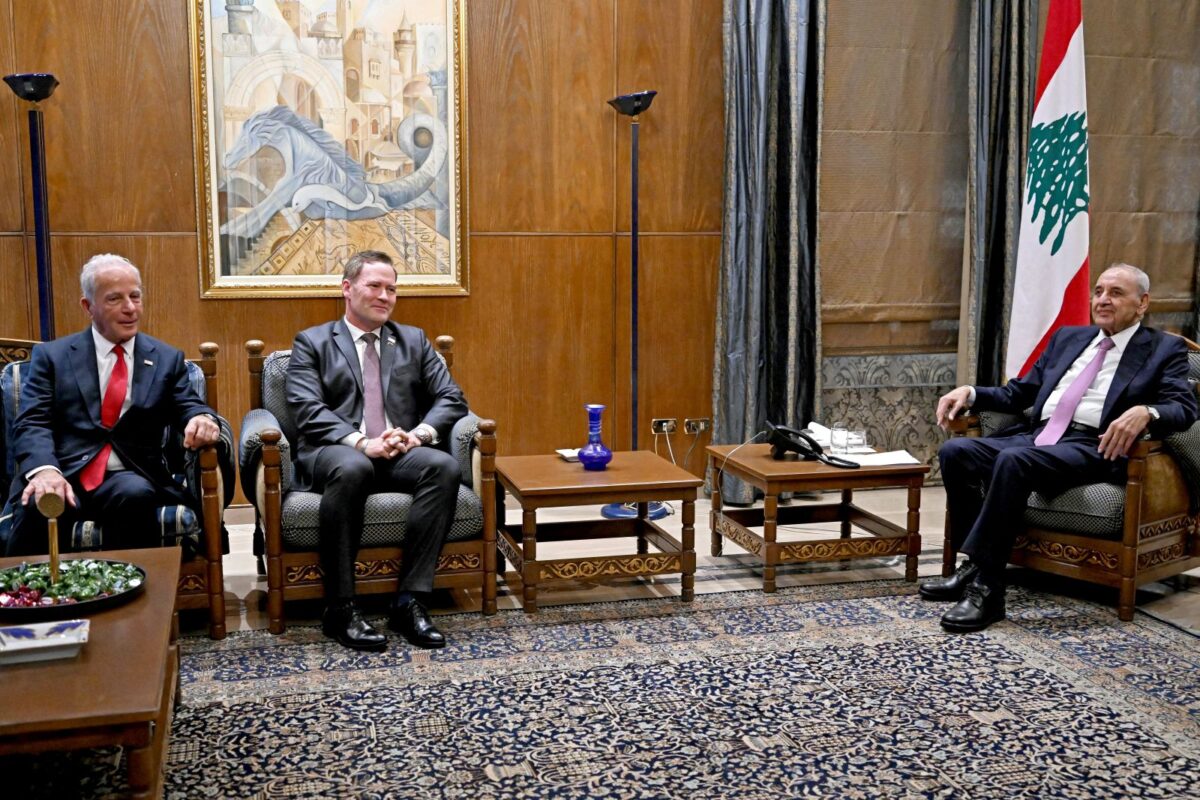
Beirut, Lebanon. Photo by- / LEBANESE PARLIAMENT PRESS OFFICE / AFP. This handout photograph released by the Lebanese Parliament Press Office on November 16, 2026 shows Lebanese parliament speaker Nabih Berri (R) attending a meeting with US envoy Mike Waltz (2L) and US Ambassador to Lebanon Michel Issa, in Beirut.
Mike Waltz’s demand for one army in Lebanon creates an obligation for everyone who supports it: explain how that army will protect the country, and how the country will hold it accountable. Speaking in Beirut on November 16, the US ambassador to the United Nations said he hoped Hezbollah would surrender its weapons voluntarily, insisting that “no country can have two armies.” He also criticized UNIFIL’s cost over the past twenty years and called for changes to the international arrangements. His visit put the transition to Lebanese responsibility firmly on the agenda.
Under the current Security Council resolution, UNIFIL’s mandate ends on December 31, with withdrawal to follow during 2027. That gives Lebanon a timetable for losing an existing international presence. It does not, by itself, provide the soldiers, equipment, political decisions or diplomatic guarantees needed to assume its responsibilities.
Prime Minister Nawaf Salam’s response addressed that problem. He called for a continued international presence authorized by the Security Council, supporting the army through monitoring, reporting and liaison. He also sought a clear timetable for parallel progress on Israeli withdrawal and the extension of Lebanese state authority, with verification of both sides’ commitments.
For a family deciding whether to return to a border village, the value of these arrangements depends on what they change on the ground. A monitoring mission must have access to the places it monitors. An agreement must specify what happens when either side obstructs implementation. Support for the army must arrive as usable equipment, training and reliable funding. Washington should explain what it will help provide and how it will use its influence to secure Israeli compliance.
Lebanon’s authorities have obligations of their own. They should identify what the army can accomplish with its existing powers and resources, what requires additional support, and what remains blocked by political decisions. A serious plan must make those distinctions visible. Otherwise, every delay can disappear into the same explanation: the circumstances are difficult. That is where the visit meets the domestic argument over trust in the army.
On November 7, army commander Rodolphe Haykal said that people speaking ill of their country’s army had no right to be in Lebanon. On November 11, President Joseph Aoun said people could not claim to support sovereignty and love their country while criticizing its army and security forces.
The institution receives applause while the original question remains unanswered.
This language makes the citizen’s loyalty the subject of examination. Someone asks whether a decision was justified; the response asks whether that person belongs. Once the discussion moves there, evidence about performance becomes secondary to declarations of affection. The institution receives applause while the original question remains unanswered.
That is a poor foundation for the authority Waltz wants the state to exercise. Asking people to accept one military authority means asking them to entrust that institution with their safety, including when they oppose its leaders. They need confidence that protection will survive disagreement and that a complaint will receive a hearing without becoming evidence against the complainant.
The army faces real constraints. Disarming an entrenched armed organization involves risks that a television demand for immediate action cannot resolve. Commanders must assess those risks and advise the government. But professional caution needs an explanation, a proposed course of action and a point of review. Without them, caution can become an indefinite power to postpone.
The government should set objectives, provide resources and take responsibility for the political choices involved. The command should explain its progress and the obstacles it encounters. Parliament should scrutinize both. Operational secrecy can protect particular deployments and intelligence; it cannot reasonably cover every question about budgets, preparedness or the implementation of government decisions.
Such scrutiny also protects soldiers. Inadequate equipment, an unclear mission and a poor command decision require different remedies. If every failure is absorbed into a tribute to the army’s sacrifices, those distinctions disappear. The soldier bears the consequences while the people responsible for funding, orders and judgement remain difficult to identify.
The public also deserves to know what follows when a commitment is broken. Which authority investigates? Who must correct the failure? When should a commander or minister be replaced? Trust becomes more credible when citizens can see that responsibility has consequences, including for people they otherwise respect.
Waltz’s visit should therefore produce obligations that can be checked: international support with delivery dates, security commitments with verification, and Lebanese decisions with named responsibilities. Extending state authority requires the government and army to demonstrate that they can exercise it fairly and effectively. Demanding confidence before answering those questions reverses the relationship between a public institution and its citizens.
Respect for his sacrifice begins with the decisions made while he is still alive.
Before another soldier is asked to assume greater risks, his family should be able to trust that someone has examined the mission, the equipment and the alternatives. Respect for his sacrifice begins with the decisions made while he is still alive.
Ramzi Abou Ismail is a Political Psychologist, Researcher and Analyst.
The views in this story reflect those of the author alone and do not necessarily reflect the beliefs of NOW.