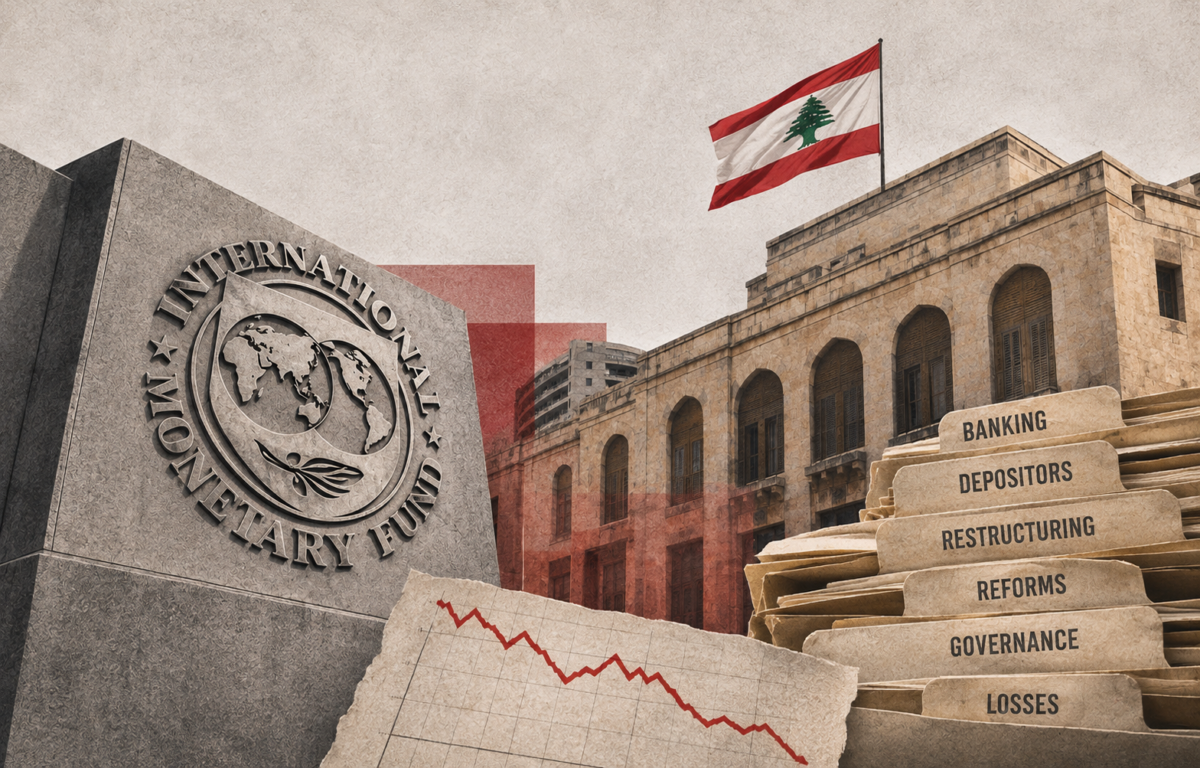
On November 13, an IMF mission concluded four days of talks in Beirut. The statement was brief. Progress was made, but further work is needed to agree on a strategy to restructure the banks, and engagement will continue in the coming weeks. Anyone who has followed Lebanon and the IMF since 2019 has read this statement before. So I went back and reviewed all statements, counting how often what has been repeated since 2019.
Thirteen missions, one agreement
Since the crisis began in October 2019, the IMF has issued 18 statements on Lebanon. Thirteen were issued after missions. The first came after a technical visit in February 2020, when Lebanon was still seeking advice, not money. The government formally requested a program on May 1, 2020. Sixteen video sessions followed, and the talks stalled in July over the size of the losses. In 2021, there was no mission.
Five months later, the IMF described progress as “very slow.” A year later, it wrote that Lebanon “has not undertaken the urgently needed reforms.”
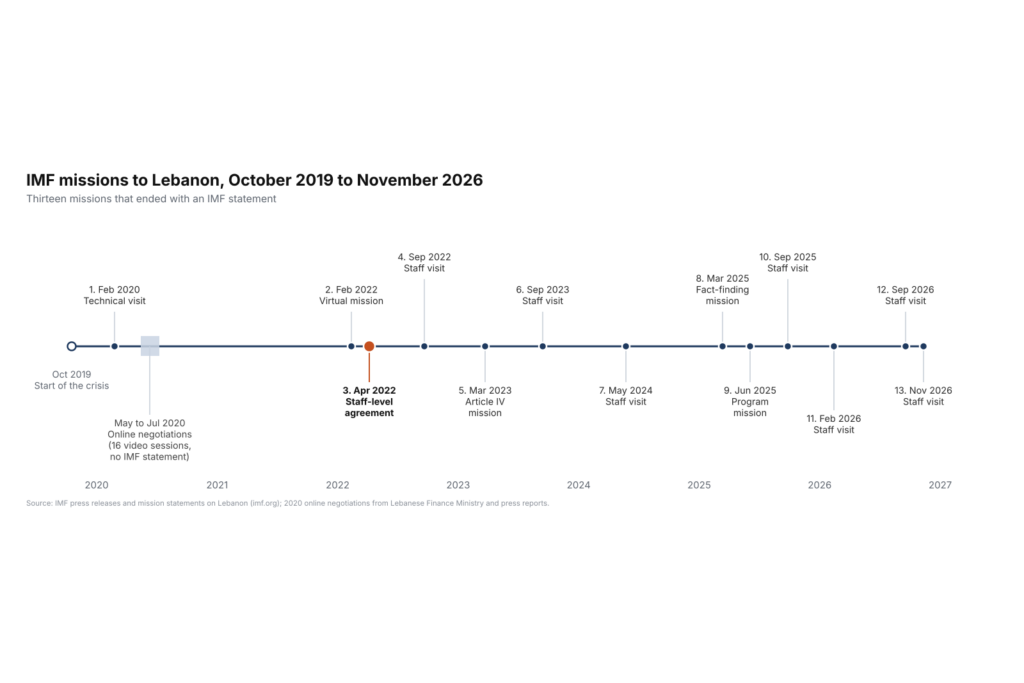
Lebanon and the IMF reached a staff-level agreement on April 7, 2022, one month before the 2022 parliamentary elections. The agreement was a 46-month program worth about $3 billion, conditional on eight prior actions before the IMF Board would consider it. The Board never did. Five months later, the IMF described progress as “very slow.” A year later, it wrote that Lebanon “has not undertaken the urgently needed reforms.” Ten missions have since the agreement. Had the program started that year, it would have run its full course by now.
In April 2026, the Board was briefed on Lebanon, along with other members whose reviews are more than 18 months overdue: Afghanistan, Iran, Sudan, Syria, and Tunisia. You can learn a lot about Lebanon from the company it keeps.
Meanwhile, Lebanon fell off the IMF’s regular calendar. The Board’s last Article IV review was in June 2023. In April 2026, the Board was briefed on Lebanon, along with other members whose reviews are more than 18 months overdue: Afghanistan, Iran, Sudan, Syria, and Tunisia. You can learn a lot about Lebanon from the company it keeps.
What the IMF keeps asking for
I read the 15 statements that set out policy demands, setting aside three procedural ones, and recorded the items each one raises.
Two items appear in all fifteen. The first is restructuring the banks and allocating the losses, while the second is protecting depositors. Only the vocabulary changed. In August 2020, Kristalina Georgieva, the IMF’s managing director, said those who benefited from past excessive returns should share the cost of recapitalizing the banks. In April 2022, the IMF mission chief, Ernesto Ramirez Rigo, said the losses had to be recognized upfront. In 2026, he said the draft deposit recovery law must respect the hierarchy of claims, meaning shareholders lose before depositors. Three phrasings of the same two demands over six years.
Restructuring the Eurobonds appears in 12 statements. A medium-term fiscal framework, exchange-rate unification, tax reform, state-owned enterprises and electricity, and credible budgets each appear in 10. Governance and anti-money laundering appear in 9; the bank resolution law and central bank reform in 7; bank secrecy in 6; and capital controls in 5.
The capital controls law was never passed. It simply faded from the statements, like a guest who stops receiving invitations because he never showed up.
The bank resolution law tells the story best. In April 2022, the IMF made it a prior action, meaning a condition to be met before its Board would consider the program, and called it emergency legislation. Parliament passed it in July 2025. The IMF asked for amendments, and Parliament passed them in August 2026. In October, the Constitutional Council, acting on an appeal by the president, annulled Article 3 of the amended law. This week, the IMF responded to the ruling without naming the Council: the law, it said, should be applied in all cases.Four years to pass an emergency law, and we are still debating whether it applies.
What disappeared
Some items stopped appearing altogether. The evaluation of the 14 largest banks, a prior action in 2022, was never mentioned again. The demand to audit the central bank and publish the results was last raised in March 2023. Capital controls and bank secrecy were last raised in September 2023. Central bank reform went quiet after May 2024. Exchange rate unification, state-owned enterprises, and governance last appeared in June 2025.
The capital controls law was never passed. It simply faded from the statements, like a guest who stops receiving invitations because he never showed up.
An item can leave the statements for two reasons. Either it was implemented, or the IMF stopped asking. The exchange rate was unified, and Parliament amended the bank secrecy law in April 2025. The capital controls law was never passed. It simply faded from the statements, like a guest who stops receiving invitations because he never showed up. As for governance, its absence since June 2025 should not be taken as good news. Lebanon has been on the FATF gray list since October 2024, as I wrote earlier this month, with ten items still open.
The question nobody answers
Every law passed so far, from bank secrecy to bank resolution, has been a way of preparing the answer without giving it. The answer to that question reflects a view of how the country has been run for the past decades.
The benefit of a deal with the IMF for Lebanon was never only the credit support it can bring (about $3 billion) or the IMF’s successful track record in other countries. The IMF’s importancefor Lebanon has to do with fiscal, monetary, and financial discipline. Discipline starts with one question. Read in sequence, the fifteen statements are less a record of negotiations than a record of that question asked again and again: who pays for the losses? Every law passed so far, from bank secrecy to bank resolution, has been a way of preparing the answer without giving it. The answer to that question reflects a view of how the country has been run for the past decades.
The IMF says engagement will continue in the coming weeks. There will be a fourteenth mission and a sixteenth statement. It will be easy to predict what it will say.
Khalil Gebara is an academic and researcher.
The views in this story reflect those of the author alone and do not necessarily reflect the beliefs of NOW.