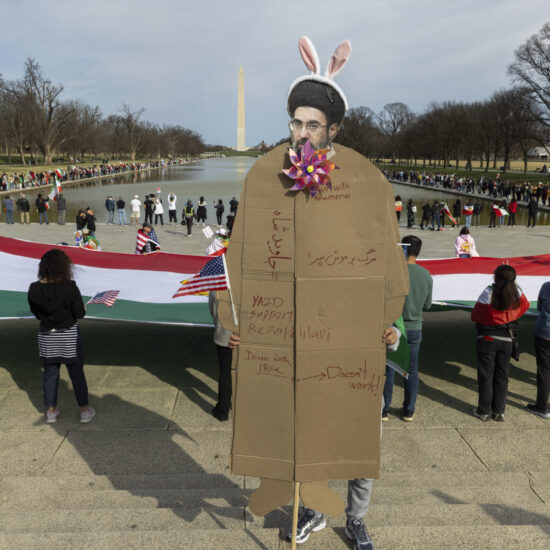
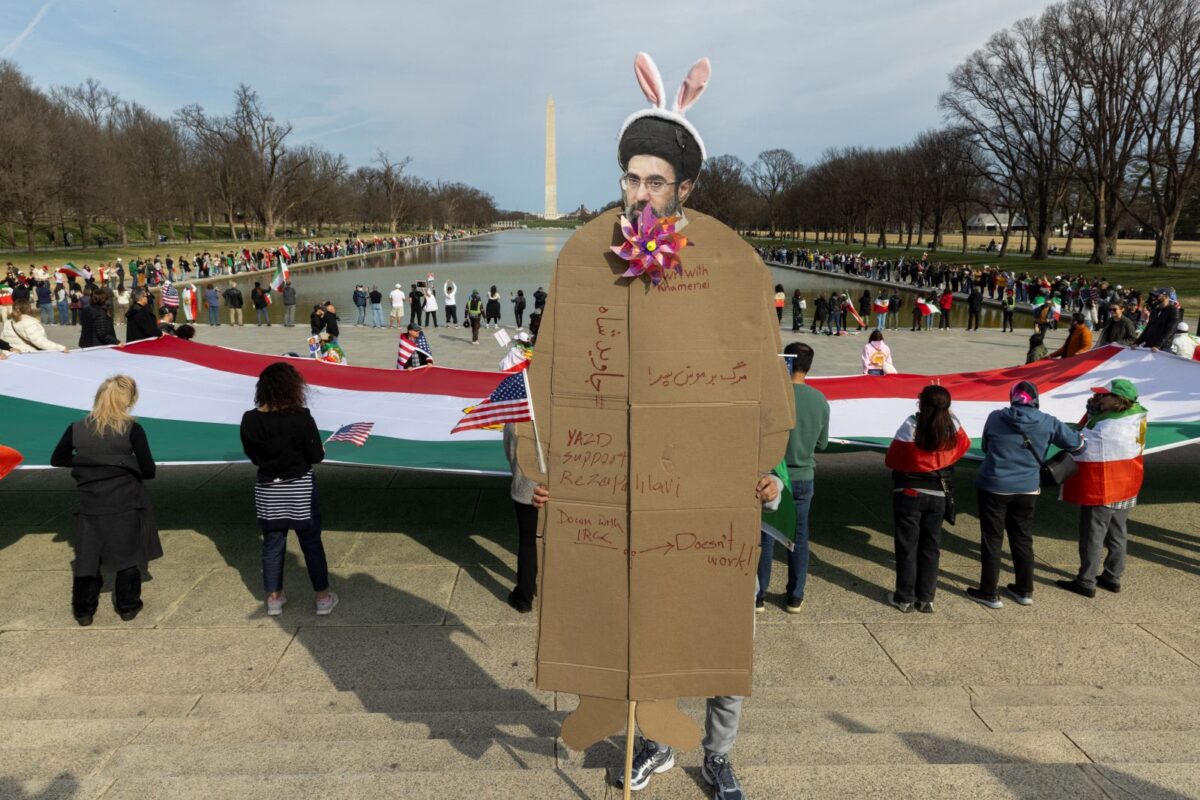
Photo by AASHISH KIPHAYET / NURPHOTO / NURPHOTO VIA AFP. A protester holds a cardboard cutout depicting Mojtaba Khamenei wearing bunny ears during a demonstration at the National Mall in Washington, D.C., United States, on March 14, 2026
Iran’s most valuable argument is often made by people with no connection to Iran.
That is what makes it powerful.
A recent Foreign Affairs essay on the “recovery” of the so-called axis of resistance offers a useful example. Its authors document how Iran-aligned groups share technical knowledge, diversify procurement, assemble inexpensive drones and rebuild damaged supply lines. From there, the article makes a much larger leap: the axis has become more dangerous, military pressure has reached its limits, and Washington must consider political engagement with Iran and its entrenched armed partners.
There is no reason to treat the authors as Iranian agents or participants in an influence operation. Their credibility is precisely what gives their conclusion greater strategic value than Iranian propaganda could achieve on its own.
Tehran’s most important intellectual success has been its ability to position itself inside the ideological divisions of the West. It did not create those divisions. It learned how to profit from them.
To parts of the left, Iran appears as an anti-imperialist state resisting American hegemony, Israeli power and the inheritance of colonial domination. To parts of the isolationist right, it embodies the dangers of endless wars, intelligence overreach and neoconservative ambition. To realists, it is a durable regional power whose interests must be accommodated. To the conflict-resolution establishment, its militias are entrenched local actors whose survival makes political inclusion unavoidable.
Different intellectual traditions therefore travel separate roads toward the same destination:
Iran cannot be defeated. Its militias cannot be removed. Pressure has failed. Washington must negotiate. The armed groups must be incorporated into regional settlements.
Iran does not need to coordinate every voice advancing this conclusion. It benefits more when the conclusion emerges independently, wrapped in professional expertise and delivered through respected universities, journals and think tanks.
This is ideological arbitrage: the conversion of Western self-criticism into Iranian strategic advantage.
The temptation has a long intellectual history. Stalin benefited from Western fellow travelers such as George Bernard Shaw, whose independent prestige gave Soviet claims more credibility than official propaganda could. Later, Maoism attracted figures including Philippe Sollers, Julia Kristeva, Alain Badiou, and Jean-Luc Godard. Jean-Paul Sartre embodied several versions of the same fascination: he defended revolutionary violence in Algeria, celebrated Castro’s Cuba alongside Simone de Beauvoir, and later intervened on behalf of imprisoned Red Army Faction leader Andreas Baader. Jean Genet attached his literary authority to the Black Panthers and Palestinian fedayeen, while other intellectuals defended the Khmer Rouge even as evidence of mass violence mounted.
The causes and degrees of complicity varied enormously. The recurring error was more stable: the justice of a grievance came to certify the movement claiming it, hostility to Western power became evidence of virtue, and radical violence was interpreted as an expression of history rather than a political choice carrying responsibility.
The contemporary version is less romantic and more technocratic, but it rests on the same temptation. Its preferred language is no longer revolution, sacrifice, or liberation. It is complexity, resilience, local legitimacy, and political inclusion. This is where sophistication bias begins.
The contemporary version is less romantic and more technocratic, but it rests on the same temptation. Its preferred language is no longer revolution, sacrifice, or liberation. It is complexity, resilience, local legitimacy, and political inclusion. This is where sophistication bias begins.
The mechanism depends on what might be called sophistication bias. After Iraq, Afghanistan and the excesses of regime-change thinking, serious analysts correctly became suspicious of simple stories about good and evil, decisive victory and military transformation. Complexity became an essential corrective.
It also became a badge of intellectual status.
The sophisticated analyst explains that the militia has local roots, that the terrorist organization provides social services, that the regime possesses historical grievances, that sanctions create adaptation and that military pressure cannot eliminate every fighter or weapons workshop.
All of this may be accurate. Yet explanation can gradually become exculpation. Context can dissolve agency. The armed group becomes an organic expression of local grievance, while the states confronting it remain fully responsible for every consequence of their policies.
An asymmetrical standard then takes hold.
American power is declared a failure unless it eradicates the adversary. Iran is declared successful if one militia survives.
Western military campaigns are judged against their most ambitious political objectives. Iranian strategy is judged by whether its partners can still launch a drone.
But survival only proves survival, not ascendancy.
The same applies to Iran’s regional network. Hezbollah, the Houthis, Iraqi militias and Hamas remain dangerous. They also represent profoundly different political phenomena.
The Houthis use their relationship with Iran to advance a local Yemeni project of power and rule. Hezbollah inhabits the Lebanese state while preserving an armed authority above it and binding the country to a strategy centered outside its borders. Iraqi factions operate through varying combinations of formal security institutions, political parties and economic networks. Hamas emerges from a specifically Palestinian history and constituency.
Tracking the circulation of engines, trainers and drone designs cannot substitute for understanding these distinctions. Iran’s regional strategy works by weaponizing different local agendas, not by reproducing a single organizational model.
Tracking the circulation of engines, trainers and drone designs cannot substitute for understanding these distinctions. Iran’s regional strategy works by weaponizing different local agendas, not by reproducing a single organizational model.
This matters because a technical account of adaptation can easily become a political argument for permanence. Once militias are described as self-reproducing and impossible to defeat, accommodation begins to appear like neutral realism rather than a contested policy choice.
The resulting prescription closely serves Tehran’s interests: armed groups retain their coercive power, political systems adapt around them, and Iran negotiates from the leverage those weapons create. The article explicitly recommends engaging established groups and pursuing settlements accompanied by U.S.-Iranian diplomacy.
The danger lies beyond one article. Credible Western institutions can transform an Iranian preference into accepted policy wisdom without receiving an instruction from Tehran.
The danger lies beyond one article. Credible Western institutions can transform an Iranian preference into accepted policy wisdom without receiving an instruction from Tehran.
That phenomenon deserves far more scrutiny. Influence should be measured not only by money, contact or covert direction. It should also be measured by the ability of a state to exploit another society’s intellectual divisions until its preferred conclusions emerge spontaneously, in the language of its opponents, carrying their reputations and authority.
Iran’s most effective advocates may therefore be the analysts who sincerely believe they are merely describing reality.
Nadim Koteich is a Media Executive and Policy Advisor
The views in this story reflect those of the author alone and do not necessarily reflect the beliefs of NOW.