True leaders are not attentistes who “wait and see.” They are women and men of audacity who steer history rather than getting steered by it—possessed of what the ancient Greeks termed thymos: that combustive mix of spiritedness, pride, and controlled madness tempered by genius. Such leaders supply their nations élan vital they may otherwise lack; true statesmen who do not manage decline but rather break Gordian Knots. Two men, both intimately (if uneasily) twined to Lebanon’s modern history, embodied those qualities.
The first was Charles de Gaulle: sententious, arrogant, theatrical, often delusional—convinced he was France (je suis la France). Friend and foe alike called him un fou qui se prend pour de Gaulle, a madman fancying himself de Gaulle. Yet he understood that leading a nation out of its nadir required boldness bordering on recklessness. As André Malraux recorded him saying, “one accomplishes nothing serious by surrendering to chimeras—but one accomplishes nothing great without them.” Without “this seed of madness,” de Gaulle often muttered in solitude, “nothing of note gets done.”
The second model for Lebanon is David Ben-Gurion. Confronted with a parallel army inside the newly established Jewish state, he neither negotiated, temporized, dialogued, nor sought consensus. He simply said “There are not going to be two states [in Israel], and there are not going to be two armies. And Mr. Begin will not do what he feels like. If he does not give in, we shall open fire.” This same Ben-Gurion who ordered the sinking of the Altalena also noted that in Israel, to be a realist one must believe in miracles. In sum, both de Gaulle and Ben-Gurion understood that the sober calculation of probabilities is sometimes the least realistic posture to assume in a nation’s hour of reckoning.
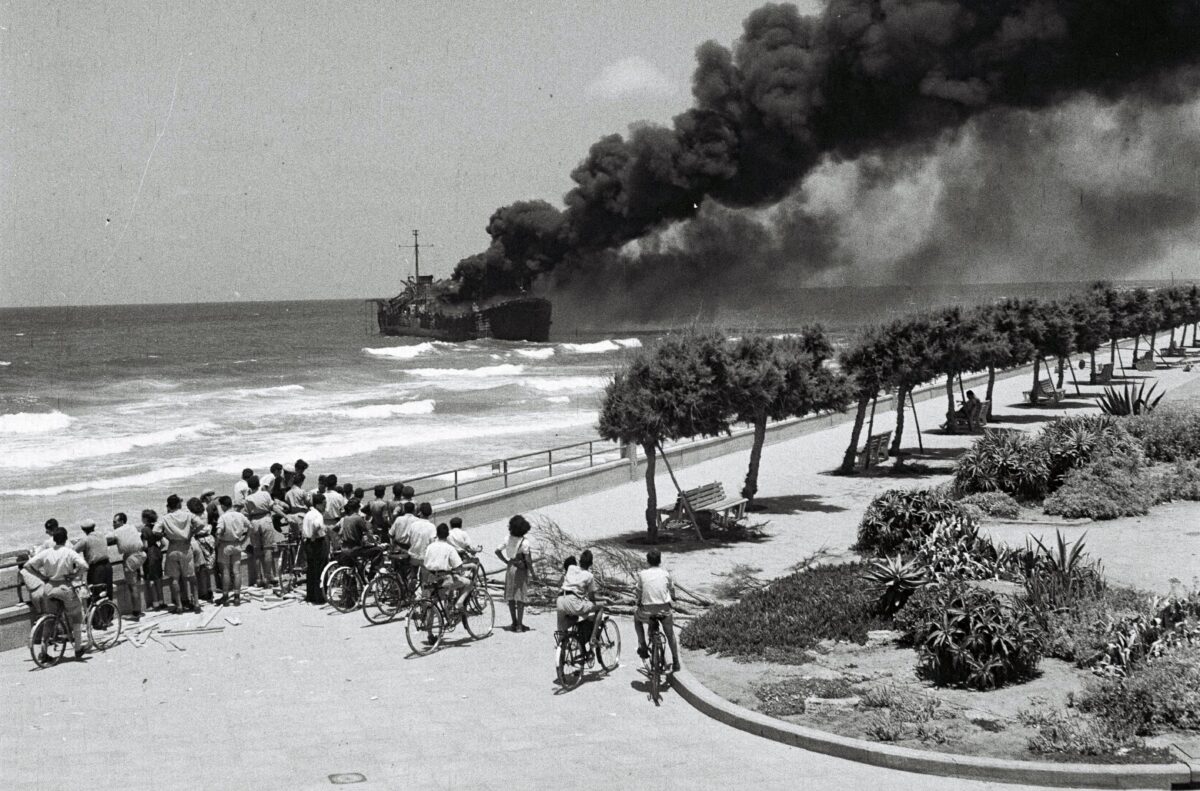
And so, in June 1948—one month after Ben-Gurion proclaimed the State of Israel—he ordered the shelling of an “Israeli” ship off Tel Aviv: the Altalena. Baptized with Ze’ev Jabotinsky’s pen name, the Altalena had sailed from the Mediterranean harbor of Port-de-Bouc in southern France, carrying some nine hundred fighters and immigrants, the great majority of them Holocaust survivors, along with a formidable cargo of arms: thousands of rifles, machine guns, mortars, and millions of rounds.
The ship belonged to the Irgun gang, Menachem Begin’s organization. This was in the thick of the first Arab-Israeli war, an existential fight during which the newly born state of Israel was outnumbered and outgunned by superior Arab forces, facing real dangers of dissolution. In this same post-May 1948 period, Begin had already consented, in principle, to disbanding the Irgun, absorbing it into the newly formed Israel Defense forces—the “unification of the gun under a single Israeli national command” as the phrase then went. Yet Begin still insisted on retaining a portion of the Altalena’s weapons for his own units, particularly those then still fighting in Jerusalem. Ben-Gurion’s answer was unforgiving, absolute: There would be one state, one nation, one army. No parallel command. No private arsenals. No statelets within the state.
And so when Begin’s ship refused unconditional surrender, Yitzhak Rabin’s forces, acting on Ben-Gurion’s orders, opened fire. The vessel burned and sank. Sixteen Irgun fighters and three IDF soldiers perished. Begin, to his lasting credit, ordered his men to de-escalate, stand down, and yield to the state. The brief ugly clash ended. The state asserted its sovereignty. Its monopoly on the legitimate use of force was upheld.
That was Israel’s “birth certificate.” While the Declaration of Independence of May 14, 1948 was word (on paper), the sinking of the Altalena on June 22 was sovereignty made real—“word becoming flesh” so to speak. Ben-Gurion understood with a clarity that still startles and sparkles, that a state that tolerates armed statelets inside its borders is not a state at all, but a “waiting room” for civil war, invasion, or foreign tutelage and domination. He opted for a short, decisive confrontation instead of the long, arduous, humiliating death of a state with dual heads and emasculated sovereignty. He was prepared to be alone, to be called a fratricide, to clash with his own people—he “broke eggs to make omelets” as it were.
Lebanese president Joseph Aoun is not that kind of man. He comes across more as a Levantine huckster than a statesman, preferring to tread softly on eggshells instead of crushing them. Yet in many ways like Ben-Gurion, Aoun inherited a non-state with inchoate state institutions—an Orwellian “animal farm” of confessional cartels, foreign patrons, and one dominant militia that answers to Tehran. Hezbollah is therefore the Lebanese Altalena that was never sunk: the only armed militia that survived the Lebanese civil war, the 1989 Taif Accord that ended that war, and that agreement’s explicit demand for the dissolution of all militias. Thus, to this day, despite the punishment that Israel meted out on Hezbollah since 2024, the organization still maintains its own chain of command, its own intelligence and security apparatus, its own foreign policy, its own arsenal, and the same disdain it has always held for Lebanese sovereignty. By its own repeated uninhibited admission, Hezbollah is a branch of Iran’s Islamic Revolutionary Guard Corps, and no amount of degradation will change that.
Beyond that, President Joseph Aoun’s public stance and vehement language countering Hezbollah’s defiance is on the face of it impeccable, brimming with sovereignist fire and brimstone: “state monopoly on the use of force,” and “one state, one army” as non-negotiables. In practice however—perhaps himself beholden to Hezbollah, perhaps playing a double game betraying a Levantine mercantilist duplicity—the President treats Hezbollah as a Lebanese faction gone astray, and that can still be coaxed through patient dialogue and the soft arts of persuasion back into the national fold. He will not risk “civil war.” He will not break eggs. He will instead negotiate relentlessly, endlessly, and gracefully sign off on the terms of his creeping irrelevance.
Except that this meek tremulous approach is not grace, it is not prudence, it is not statesmanship. It is abdication cloaked in a borrowed mantle of purity and maturity. Ben-Gurion recognized Arab nationalists as coherent custodians of an idea—carriers of a determined project that wanted the same land the Jews yearned for. He did not sentimentalize Arab nationalism, nor did he yield to it. He confronted it. He understood that strength, not conciliation, was the only language that would be respected, and that a state which preferred being “liked” to being “alive” would not remain a state for long—nor for that matter remain alive. Aoun, by contrast, still speaks and acts as though Hezbollah were merely Lebanese partners who have temporarily lost their way—as though the organization’s primary loyalty is not to the Supreme Leader in Qom, but to Lebanon itself. Such timorous performative virtue on the part of a president of the republic is not statesmanship. It is willful blindness elevated to a governing principle.
The historical parallel is not only Israeli. Charles de Gaulle—an idol to many a Lebanese army general—was l’homme seul, the man alone, as he often described himself in his Mémoires de guerre. In June 1940 he was merely a temporary brigadier general who refused both the armistice and the authority of his former mentor, a French national icon and hero of the 1916 Battle of Verdun, Philippe Pétain. As an awkward unknown, with an outlandish surname like “de Gaulle” (“from Gaul”) carrying “too much predestination to be taken for anything more than a figment of British war propaganda” Charles de Gaulle possessed no army, no territory, no popular mandate. Yet he flew to London on a whim declaring that France had lost a battle but not the war. What is more, to make a “Free France” he would improvise on June 18, 1940 really free, he had to fight other Frenchmen. The campaigns he waged with a handful of “compagnons de la première heure” (as were called the early supporters who rallied around his June 18 Appeal from London, among them this author’s Lebanese grandfather), the battles of Equatorial Africa, the Levant in 1941, and later North Africa, were a veritable French civil war, by another name. Vichy remained, for many, the legal government; de Gaulle was the rebel. Yet he accepted the blood price because the alternative was the permanent extinction of the French nation as a sovereign actor. De Gaulle, did not wait for consensus—j’aime chasser à ma manière “I hunt on my own terms” he often bragged. He supplied the thymos and the élan vital himself. The nation, in time, followed.
By contrast, Joseph Aoun has the grade (former commander of the Lebanese Armed Forces), the office, the uniform, the decorations, the international goodwill, and a Lebanese army that still commands a residue of respect. What he lacks is the solitary will; the steel backbone that de Gaulle once condensed in a single, unforgettable line: toujours le chef est seul en face du mauvais destin (“a leader is always alone in face of fate gone awry”). Aoun repeats the slogan “one state, one army” like a mantra, yet it remains in his mouth a hollow jingle treating the Hezbollah parallel army as a negotiating partner rather than a structural negation of the state he claims to preside. Every day that arrangement endures, the Lebanese system of statelets hardens, the formal republic shrinks, and sovereignty becomes a polite platitude, cheap fiction maintained for donor conferences, airport arrivals, Vatican ceremonies, and the one White House photo op with President Trump.
Ben-Gurion’s decision did not produce eternal harmony. Israeli politics, one of democracy’s most rambunctious, carried the scars of the Altalena for decades. But it did produce a durable stable state capable of making hard choices, living with their consequences, and eventually transcending them. De Gaulle’s lonely defiance did not make every Frenchman a Gaullist overnight. Instead, it preserved the promise and possibility of France—and, with it, the immortality of de Gaulle, the man and the name.
Lebanon’s president has chosen the opposite path: perpetual haggling with a non-state actor alien to the language of dialogue and that has already decided the question of dual power in its own favor. And when the choice is finally forced upon Lebanon—by Israeli action, Iranian collapse, or internal explosion—the cost will be higher, not lower.
States are not built by merchants and shopkeepers fastidiously counting inventory, genuflecting to dissatisfied customers in the hope they remain civil. States are built by men who refuse to bend the knee—men willing to impose the hard, sometimes cruel choices without which politics itself dissolves into theatre. Ben-Gurion sank the Altalena. De Gaulle fought Vichy. Aoun offers histrionics that fall flat. History has never been kind to that third kind.
Unlike Joseph Aoun, Ben-Gurion’s and de Gaulle’s work was national, not performative. They never looked for affirmation and never needed slogans or platitudes. The states they willed into being became the proof. “He who doesn’t move forward retreats,” de Gaulle often reminded himself. What mattered, Ben Gurion insisted, was not what the nations said, but what the Jews did. That remains Ben-Gurion’s sharper, harsher, more enduring legacy. On the French side of the Mediterranean, de Gaulle left another enduring line: “Every Frenchman is, was, or will be a Gaullist.” The sentence still carries the weight of a nation that recognized itself in the solitary figure who refused to let France disappear. Try this same sentence with “Joseph Aoun” in it and the effect collapses. “Every Lebanese is, was, or will be a Aounist” has neither the ring nor the gravitas. At best it sounds like an epitaph; at worst an obituary.
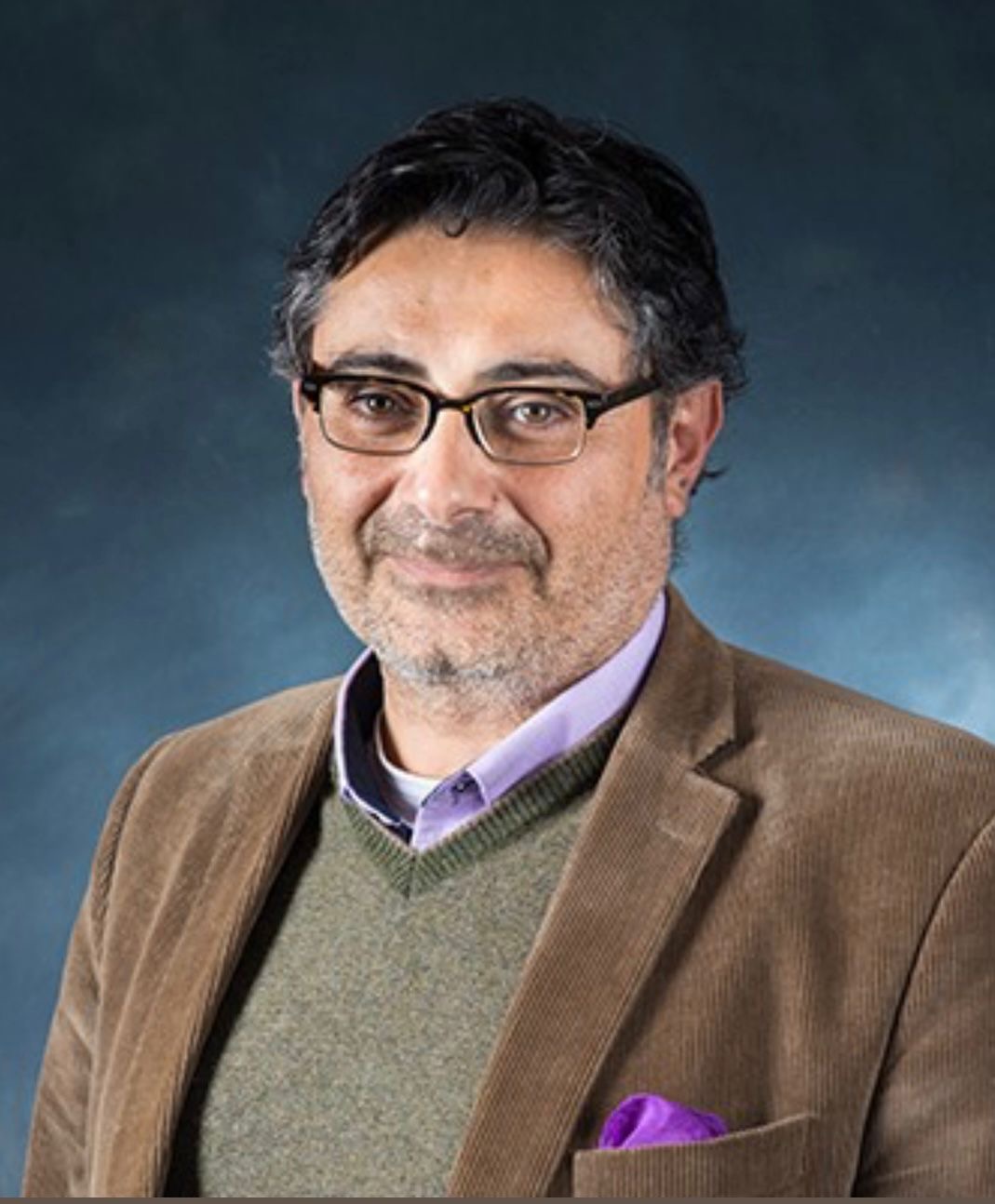
Franck Salameh is a historian, multilingual translator, biographer, memoirist, anthologist, and Professor of Near Eastern Studies at Boston College. His work centers primarily on Levantine minorities and the history of ideas and political thought in the modern Middle East, with a special focus on Arabism, Zionism, Islamism, and minority histories. His most recent books are The Other Middle East (Yale, 2017), and Lebanon’s Jewish Community (Palgrave, 2019).
The views in this story reflect those of the author alone and do not necessarily reflect the beliefs of NOW.