When Ali Khamenei was killed in U.S. and Israeli attacks on Feb 28, 2026, the Islamic Republic faced its first leadership transition in more than three decades. His son, Mojtaba Khamenei, formally succeeded him. But for months, he did not appear in public. That absence raised questions about his health and about how much authority he could exercise.
But Mojtaba’s personal power is only part of the story. The bigger question is who now makes Iran’s most important decisions — and how power is divided among the country’s political, military and security institutions.
This report draws on an interview with a source familiar with the Islamic Republic’s power structure. Facts that can be established are separated from the source’s interpretation. The argument running through the account is straightforward: the war bought the system time. It pushed internal rivalries into the background and gave the military-security establishment room to regroup.
Who Really Holds Power in Iran?
For readers outside Iran, one distinction is essential. Iran has an elected president and a supreme leader. The president and cabinet run the day-to-day government, but the supreme leader sits above them on the most important questions of war, foreign policy and national security.
Around the supreme leader sits what Iranians often call the bayt — literally, the leader’s “house,” but in practice much more than an office. It is a network of advisers, political operators and security officials with influence across the state.
Then there is the Islamic Revolutionary Guard Corps, or IRGC. It is separate from Iran’s regular army and has grown into a military, intelligence, political and economic power center of its own. The Basij, a mass paramilitary force under the IRGC, plays a major role in domestic mobilization and security. Above the military branches, the Armed Forces General Staff coordinates the IRGC, the regular army and the country’s other armed forces.
A fourth institution, the Supreme National Security Council, or SNSC, connects many of these parts. It brings senior political, military and security officials into one body to coordinate national-security policy. The president formally chairs it, but its decisions require the supreme leader’s approval. That makes the council’s secretary an important broker between the elected government, intelligence agencies and the armed forces.
This is why power in Iran cannot be understood by looking at one office. Mojtaba Khamenei has the formal authority of supreme leader, but different institutions control different parts of the system. Mohsen Rezaei, a former IRGC commander, runs the SNSC. Ahmad Vahidi commands the IRGC. Ali Abdollahi heads the body that coordinates the armed forces. Hossein Taeb leads the Basij. Parliament Speaker Mohammad Bagher Ghalibaf remains influential. President Masoud Pezeshkian and his cabinet, by contrast, have much less control over strategic decisions.
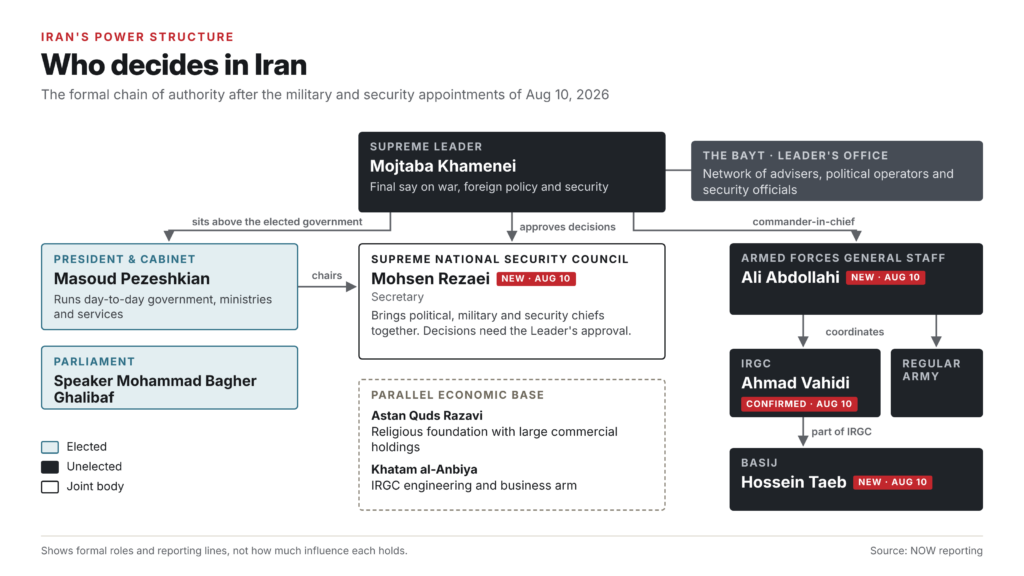
A wave of military and security appointments on Aug 10, 2026 made this arrangement easier to see. To understand how Iran reached this point, it is necessary to go back to the system that took shape after Ruhollah Khomeini’s death.
How Khamenei Built a State Beside the State
The roots of this system go back to 1989. After the death of Ruhollah Khomeini, the founder of the Islamic Republic, Ali Khamenei became supreme leader and Akbar Hashemi Rafsanjani became president. Khamenei gradually strengthened his position by placing loyal IRGC commanders and security officials in sensitive posts. Over time, the supreme leader’s office and the military-security establishment became increasingly dependent on one another.
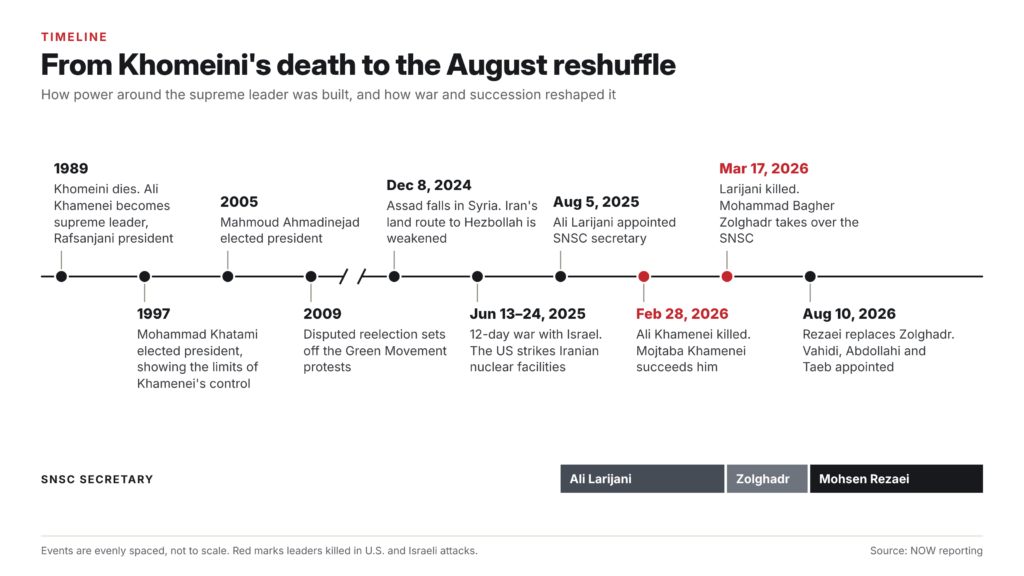
Mohammad Khatami’s election as president in 1997 showed the limits of Khamenei’s control over electoral politics. In the years that followed, Khamenei strengthened unelected institutions and organizations answerable to him, giving the supreme leader more ways to limit or bypass the elected government. Mahmoud Ahmadinejad became president in 2005. His disputed reelection four years later triggered the mass protests that became known as the Green Movement.
At the same time, a second layer of power was taking shape beside the elected government. It was not a separate legal state. It was a network of foundations, companies and institutions linked to the supreme leader or the IRGC, with access to major resources outside the cabinet’s direct control.
Two institutions show how this works. Astan Quds Razavi is a powerful religious foundation with large commercial holdings. Khatam al-Anbiya Construction Headquarters is the IRGC’s engineering and business arm, with a major presence in oil, petrochemicals, infrastructure and construction. Together with other foundations and IRGC-linked companies, such institutions give the unelected side of the system its own economic base.
That economic base matters politically. It allows institutions tied to the supreme leader and the IRGC to operate without depending entirely on the elected government’s budget or decisions. The president and cabinet remain the public face of the state — and, in moments of crisis, often carry the political cost for decisions they did not fully control.
The Succession Fight Inside Khamenei’s Circle
Even before the 12-day war in 2025, the question of who would succeed Ali Khamenei had become a central issue inside the ruling system. Hossein Taeb led the IRGC Intelligence Organization from 2009 until June 2022 and later served as an adviser to the IRGC commander-in-chief. He was close to the Khamenei security network and supported Mojtaba Khamenei as his father’s successor.
According to the source, Ali Khamenei resisted a direct transfer of power to his son at that stage. One concern was the public reaction to hereditary leadership. Another was what might happen to the network he had built over decades if Mojtaba took control. The source also describes Mojtaba’s approach to relations with the West as a point of tension inside the ruling circle. Those disagreements, in this account, temporarily weakened several officials, including Taeb and Vahid Haghanian.
Khamenei’s regional strategy also depended on armed and political groups aligned with Tehran in Iraq, Syria, Lebanon and elsewhere. Iranian officials call this network the “Axis of Resistance.” It gave Tehran a way to pressure and deter Israel and the United States while extending Iranian influence beyond the country’s borders.
Syria and the Loss of a Strategic Corridor
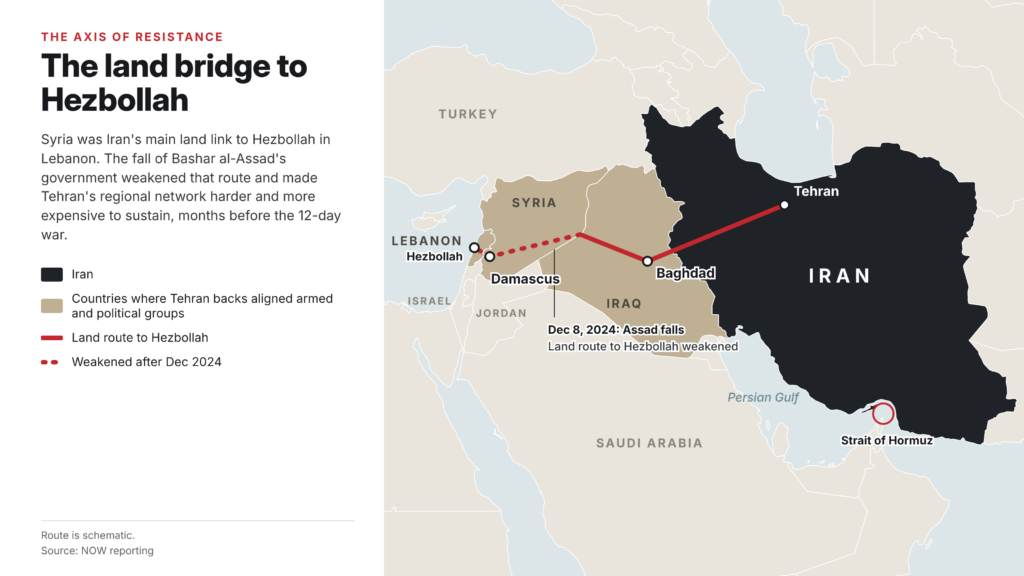
A few months before the 2025 security reshuffle, the Islamic Republic suffered one of its biggest regional setbacks. Opposition forces led by Ahmed al-Sharaa entered Damascus on Dec 8, 2024, and Bashar al-Assad’s government fell.
For Tehran, Syria was more than an ally. It was the main land bridge linking Iran to Hezbollah, the Lebanese armed group and political movement that has long been one of Tehran’s closest regional partners. Assad’s fall weakened that route and made Iran’s regional network harder and more expensive to sustain. The loss came before the 12-day war and left Tehran more exposed when the fighting began.
The 12-Day War Changes the Chain of Command
The 12-day war between Iran and Israel ran from Jun 13 to Jun 24, 2025. In its final days, the United States directly attacked Iranian nuclear facilities. Senior commanders were killed and military infrastructure was damaged. For Tehran, the lesson was clear: in another war, the supreme leader himself could be cut off from the chain of command — or removed from it altogether.
After the war, some decision-making was spread across two bodies. The SNSC handled the broader political and security picture. A Defense Council — a wartime body revived from the Iran-Iraq War era — was brought back to focus on military planning, rebuilding damaged capabilities and preparing for another conflict.
The source says the SNSC’s reach widened as well, covering the nuclear file, domestic security, relations with the United States and other major decisions.
Ali Larijani returned to the center of power during this period. President Masoud Pezeshkian appointed him secretary of the SNSC on Aug 5, 2025, returning him to a job he had held two decades earlier. Larijani was a former parliament speaker with long experience inside the conservative establishment. More importantly, he could speak to the elected government, the supreme leader’s office and parts of the military-security system — a rare position in an increasingly divided structure.
According to the source, the postwar structure was designed to keep political and security coordination functioning if Ali Khamenei could no longer do so himself. Larijani was meant to provide continuity. But as long as Khamenei was alive, he remained the figure who kept rival networks in balance and their disputes largely out of public view.
Khamenei Dies. Then Larijani.
Ali Khamenei’s killing on Feb 28, 2026 removed that center of gravity. Mojtaba Khamenei formally became supreme leader, but his long absence from public view, together with reports that he had been injured, raised doubts about his ability to project authority. The office had passed from father to son. The father’s full personal power had not necessarily passed with it.
Larijani remained one of the most important figures in the security establishment after Khamenei’s death. But he too was killed during U.S. and Israeli attacks on Mar 17, 2026. His death, only weeks after that of the former supreme leader, removed one of the main links among Iran’s competing centers of power.
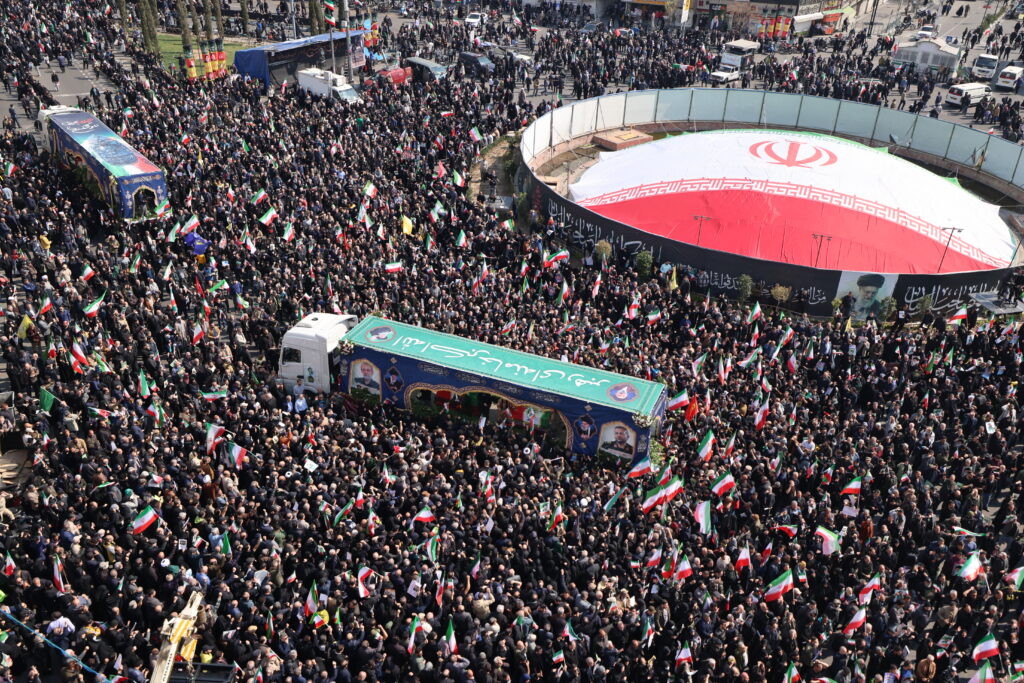
Iranian mourners gather during the funeral of Iran’s security chief Ali Larijani and Gholamreza Soleimani, a senior officer in the Islamic Revolutionary Guard Corps who commands Basij forces, in Tehran on March 18, 2026. After crowds gathered in central Tehran for the funeral of Iran’s security chief Ali Larijani, Iran’s new supreme leader Mojtaba Khamenei declared in a written message that his killers would pay. Larijani’s funeral was held alongside those of Gholamreza Soleimani, the head of the Basij paramilitary force who was also killed in a strike in Iran this week, and dozens of Iranian sailors who were killed when US forces torpedoed their frigate off Sri Lanka earlier this month. (Photo by ATTA KENARE / AFP)
After Larijani’s death, Mohammad Bagher Zolghadr, a former IRGC commander, briefly took over the SNSC. On Aug 10, 2026, he was replaced by Mohsen Rezaei, another veteran of the Guards who commanded the IRGC for much of the 1980s and 1990s. The change brought one of the Islamic Republic’s oldest military figures back into a central security role.
The source does not see Zolghadr’s replacement as a routine administrative change. Iran was trying to stop the war and reopen a path to negotiations with the United States. But fighting in the Persian Gulf and the dispute over the Strait of Hormuz changed the calculation again. In this reading, Rezaei’s growing influence marked a further shift of security policy toward the IRGC’s older generation.
The IRGC Moves Back to the Center
The same day, Mojtaba Khamenei announced a series of senior military appointments. Ahmad Vahidi was confirmed as head of the IRGC. Ali Abdollahi took charge of the body that coordinates all of Iran’s armed forces. Hossein Taeb, a former intelligence chief, returned to lead the Basij.
The appointments put three different levers of power in the hands of veteran security figures: the Guards, the overall military command and the organization most closely associated with mass mobilization and control inside the country.
For the source, Taeb’s return is the most revealing. He spent years running the IRGC’s intelligence organization. Putting him in charge of the Basij suggests that internal control is again becoming a central priority. In this reading, the security establishment is preparing not only for another external conflict, but also for unrest at home.
Parliament Speaker Mohammad Bagher Ghalibaf still matters, and his own background is in the IRGC. But in the source’s account, the military-security network has become the main center of gravity. He uses the blunt word “scarecrow” for Pezeshkian’s government. The point is not that the elected government does nothing. It runs ministries, manages services and remains the public face of the state. But on war, security and negotiations, the decisive choices are made elsewhere.
From “Calculated Survival” to “Instinctive Survival”
The source calls this a shift from “calculated survival” to “instinctive survival”: a system relying less on a coherent long-term strategy and reacting more urgently to the threat in front of it.
It is an interpretation, not a measurable fact. But it captures the contradiction at the center of the current system: negotiating while rebuilding deterrence, tightening control at home while trying to repair influence abroad.
The war did not bring about the Islamic Republic’s immediate collapse. It did something more complicated: it bought the system time to regroup while removing some of the figures who had held its competing centers together. The result is not a simpler chain of command, but a more militarized and fragmented one.
That division also determines who carries the cost of survival. The institutions closest to the security establishment still control major economic networks and resources. The elected government, meanwhile, remains the part of the state most visible to ordinary people when prices rise, services fail or the economy contracts. The question after Ali Khamenei is therefore not simply who replaced him. It is who can keep these military, security, political and economic centers moving in the same direction.
The formal succession is complete; the center of power is not. The war bought the Islamic Republic time. It did not rebuild the center that once held the system together. Time was bought for the state. The cost is not confined to the institutions that gained it.
Elham Adimi is an Iranian freelancer journalist based in Beirut
The views in this story reflect those of the author alone and do not necessarily reflect the beliefs of NOW.