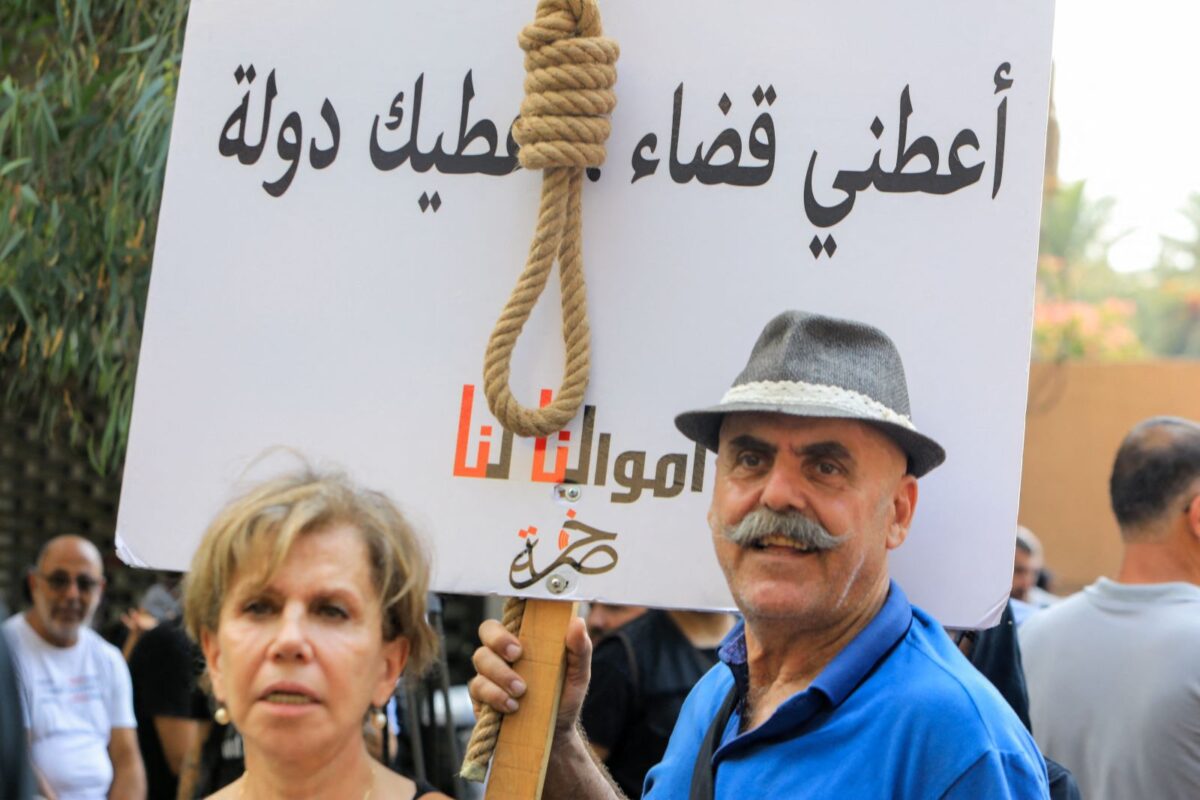
Protesters lift placards during a rally outside the Palace of Justice in Beirut where Lebanon's former Central Bank chief Riad Salameh is set to attend a questioning hearing on September 9, 2024. (Photo by AFP)
The latest developments have reignited debate over whether one of Lebanon’s most consequential financial corruption cases will finally move towards a verdict or face yet another delay.
The Public Prosecutor’s Office at the Court of Cassation announced that Riad Salameh is receiving continuous medical care under judicial supervision following reports of a deterioration in his health. Authorities stressed that his condition is being monitored while legal proceedings continue, seeking to reassure the public that medical treatment would not bring the judicial process to a halt altogether.
The statement came after days of speculation about Salameh’s health. A medical committee has reportedly been monitoring his condition, and judges will decide whether he can appear in court based on medical assessments.
For Louay Ghandour, lawyer and president of the Lebanese Anti-Corruption Task Force, the judiciary’s position reflects an important legal principle: illness alone should not become a mechanism for indefinitely postponing justice.
For Louay Ghandour, lawyer and president of the Lebanese Anti-Corruption Task Force, the judiciary’s position reflects an important legal principle: illness alone should not become a mechanism for indefinitely postponing justice.
“If a defendant is medically capable of understanding proceedings and answering questions, there is no legal obstacle preventing the investigation from continuing,” Ghandour told NOW. He noted that Lebanese law allows judges to question defendants at their place of detention should their physical condition genuinely prevent them from appearing in court, arguing that appropriate legal safeguards already exist to balance a defendant’s health with the public interest in pursuing justice.
Salameh’s legal team has previously sought postponements on medical grounds. However, Ghandour questioned whether repeated delays remain justified, pointing to the Public Prosecutor’s confirmation that Salameh continues to receive medical care under judicial supervision.
The former central bank governor faces several separate investigations involving alleged embezzlement, illicit enrichment, money laundering and the misuse of public funds—charges he has consistently denied.
Investigations linked to the transfer of hundreds of millions of dollars through offshore entities, including the Forry Associates case, continue in both Lebanon and several European jurisdictions.
The current proceedings form part of a broader judicial campaign that has gathered momentum since Banque du Liban’s new leadership pledged greater cooperation with prosecutors and initiated legal action aimed at recovering allegedly misappropriated public funds.
Earlier this year, current central bank governor Karim Souaid filed additional complaints relating to suspected illicit enrichment and offshore financial structures linked to Salameh’s tenure.
Yet Ghandour argues that the proceedings risk becoming too narrowly focused on one individual. While prosecuting Salameh is important, he says, Lebanon’s financial collapse cannot be understood without examining the broader political and financial network that enabled it.
“The disappearance of around 170 billion dollars cannot be explained through one case alone,” he said, arguing that responsibility extends beyond the former governor to political decision-makers, banking executives and institutions that benefited from financial engineering and other policies over many years.
He believes the scale and technical complexity of the financial collapse exceeds the expertise of an ordinary criminal court, calling instead for a specialized judicial body bringing together judges, banking specialists and financial experts capable of examining the entire architecture of Lebanon’s economic collapse rather than isolated files.
That broader question of accountability extends beyond Lebanon’s domestic legal system. According to Dr. Walid Marrouch, Professor of Economics at the Lebanese American University, the repeated delays and procedural twists in Salameh’s case carry significant implications for Lebanon’s international credibility.
“The continuous delays send a clear message to the IMF, international investors and donor countries that Lebanon’s judicial system remains vulnerable to political influence and lacks the independence necessary to deliver meaningful accountability,” Dr Marrouch told NOW.
He argues that while prosecuting senior officials carries important symbolic value, accountability alone cannot restore confidence in Lebanon’s economy.
“Seeing high-profile figures face justice may resonate with the public, but it is no substitute for structural reform,” he said. “Foreign confidence depends on comprehensive banking sector reform, debt restructuring and genuine transparency across state institutions. Convicting one individual without dismantling the system that enabled the crisis simply treats a symptom rather than the underlying disease.”
Dr Marrouch nevertheless argues that accountability remains essential to reducing what economists describe as “moral hazard”—the risk that future policymakers may believe catastrophic economic decisions carry no personal consequences.
“I believe Riad Salameh was fundamentally unqualified for the position and likely guilty of corruption,” he said. “But his greatest failure lies in the policies that devastated the Lebanese economy, including the defense of the currency peg, financial engineering and the failure to separate monetary policy from fiscal policy.”
At the same time, Dr Marrouch cautions against portraying Salameh as the sole architect of Lebanon’s collapse. He argues that successive political leaders relied heavily on the central bank to finance an unsustainable political and economic system, making broader accountability indispensable if the trial is to restore public trust.
“Unless the wider network of former ministers and political decision-makers also faces justice,” he said, “the proceedings risk becoming little more than a kangaroo court that will ultimately fail to rebuild international confidence in Lebanon’s governance.”
Salameh’s legal troubles have unfolded across multiple jurisdictions. Beyond the Lebanese investigations, he remains the subject of criminal proceedings in France and other European countries, where authorities have frozen assets and pursued inquiries into alleged financial crimes committed during his three decades as governor. He has consistently denied all allegations, maintaining that his wealth derives from legitimate investments and income earned before entering public office.
For many Lebanese, however, the case extends far beyond the fate of one former official. Salameh led Banque du Liban from 1993 until 2023, presiding over a period in which he was once praised for maintaining monetary stability before becoming one of the figures most closely associated with the financial collapse that erupted in 2019.
Millions of depositors remain unable to access their savings, while confidence in Lebanon’s banking sector and public institutions has yet to recover.
Whether Salameh’s latest health developments amount to a temporary procedural obstacle or another chapter in a years-long legal saga remains uncertain.
Whether Salameh’s latest health developments amount to a temporary procedural obstacle or another chapter in a years-long legal saga remains uncertain.
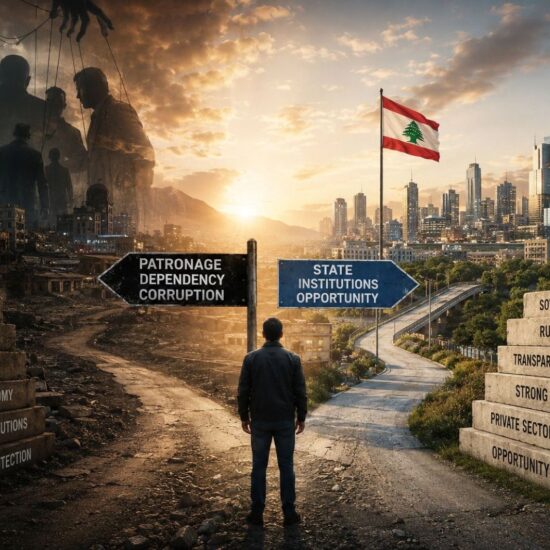
What is increasingly clear, however, is that the case has evolved beyond the prosecution of one former central banker. It has become a test of whether Lebanon’s judiciary can deliver accountability commensurate with one of the country’s greatest economic catastrophes and whether justice, if achieved, will be broad enough to restore confidence at home and abroad.