For decades, Tripoli has been spoken about through the vocabulary of deprivation.
Lebanon’s second city, together with the wider North stretching toward Akkar, has repeatedly paid the price of geography, politics, conflict and neglect.
Since the Lebanese Civil War, and arguably even before it, Tripoli and its surroundings became an arena where others settled their scores: the Syrian Assad regime, Palestinian factions, Lebanese political rivalries, armed groups and competing regional interests.
Wars were fought there. Conflicts were imported there. Poverty was allowed to deepen there.
And one of Lebanon’s greatest cities was rarely given the opportunity to become what its geography, history and people should have allowed it to become.
There were moments when that trajectory could have changed. The late Prime Minister Rafic Hariri understood the importance of developing Tripoli and the North, but the political realities of the time, particularly the constraints imposed during the period of Syrian domination, severely limited what could ultimately be achieved.
Today, something different appears to be happening.
Quietly, and refreshingly without the political spectacle that so often accompanies major announcements in Lebanon, the government of Prime Minister Dr. Nawaf Salam has begun assembling what could become one of the most consequential regional development initiatives undertaken by the Lebanese state in decades.
It is not one project.
It is an ecosystem.
An airport. A Mediterranean port. A special economic zone. A railway. One of the world’s great modernist exhibition complexes. And potentially, once again, an energy corridor connecting Iraq to the Mediterranean.
Separately, they are infrastructure projects.
Connected, they begin to tell a much bigger story:
a future-ready Tripoli.
Six Pieces of One Vision
The first pillar is René Mouawad Airport at Qlayaat.
In June 2026, Lebanon formally launched its redevelopment as the country’s second civilian aviation hub. It is intended not to compete with Beirut, but to complement it while creating an economic gateway for Akkar and the entire North.
An airport is never merely a runway. It brings tourism, cargo, logistics, transportation, hospitality, employment and investment. More importantly, it changes the economic geography of a region.
The second pillar is the Tripoli Special Economic Zone, being repositioned to attract Lebanese and international investment, encourage exports and connect more effectively with both the port and Qlayaat Airport.
An economic zone standing alone is essentially land with legislation attached to it.
Connect it to an airport, a Mediterranean port and eventually a railway, and it becomes something fundamentally different:
an industrial, logistics and export platform.
The third pillar is the Port of Tripoli.
Infrastructure works are moving forward, but Tripoli should aspire to become much more than Lebanon’s “second port.”
Its real strategic value lies in the geography behind it.
Tripoli faces the Mediterranean, but its natural economic reach extends inland, toward Akkar, Syria and potentially much further into the Arab East. Its future therefore depends not only on its coastline, but on reconnecting the city with its hinterland.
This is what could transform Tripoli from a Lebanese port into a regional gateway.
The fourth pillar, and perhaps the clearest expression of that idea, is the railway.
The government has taken an official first step toward studying the rehabilitation of approximately 40 kilometres of railway between the Port of Tripoli and the Abboudieh border crossing with Syria.
Its strategic significance does not end at the border.
If political conditions, security and regional agreements eventually permit, Tripoli could reconnect with Syrian and wider regional railway networks and position itself within emerging transport corridors linking the Mediterranean to the Levant and potentially the Gulf.
The project remains at feasibility stage, and tomorrow’s possibilities should never be presented as today’s achievements.
But Lebanon is thinking about connectivity again.
That matters.
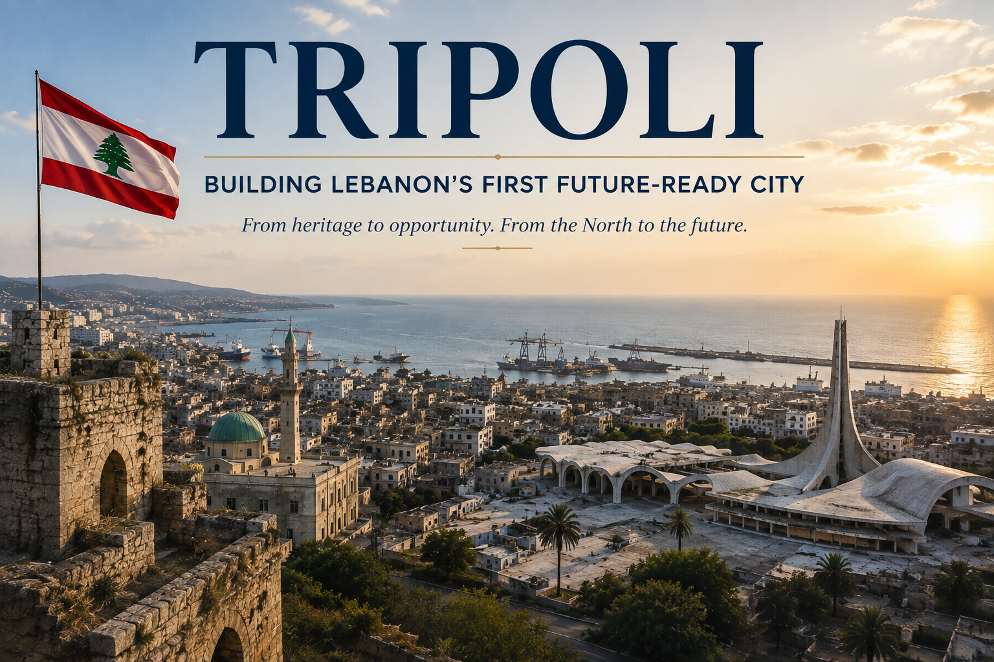
The fifth pillar is the extraordinary Rachid Karami International Fair.
Designed by Oscar Niemeyer and inscribed by UNESCO on the World Heritage List, it is not merely a Tripoli landmark but one of Lebanon’s great architectural assets.
Its revival could create something unique in the Eastern Mediterranean: a destination combining exhibitions, conferences, architecture, culture, design, technology, business and tourism.
The Rachid Karami Fair should not become a monument to what Tripoli once dreamed of becoming.
It should become a platform for what Tripoli intends to become next.
And then comes the sixth possibility, potentially the most strategically significant:
the revival of the historic Kirkuk-Tripoli oil corridor and the Tripoli refinery.
This is not a new corridor imagined on a map. It is the revival of a historic role Tripoli once actually played. Beginning in the 1930s, the Iraq Petroleum Company, IPC, transported crude oil from the Kirkuk fields across Syria to its terminal in Tripoli, later complemented by the Tripoli refinery. For decades, this infrastructure connected Iraq’s energy resources to the Mediterranean through northern Lebanon.
Today, its possible revival remains an emerging strategic opportunity rather than an accomplished project. But in a Middle East increasingly defined by trade, energy, railway and digital corridors, Lebanon should understand the strategic value of possessing a Mediterranean endpoint connected to an Arab hinterland.
Tripoli once played that role. It could play it again.
The Real Project Is Tripoli
But perhaps we are still looking at this from the wrong angle.
The airport is not the project.
The port is not the project.
The railway, economic zone, international fair and potential energy corridor are not individually the project.
Tripoli itself is the project.
What the Salam government is beginning to assemble is an economic architecture capable of changing the relationship between citizens, their region and the Lebanese state.
For decades, Lebanon attempted to manufacture stability through political arrangements, security compromises and distributions of influence.
Sustainable stability, however, also comes from something much simpler:
having a future worth protecting.
When businesses operate, factories employ people, aircraft arrive, ships dock, goods move and families begin to see economic futures for their children, society develops an enormous interest in protecting stability.
Investment requires security.
Security encourages investment.
Investment creates opportunity.
Opportunity restores dignity.
Dignity strengthens citizenship.
And citizenship strengthens the state.
This is the virtuous circle Lebanon has too rarely attempted to build.
Sovereignty Through Prosperity
This is where development acquires a meaning far beyond economics.
Development itself can become an instrument of sovereignty.
A territory dominated by poverty, unemployment and hopelessness becomes vulnerable to clientelism, illegal economies, extremism, foreign influence and armed actors.
A productive territory behaves differently.
When people’s livelihoods depend upon functioning institutions, secure borders, international investors, factories, airports, ports, tourism and trade, stability stops being an abstract political slogan.
It becomes an economic and social necessity.
Prime Minister Nawaf Salam has repeatedly connected these concepts: without the authority of the state there can be no lasting security and stability; without security and stability, investment will not come; and without investment, economies cannot grow.
That should become more than a statement.
It should become a Lebanese development doctrine.
Because sovereignty, stability and prosperity are not competing objectives.
They are dimensions of the same national project.
Decentralization Without Division
Perhaps this is also one of the most beautiful and refined meanings of decentralization.
Decentralization should never mean partition or competing Lebanons.
It should mean giving every Lebanese region the infrastructure, institutions and economic tools necessary to develop its comparative advantages while remaining firmly anchored within one sovereign state.
Tripoli should not need Beirut’s permission to prosper every morning.
Neither should Zahle, Saida, Tyre, Baalbek, Akkar, the Chouf or Nabatieh.
A strong Lebanon should be a country of economically strong regions connected to a strong central state.
That is productive decentralization.
And it creates something equally important: financial sovereignty for the citizen.
A person with a profession, a business, an income and an economic future possesses independence. A person whose survival depends upon a political leader, sectarian organization, foreign patron or permanent assistance does not possess the same freedom.
Economic independence protects dignity.
Dignity allows citizenship to flourish.
And citizenship ultimately strengthens sovereignty.
From Tripoli to the South
If Tripoli succeeds, its greatest contribution may therefore extend far beyond Tripoli.
Because Lebanon desperately needs successful models.
Imagine applying the same philosophy across the country: identify each region’s assets, build infrastructure around them, connect them to private capital, establish security, attract investment and allow productive opportunity gradually to replace dependency.
Nowhere is that lesson more urgently needed than in Lebanon’s South.
The South has endured conflict, destruction, displacement and uncertainty for far too long.
It does not merely need reconstruction.
It is thirsty for a sip of hope.
It needs an economic horizon, investment, opportunity and productive infrastructure. Its people deserve the possibility of building their prosperity around the opportunities of tomorrow rather than the conflicts of yesterday.
If Tripoli can move from decades of deprivation toward becoming a Mediterranean logistics, industrial, cultural and transportation gateway, then perhaps it can offer every other neglected Lebanese region something extraordinarily valuable:
proof that transformation is possible.
When Government Gets It Right
Lebanese political culture has become exceptionally skilled at criticism.
Much of that criticism is deserved.
But accountability also requires the intellectual honesty to recognize when government moves in the right direction.
What Prime Minister Dr. Nawaf Salam and his government are attempting in Tripoli and the North deserves recognition, encouragement and support.
Not blind support. Not political allegiance. And certainly not premature celebration.
These projects still have to be delivered. Tenders must remain transparent. Investors must arrive. Institutions must function. Security must be guaranteed. And announcements must ultimately become operating infrastructure.
But there is an enormous difference between announcing disconnected projects and beginning to construct a coherent development architecture.
In Tripoli, that architecture is becoming visible.
Airport. Port. Economic zone. Railway. International fair. Potential energy corridor.
Individually, they are projects.
Together, they are a vision.
A Future-Ready Lebanese City
For decades, Lebanon has asked how to rescue its deprived regions.
Perhaps we have been asking the wrong question.
How do we make every Lebanese region indispensable to Lebanon’s future?
Tripoli already possesses the geography.
It possesses the Mediterranean and access to a vast hinterland.
It possesses the history and human capital.
And increasingly, it possesses the beginnings of the infrastructure and political will necessary to connect them.
The challenge now is execution.
If Lebanon succeeds, we may one day stop describing Tripoli as one of the country’s most deprived major cities and describe it very differently:
Lebanon’s first future-ready city.
And perhaps its model will travel south, east and across the mountains, until development is no longer a privilege concentrated in certain parts of Lebanon, but an opportunity available to every Lebanese region.
That would be much more than the rebirth of Tripoli.
It could be the beginning of a different Lebanon.
Farid Fakherddin is a Lebanese businessman and Board Member of the Lebanese Private Sector Network (LPSN).
The views in this story reflect those of the author alone and do not necessarily reflect the beliefs of NOW.