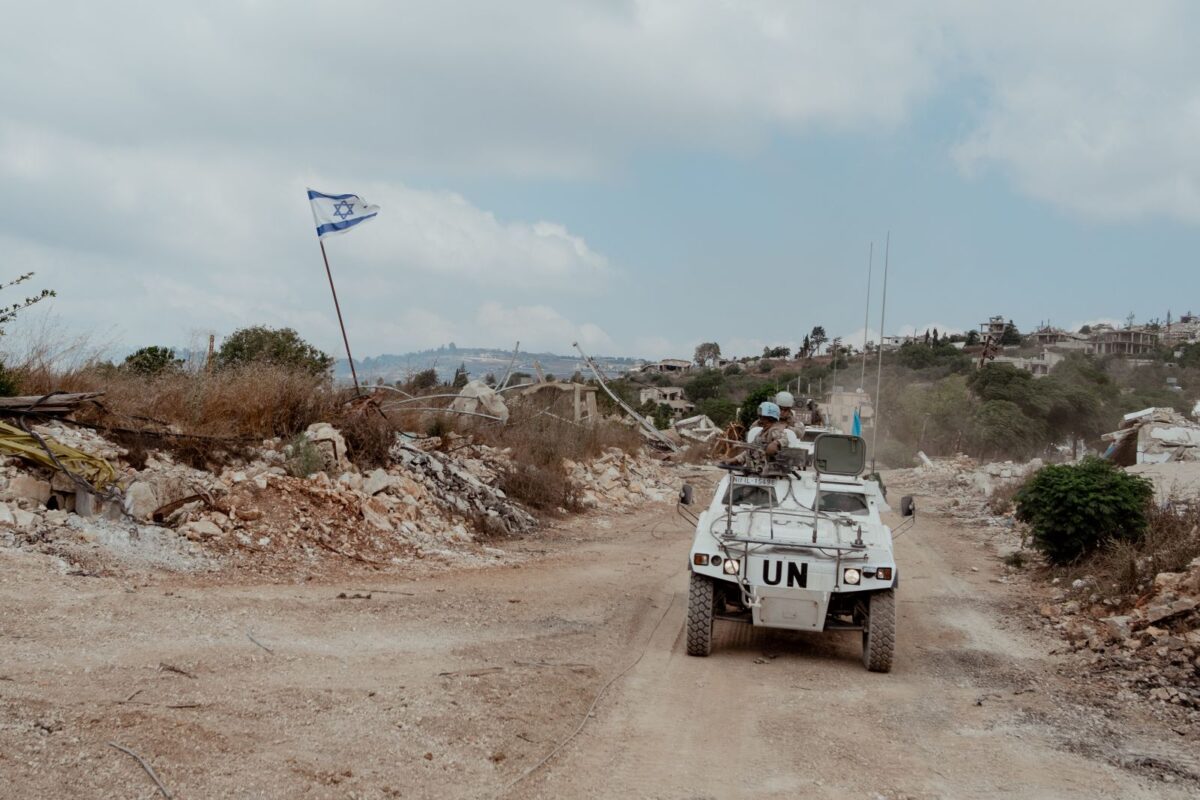
Lebanon, Houla, July 9 2026, A French UNIFIL vehicle drives past an Israeli flag fluttering by the roadside during a patrol on the road to Houla, south of the “Yellow Line”, a buffer zone established by Israel in southern Lebanon. Photograph taken while embedded with the UNIFIL. Photograph by Alexandra Henry / Hans Lucas.
How buffer zones erode sovereign states, strain Israel’s economy, and fuel the next generation of armed militancy
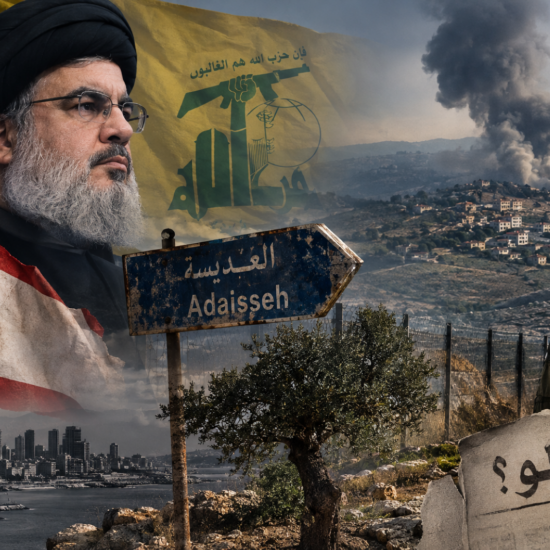
Three years after the October 7, 2023 attack, Israel’s political and military establishment appears to have settled on a familiar, reactive strategy: fleeing back to geography. Facing the collapse of past high-tech containment concepts, Israel has re-embraced buffer zones and scorched-earth perimeter security as a permanent defense doctrine—carving out flattened security belts inside Gaza, enforcing an arbitrary military exclusion zone in Southern Lebanon, and pushing deeper into Syrian territory.
This approach rests on a mechanical premise: the larger the wasteland surrounding Israel’s borders, the safer its communities will be. This territorial mindset has found political cover in Washington, echoing Donald Trump’s infamous assertion that Israel’s territory is “too small compared to the Middle East” and should be expanded. Yet, as Israel redraws boundary lines with bulldozers and artillery, a critical question must be asked: Does capturing buffer zones deliver genuine long-term security, or does it lay the groundwork for an even more explosive regional conflict?
Displacing Communities, Fueling Militancy
The engineering of buffer zones ignores a fundamental lesson of Middle Eastern conflicts: emptied geography never stays empty. Scorched earth creates the ideal breeding ground for radicalization.
When military forces demolish border villages, clear agricultural land, and forcibly displace populations to establish a “security belt,” they do not dismantle the infrastructure of armed groups—they re-energize it. Displacing thousands of families and destroying local economies severs the ties that bind border communities to peace and stability. For younger generations stripped of their homes and livelihoods, joining armed groups becomes the default—and often sole—path to resisting occupation and restoring dignity. Far from neutralizing non-state actors in Gaza or Southern Lebanon, buffer zones grant them a renewed mandate and a steady supply of recruits.
Undermining the Sovereign State
For regional stability, a functional, sovereign nation-state in neighboring countries remains the ultimate safeguard. Israel’s unilateral enforcement of exclusion zones—in direct breach of international frameworks like UN Security Council Resolution 1701—directly undermines and delegitimizes the very state institutions capable of maintaining order.
When an occupying power unilaterally alters borders and enforces exclusion zones, it cripples the capacity of national governments and state armies to exercise authority over their own territory. This dynamic creates a dangerous power vacuum. Historically, such vacuums are never filled by moderate political movements or weak state institutions; they are inevitably exploited by non-state actors and armed militias seeking to expand their influence. By weakening neighboring states, Israel inadvertently destroys the only viable partners for long-term regional security.
The Unsustainable Economic Burden
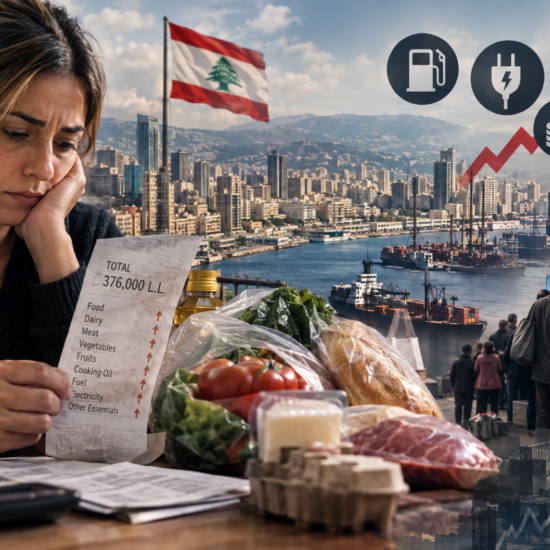
Beyond the human and strategic costs, maintaining permanent buffers imposes a staggering financial and macroeconomic toll on Israel itself. Holding perimeter zones in Gaza, Lebanon, and Syria transforms temporary wartime deployments into a structural, endless drain on national resources.
Static military positions inside hostile buffer zones require constant troop rotations, fortified outposts, continuous drone and artillery surveillance, and heavy armor patrols. Operational estimates indicate that maintaining garrison forces across these newly created perimeter zones requires the sustained mobilization of tens of thousands of reservists—at a time when defense budgets have ballooned into record-high territory. The broader economic fallout is severe: protracted reserve duty pulls high-productivity workers out of Israel’s tech and civilian sectors, while soaring defense expenditures force sharp trade-offs in public health, education, and infrastructure. Rather than providing a low-cost security blanket, buffer zones lock Israel into a costly war of attrition that bleeds its economy over time.
Tactical Gains vs. Strategic Vulnerability
In the short term, buffer zones provide Israel with immediate tactical advantages—reducing direct line-of-sight anti-tank fire and keeping small-arms threats at a distance. Converting these emergency measures into a permanent defense posture, however, traps Israel in a cycle of perpetual confrontation.
Surrounding a country with rings of destruction guarantees continuous low-intensity warfare. A buffer zone does not deter a determined insurgency; it simply alters its tactics, turning the border into a permanent zone of attrition. No amount of aerial surveillance, artillery coverage, or ground incursions can compensate for the absence of a stable, political arrangement grounded in mutual recognition of sovereignty.
The Illusion of Safety
Israel’s reliance on buffer zones represents a flawed reading of regional dynamics. True security cannot be built on erased villages, displaced populations, weakened neighbors, or strained domestic economies. By dismantling the sovereignty of surrounding states and displacing their people, Israel is not insulating itself from threat—it is cultivating the next generation of armed resistance while entrenching its own strategic isolation.
Ibrahim Rihan is a Lebanese journalist and writer focusing on Arab and international affairs. He is particularly interested in U.S., Saudi, and Egyptian policies in the Middle East.
The views in this story reflect those of the author alone and do not necessarily reflect the beliefs of NOW.