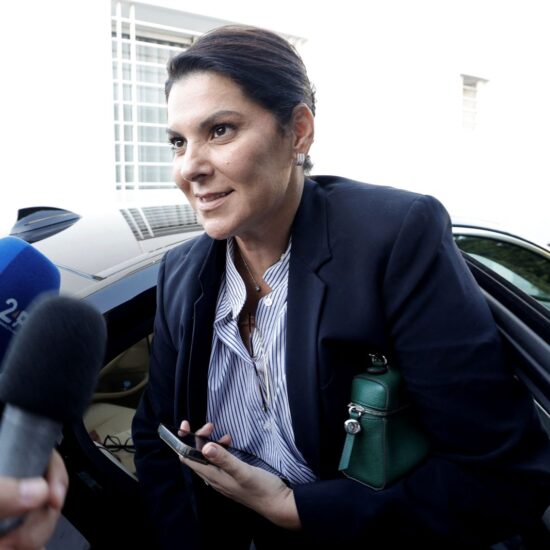
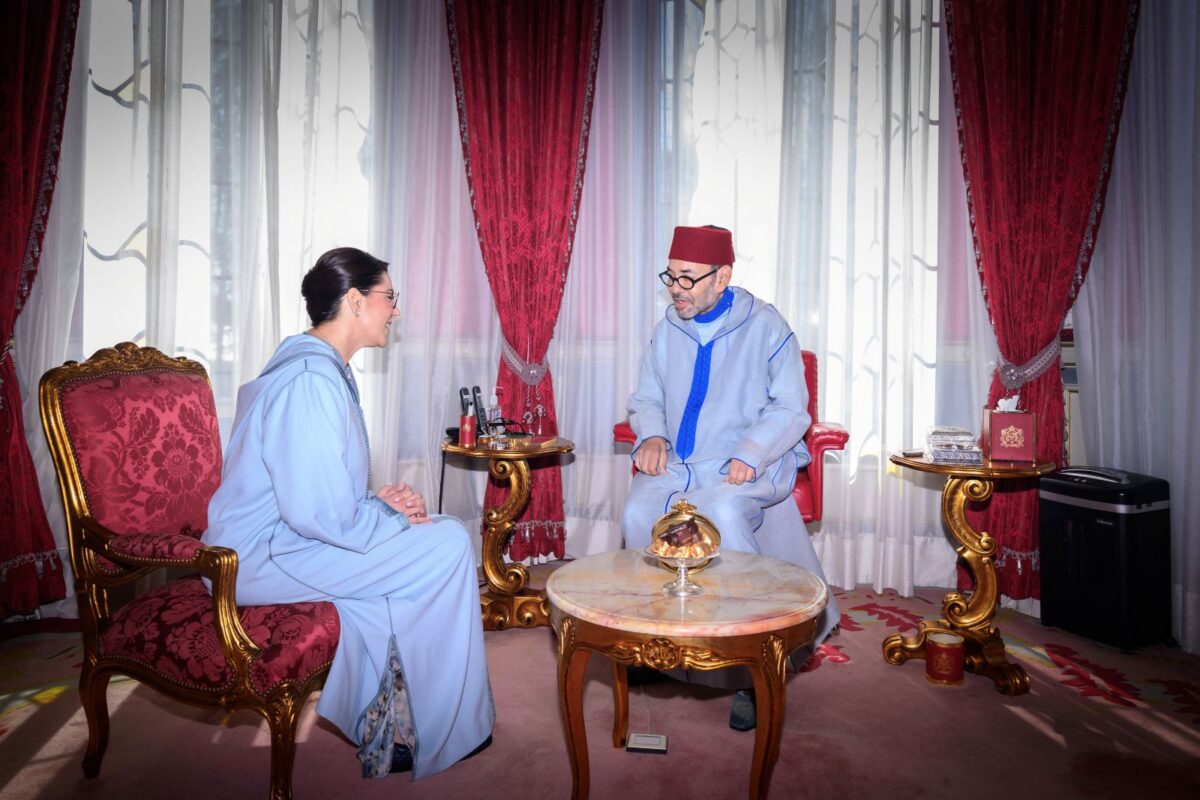
Photo by DRISS BEN MALEK / MAP / AFP. This handout photograph provided by the Moroccan Maghreb Arabe Presse (MAP) news agency shows Morocco's King Mohammed VI (R) sitting next to Fatima Ezzahra El Mansouri during a meeting at which he appointed her head of government in Rabat on September 29, 2026.
The most revealing message of Morocco’s parliamentary elections came from the south. While party leaders counted seats and weighed the possibilities of coalition government, voters in the Saharan provinces offered a reminder that the strength of a state depends on the relationship it builds with those living furthest from its capital.
The Authenticity and Modernity Party emerged with 97 of parliament’s 395 seats. Yet beyond this victory lay a striking contrast. National turnout fell to 38.08 percent, while participation reached 77 percent in Laayoune–Sakia El Hamra, 61 percent in Dakhla–Oued Eddahab and 53.48 percent in Guelmim–Oued Noun.
These figures deserve more serious consideration than the predictable language of electoral celebration. They suggest a considerable willingness among southern voters to pursue their interests through Moroccan institutions. In a region so often reduced to a territorial dispute, the act of voting brings the discussion back to the people who live there, the choices they make and the future they expect their government to provide.
For these citizens, political belonging carries practical demands. A representative must answer for the condition of a road, the absence of a hospital or the young graduate who cannot find work. Participation gives those demands an institutional address. It also places an obligation on the state: citizens who invest their confidence in its institutions are entitled to expect something in return.
The significance of the southern vote did not escape international observers. The International Republican Institute dispatched a delegation co-led by former US Assistant Secretary of State for Near Eastern Affairs David Schenker and IRI board member Tami Longaberger, with its assessment focused on the southern provinces, including Laayoune and Dakhla.
IRI is an independent organization, and its mission does not speak for the American government. Nevertheless, the choice of geography and leadership carries an unmistakable political resonance. Schenker served in the administration that recognized Moroccan sovereignty over Western Sahara in 2020 and visited Dakhla shortly after that decision. His return in an electoral observation role invites a broader discussion about what recognition should mean in practice.
For Washington, there is an opportunity to give its diplomatic position greater substance through support for accountable institutions, productive investment and economic opportunity. Recognition should open doors. Its value grows when the people concerned can trace a connection between a decision taken in a distant capital and an improvement in their own lives.
The greater responsibility, however, remains with Rabat.
Morocco’s most persuasive argument in its south will be the quality of citizenship it offers. A Sahrawi who elects a representative, challenges a policy or demands better public services is participating in the life of the state. That relationship becomes durable when the citizen knows that participation can produce results.
Morocco’s most persuasive argument in its south will be the quality of citizenship it offers. A Sahrawi who elects a representative, challenges a policy or demands better public services is participating in the life of the state. That relationship becomes durable when the citizen knows that participation can produce results.
The task is therefore to ensure that distance from the capital does not become distance from opportunity. The people of the south must have a meaningful share in national wealth and a voice in the decisions shaping their communities. Belonging deepens when citizens can recognize their own ambitions in the future their country is building.
This gives development in the southern provinces a significance that exceeds its financial cost. Launched in 2015, the region’s development model has been assigned 87.5 billion Moroccan dirhams, supporting infrastructure, economic activity and human development. The wider transformation includes the Tiznit–Dakhla expressway, Dakhla Atlantic Port, desalination facilities, industrial zones and renewable energy projects.
Such investments give sovereignty a material presence. A port connecting Dakhla to African and international markets expands the possibilities available to its residents. A road linking the south to the rest of the kingdom brings markets, services and communities closer together. Over time, these connections can narrow the political and psychological distance between the periphery and the center.
Their success, however, must be measured in the lives built around them. Infrastructure acquires lasting value when it sustains local businesses, creates stable employment and improves access to education and healthcare. Residents should help shape this development and participate in its management. Young people and women, in particular, deserve a place in the decisions determining the economy they will inherit.
King Mohammed VI’s appointment of Fatima Zahra El Mansouri as Morocco’s first woman prime minister subsequently brought that participation to the leadership of government.
Women’s political participation gave these elections another important dimension. Some 2,659 women stood as candidates, representing approximately 37 percent of the total. King Mohammed VI’s appointment of Fatima Zahra El Mansouri as Morocco’s first woman prime minister subsequently brought that participation to the leadership of government.
The appointment marks a substantial moment in Morocco’s political development. It lends weight to the argument that gradual reform can produce meaningful change through existing institutions, while preserving the continuity on which effective government depends.
Mansouri now faces the more demanding work of giving that achievement a life beyond the ceremony of appointment. Her government will have to demonstrate that representation at the highest level can translate into greater opportunity throughout society. Its performance will be judged by the quality of public services, its response to inequality and its ability to bring neglected communities more fully into national life.
Morocco’s resources are finite, and its social and regional disparities remain real. The low national turnout should temper any temptation toward self-congratulation. Strong participation in the south cannot absolve political leaders of the need to understand why so many citizens elsewhere stayed away.
The gradual reform and investment pursued under Mohammed VI offer a foundation on which to build. Their promise now depends on a government willing to listen, capable of delivering and prepared to account for its failures. Institutional confidence must be earned repeatedly, through the ordinary encounters between citizens and the state.
The gradual reform and investment pursued under Mohammed VI offer a foundation on which to build. Their promise now depends on a government willing to listen, capable of delivering and prepared to account for its failures. Institutional confidence must be earned repeatedly, through the ordinary encounters between citizens and the state.
The southern vote should therefore be understood as both an affirmation and a demand. Its message to Rabat is clear: belonging to Morocco must mean sharing fully in Morocco’s future. For Washington, it offers an opportunity to turn diplomatic recognition into a more enduring partnership with the people whose future that recognition concerns.
The south has cast its ballots. The responsibility to answer now rests with the state.
This article originally appeared in Elaph.
Makram Rabah is the managing editor at Now Lebanon and an Assistant Professor at the American University of Beirut, Department of History. His book Conflict on Mount Lebanon: The Druze, the Maronites and Collective Memory (Edinburgh University Press) covers collective identities and the Lebanese Civil War. He tweets at @makramrabah