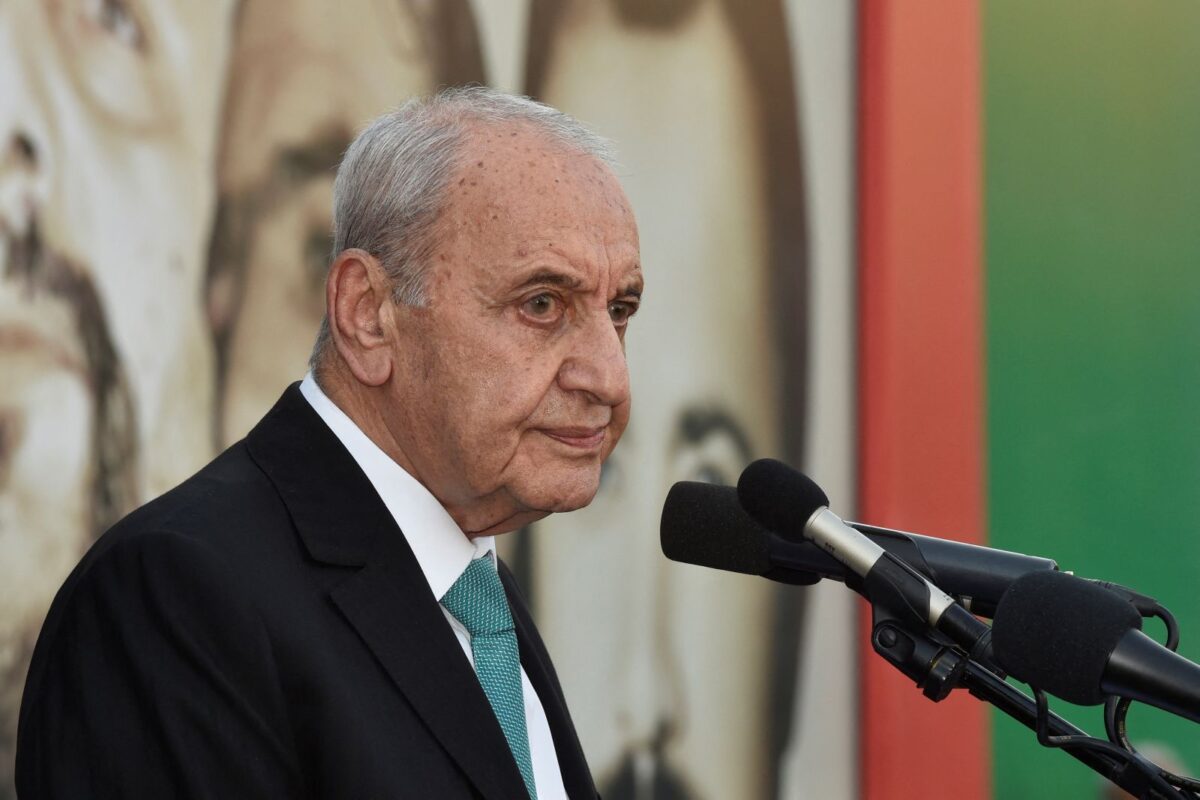
Nabih Berri, Lebanon's Parliament Speaker and leader of the Shiite Amal movement, addresses supporters in Beirut on August 31, 2023 commemorating the anniversary of Imam Musa al-Sadr's disappearance.
On the forty-eighth anniversary of Imam Musa al-Sadr’s abrupt vanishing, Nabih Berri reminded the Lebanese that the revered cleric remains missing. He neglected to mention that the Lebanese state has also been made to vanish—and that he is among the longest-serving custodians of its erasure.
Berri began his speech by honoring the dead, the displaced and the villages destroyed by war. He then declared that “nothing is more precious than Lebanon.” These are moving words, especially from a man who has occupied the heart of power for more than four decades, served as speaker of parliament since 1992, and participated in virtually every bargain, quota arrangement, institutional paralysis and political failure that brought Lebanon to ruin.
If Lebanon has been lost, Berri is not merely a witness to the crime. He is one of the longest-standing figures at the scene.
If Lebanon has been lost, Berri is not merely a witness to the crime. He is one of the longest-standing figures at the scene.
Berri declared that civil peace, national unity and the Lebanese Armed Forces were “red lines.” Yet the only truly untouchable red line within the system he helped construct has always been Hezbollah’s weapons. The army was prevented from challenging them, the state from scrutinizing them, and the Lebanese from questioning their cost without being accused of treason or collaboration with Israel.
He then made a remarkable discovery: “The responsibility for protecting and defending the south belongs to the state and its military, security and constitutional institutions.”
Excellent. But where was this conviction when the south—its security, its inhabitants and the decisions of war and peace—was surrendered to Hezbollah and Iran’s Islamic Revolutionary Guard Corps? Where was the state when villages were turned into military zones and their residents made human shields for a project designed in Tehran and executed by its Lebanese proxy?
Berri cannot demand that the state assume responsibility today after spending decades denying it the instruments needed to do so. Nor can he invoke the army after helping protect a formula that allowed an ideological parallel army to become more powerful than the legitimate one.
The state is not an insurance company to be summoned after the fire while those who lit it retain the exclusive right to play with matches.
The state is not an insurance company to be summoned after the fire while those who lit it retain the exclusive right to play with matches.
Berri also claimed that Israel’s real target was “neither Hezbollah nor its weapons,” but Lebanon and domestic strife. Here he returned to the oldest trick in the political handbook: absolve the Iranian-backed arsenal of responsibility and portray every discussion of it as a conspiracy against Lebanon’s Shiite community.
As if Lebanese Shiites cannot live without the IRGC’s rockets. As if their dignity depends on Lebanon remaining an arena in which Iran negotiates with the world using Lebanese blood and territory.
In fact, the most dangerous form of sectarian incitement is reducing an entire community to an armed organization and tying its security and future to a foreign project. And the greatest insult to Musa al-Sadr is to use his memory to legitimize a political and military system that contradicts his vision of citizenship, coexistence and the state.
Berri criticized direct negotiations with Israel and asked what seven rounds of talks had achieved. But he did not ask what four decades of “resistance” had produced. How many villages were destroyed? How many Lebanese were displaced? How many times was Lebanon used to improve Iran’s negotiating position?
In the accounting system of Berri’s political order, negotiations are judged after seven meetings. The weapons are never judged—even after seven wars.
In the accounting system of Berri’s political order, negotiations are judged after seven meetings. The weapons are never judged—even after seven wars.
His defense of the Taif Agreement was equally selective. He embraces the provisions that protect his position while ignoring those requiring the restoration of state authority and the disbandment of militias. For Berri, Taif is less a national compact than an à la carte menu: he chooses what suits the table and leaves the rest untouched.
Nabih Berri is not an opposition leader describing destruction caused by others. He is a central pillar of the deep state that enabled Iranian influence, protected Hezbollah’s autonomy and paralyzed institutions whenever they threatened the interests of the armed political duopoly.
After forty-eight years, the question is no longer only: Who was responsible for Imam Musa al-Sadr’s abrupt vanishing?
It is also: Who erased his political legacy, ruled in his name and surrendered the state he envisioned to the Islamic Revolutionary Guard Corps?
Imam Musa al-Sadr is a national trust. But so is Lebanon—and Nabih Berri did not preserve it.
Makram Rabah is the managing editor at Now Lebanon and an Assistant Professor at the American University of Beirut, Department of History. His book Conflict on Mount Lebanon: The Druze, the Maronites and Collective Memory (Edinburgh University Press) covers collective identities and the Lebanese Civil War. He tweets at @makramrabah