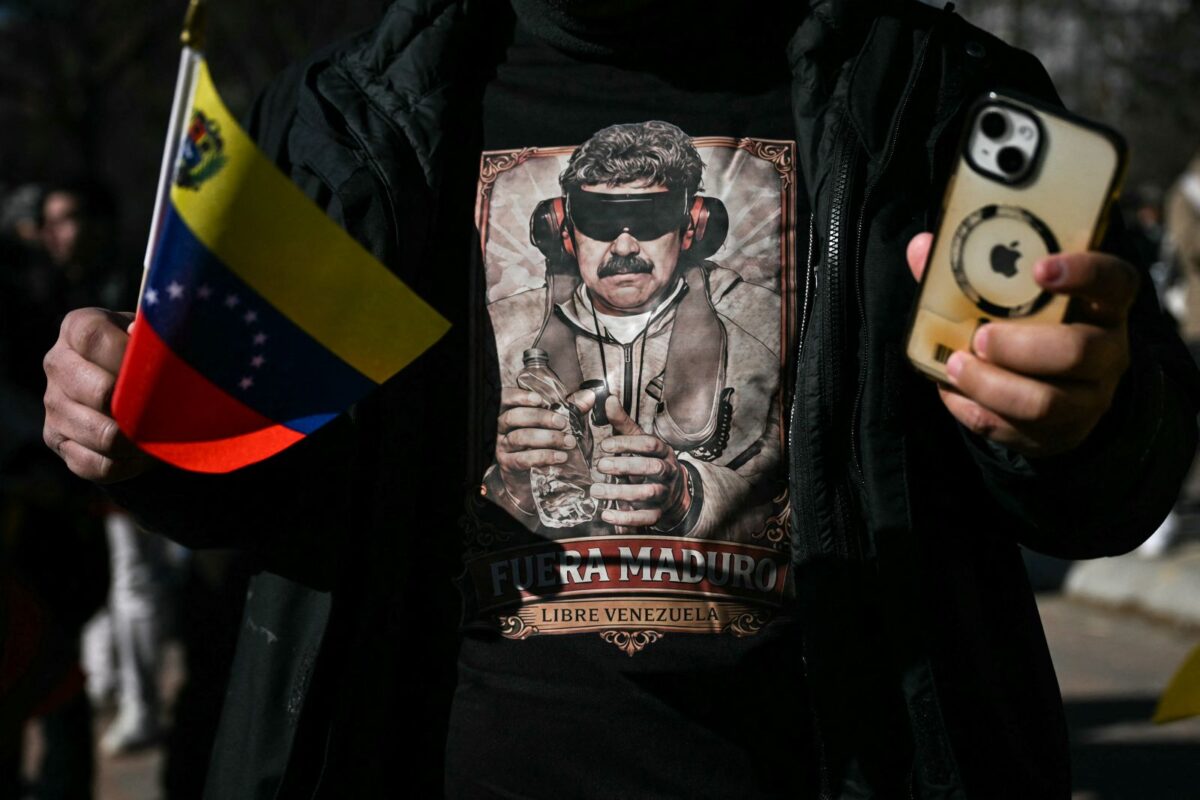
A mean wears a shirt with an image of deposed Venezuelan president Nicolas Maduro as supporters of Venezuela gather outside the White House ahead of the meeting between US President Donald Trump Venezuelan opposition leader Maria Corina Machado in Washington, DC on January 15, 2026. (Photo by Brendan SMIALOWSKI / AFP)
An Early Obituary for the Era of Collective Action
Bloomberg reported late last week that Venezuela is considering leaving the Organization of the Petroleum Exporting Countries (OPEC). For oil-market analysts, the story may not seem particularly important. After all, Venezuela long ago lost its status as a major oil producer and exporter. This stands in sharp contrast to 1929, when it was the world’s largest oil exporter and the second-largest producer, behind only the United States.
A century later, the picture could hardly be more different. Decades of nationalization, policy reversals, underinvestment, and mismanagement, followed by US sanctions, hollowed out an industry that once sat at the center of the global oil market. Venezuela pumped about 1.16 million barrels a day in July, according to a Bloomberg survey, less than half of what it produced a decade ago and a little over 1% of world output. In purely market terms, Venezuela leaving OPEC would hardly be breaking news.
Venezuela may no longer matter to OPEC as much as it once did. But OPEC matters enormously to Venezuela’s story.
Venezuela may no longer matter to OPEC as much as it once did. But OPEC matters enormously to Venezuela’s story.
The symbolism, however, is worth considering. Venezuela is not simply another OPEC member. It is one of the countries without which OPEC might never have existed. Juan Pablo Perez Alfonzo, Venezuela’s oil minister, was one of the organization’s principal architects. For years, Perez Alfonzo had argued that oil-producing countries shared a common interest in countering the international companies that dominated the industry. In Cairo in 1959, he met with Saudi Arabia’s oil minister, Abdullah al-Tariki, and representatives from Iran, Iraq, and Kuwait. OPEC was officially established in Baghdad in September 1960.
An extraordinary irony followed. The man who had helped organize oil-producing countries to retain more of the revenues flowing to Western companies became a critic of how oil wealth was affecting his own country. After the oil-price boom of the 1970s, Perez Alfonzo watched revenues flood into Venezuela and grew increasingly convinced that oil wealth was not building the country but deforming it. He said the line that many still quote: “Ten years from now, twenty years from now, you will see, oil will bring us ruin… It is the devil’s excrement.”
What Perez Alfonzo had captured intuitively would later be formalized by economists through several related theories, perhaps most famously Dutch disease. Large, sudden inflows of resource revenues can appreciate the real exchange rate, weaken the competitiveness of non-resource tradable sectors, distort the allocation of capital and labor, and increase the economy’s exposure to oil price fluctuations. In the broader literature on the resource curse, the concern extends beyond macroeconomic effects to how resource rents can shape fiscal policy, institutional incentives, state capacity, and the structure of political competition in less diversified economies.
Before 1960, a handful of Western companies set the price of Arab and Venezuelan crude. They discovered, extracted, refined, and shipped the oil, and controlled much of the supply chain. The instrument that made this possible was the concession: foreign companies received extensive exploration and production rights, while countries collected royalties, taxes, and, in some cases, a share of the profits. One of the most often-told stories was the Iranian parliament’s 1951 nationalization of the Anglo-Iranian Oil Company and, two years later, the CIA and MI6’s removal of Prime Minister Mohammad Mossadegh in August 1953 through Operation Ajax. Oil-rich countries took away the lesson that collective action could help avoid a repeat of Iran’s situation.
Nationalization of oil companies proved to be one of the largest state-building events most of these countries experienced in the twentieth century. But how much OPEC contributed to this state-building process is difficult to assess.
What is certain is that one cannot analyze OPEC’s influence without considering the entire second half of the 20th century and the impact of coups d’etat in the Global South, the rise of authoritarian leaders, the concept of revolution from above, the anti-colonial movement, and self-determination. At the same time, OPEC’s rise coincided with other events, including the oil shocks of the 1970s, when oil prices quadrupled from about $3 a barrel to $11; President Richard Nixon’s decision to end the gold standard; and the phenomenon of cost-push inflation. Jeff Colgan found that between 1982 and 2009, OPEC as a whole produced above its quotas 96 percent of the time, while changes in quotas explained very little of the month-to-month variation in actual production.
Political Science theory has examined this through rentier state theory. Hossein Mahdavy, and later Hazem Beblawi and Giacomo Luciani, argued that a state that derives a large share of its income from external rents and allocates them operates differently from one whose revenues depend on taxing its citizens. Variants of this theory later emerged, including my own work on Syria under Hafez and Bashar al-Assad, in which strategic rents, remittances, and financial inflows reproduced some of the political-economic effects associated with hydrocarbon rentierism. This is also where OPEC’s real achievement lies. The great political-economic transformation of the 1970s was not simply the transfer of income from consumers to producers. It was also the transfer of control over petroleum rents from international companies to producer states. OPEC’s most durable achievement may therefore have been less its ability to administer the price of oil than its role in changing who captured the rent.
OPEC’s most durable achievement may have been less about its ability to set the price of oil than about its role in changing who captured the rent.
OPEC’s most durable achievement may have been less about its ability to set the price of oil than about its role in changing who captured the rent.
OPEC and the incentive of cheating
Open any economics textbook, and OPEC appears in the oligopoly chapter as the classic example of an explicit cartel: few producers, a homogeneous good, and an agreed quota. However, cartels always have a structural flaw: each member privately gains by producing above its share while others hold back. This incentive to cheat makes cartels unstable.
This image is even embedded in streaming platforms. In Netflix’s Narcos-Mexico series, Miguel Angel Felix Gallardo explains his plan to unify Mexico’s fragmented drug traffickers into a federation: coordinate production and distribution, dominate the market, and set a common price. One of the men listening immediately recognizes the model: “OPEC for weed.”
However, after the series ended, we learned what happened. Cartel members attempted to cheat, and the narco wars ended in bloodshed.
The rentier lens explains why cheating was never simply a matter of discipline. Quota compliance requires an oil-dependent government to forgo revenue today in exchange for the collective benefit of supporting prices. For governments facing immediate fiscal pressures, the incentive to produce above quota is obvious. The fiscal reality compels the minister to pump.
Another Venezuelan linked to OPEC, Ilich Ramirez Sanchez, is known worldwide as Carlos the Jackal. On December 21, 1975, six gunmen walked into OPEC’s headquarters on Vienna’s Ringstrasse during a ministerial meeting, killed three people, and took 62 people hostage, including eleven oil ministers. Venezuela gave OPEC one of its founders and its most famous assailant, and ironically, the latter is better known.
Quota compliance requires an oil-dependent government to forgo revenue today in exchange for the collective benefit of supporting prices.
Quota compliance requires an oil-dependent government to forgo revenue today in exchange for the collective benefit of supporting prices.
The supply side
Cartels operate on the premise that producers should act collectively. But they are not the only producers, and this is the problem OPEC never solved. Periods of successful price discipline also helped finance OPEC’s own competition. High prices in the 1970s made North Sea and Alaskan production economically viable. High prices in the 2000s did the same for American shale, which did more damage to OPEC’s position than any internal defection because it created a fast, price-responsive supply that answered to no one. OPEC broadened its coordination in 2016 through what became OPEC+, bringing in Russia and other producers, but the rest of the world stayed outside the club. The offshore wave is more recent. Guyana has gone from nothing to a significant exporter in under a decade; Brazil’s pre-salt fields keep expanding; Argentina’s Vaca Muerta is scaling; and Washington is opening federal lands and offshore waters to drilling.
Periods of successful price discipline also helped finance OPEC’s own competition.
This is how price wars should be understood, in 2020 and before. They are fights over market share, not merely policy failures. In an illicit cartel, that fight produces dead bodies. In oil, it produces fiscal crises, inflation, and abandoned infrastructure projects.
Periods of successful price discipline also helped finance OPEC’s own competition.
The demand side
The Iran war and the closure of Hormuz were a genuine surprise, and it was not on the supply side. After six months of war and a closed strait, Brent traded below the $150-$200 levels that some analysts feared in the first few days of the conflict. This produced a wave of theories that oil demand is more elastic than previously assumed.
One explanation lies in Beijing. Chinese crude imports fell from a record 13.18 million barrels a day in December to about 7.12 million in June, a roughly 46% decline. Yet China absorbed the shock without the severe economic disruption such a drop might once have implied.
It is still too early to know what these shifts mean for long-term oil supply and demand. China may eventually return to the market more aggressively to rebuild inventories. Climate change may also put upward pressure on oil demand, as higher temperatures increase cooling needs and water scarcity raises demand for energy-intensive desalination, particularly in economies where power generation still relies on oil products. On the supply side, new production from the Americas is giving consumers alternatives that were not available during earlier oil shocks.
The Iran war has also exposed a change on the demand side: consumers, particularly China, appear better able to adjust to severe disruptions in oil supply than they were during earlier oil shocks.
The Iran war has also exposed a change on the demand side: consumers, particularly China, appear better able to adjust to severe disruptions in oil supply than they were during earlier oil shocks.
Not Quite Goodbye
If Venezuela leaves OPEC, it will not be the first. Ecuador, Qatar, Angola, and the UAE made the same decision before. It certainly will not be the last. A couple of months ago, Iraqi officials warned that the country could consider leaving OPEC if it is not granted a significantly higher production quota. At the same time, a reformed or politically transformed Iranian regime seeking to finance recovery and reconstruction would have a strong incentive to increase exports and to demand a higher production quota.
More broadly, Venezuela’s possible exit would fit a broader retreat from the era of collective action that shaped much of the post-World War II period. That era produced the Bretton Woods institutions, multiple UN agencies, OPEC, the African Union, and other regional organizations. Today, economic relations are increasingly organized around bilateral deals, strategic control of resources, and a resurgence of mercantilism.
Viewed in that light, Venezuela’s possible exit from OPEC is more than a simple dispute over quotas or production. The same country that helped create OPEC to counter the influence of foreign companies is now considering leaving it while negotiating new long-term concessions with those same foreign interests. In 1960, Venezuela looked to collective action to gain leverage; in 2026, it is seeking new concessions. That, perhaps more than Venezuela’s departure from OPEC itself, tells us something about the world we live in.
Venezuela’s possible exit would fit a broader retreat from the era of collective action that shaped much of the post-World War II period, as economic relations become increasingly organized around bilateral deals, strategic control of resources, and a renewed mercantilism.
Venezuela’s possible exit would fit a broader retreat from the era of collective action that shaped much of the post-World War II period, as economic relations become increasingly organized around bilateral deals, strategic control of resources, and a renewed mercantilism.
Khalil Gebara is an academic and researcher.
The views in this story reflect those of the author alone and do not necessarily reflect the beliefs of NOW.