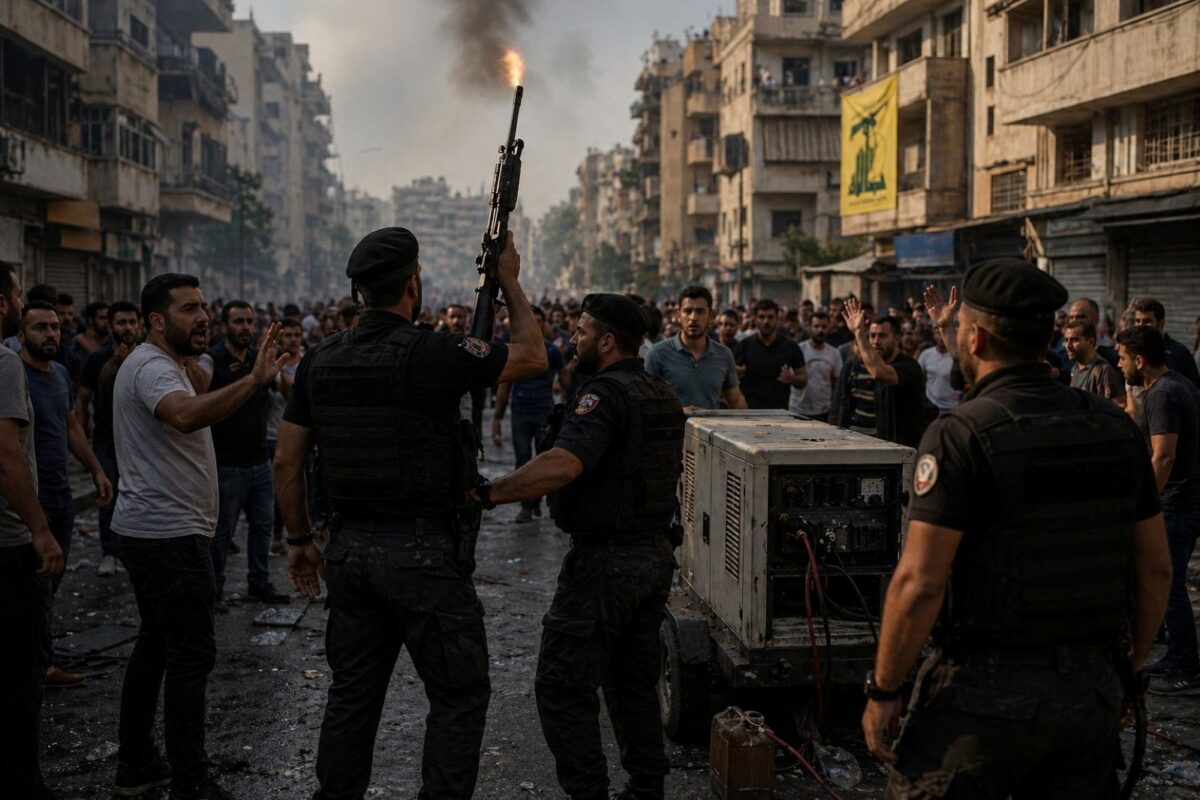
The incident in Beirut’s Saqiet el-Janzir on Saturday has shocked Lebanon’s capital, as it went beyond a routine case of security overreach. A group within State Security acted against civilians without a legal basis — risking increased sectarian tensions during a period already characterized by instability.
A State Security unit pressured a private generator owner to lower electricity prices for Shiite residents displaced by the war. The owner, a Sunni from a well-known Beirut family, refused, citing fuel costs. The situation escalated into gunfire in the air, minor injuries, and panic.
According to Lebanese media reports, the state security officials received instructions to arrest generator and supermarket operators who had allegedly increased the prices disproportionately.
The Future Movement’s Secretary General Ahmad Hariri, doubted whether “certain elements within the security services have turned into a militia and decided to play with the fire of tensions”. Another lawmaker, Ibrahim Mneimneh, suggested that the incident underlined that some are questioning the monopolisation of weapons.
Lebanon’s Prime Minister Nawaf Salam acted immediately. He gave “strict orders to open an immediate investigation” into the incident and the perpetrators of the attack. According to Salam “acts of violence by security agents against civilians, and firing into the air to frighten residents, are unacceptable behavior regardless of the reasons.”
The incident begs the question whether authority was used to provoke tension. Instead of applying general regulation, specific individuals were targeted, without legal basis. Intimidation was used in mixed neighborhoods.
These actions suggest misuse of security power for political purposes rather than public order — while suggesting that Hezbollah retains influence inside the State Security apparatus.
In Lebanon
Accusations of ceasefire violations from Hezbollah and the IDF: The Israeli military and Hezbollah accuse each other of breaching the ceasefire, as southern Lebanon witnesses heavy fighting between the two sides. On Saturday, Israeli Prime Minister Benjamin Netanyahu ordered his military to “respond forcefully” against Hezbollah strikes — accusing the militia of violating the truce. According to Israeli media, Netanyahu claimed Israel’s continuous military action is legitimate, citing its right to respond to imminent attacks. The Iranian-backed militia rejected Israel’s claim, instead accusing Israel of breaching the truce. Hezbollah also said Israel’s attacks “will be met with a response” to defend Lebanon.
Israel’s attacks on southern Lebanon: On Monday morning, Israel’s military continued attacking southern Lebanon, including the area of Bint Jbeil. Three members of a family were killed by an Israeli attack on Sunday in the same area. Over the weekend, residents of several villages near Nabatieh had to leave their homes, after Israel issued evacuation orders.
Fighting around Marjayoun: A Hezbollah drone killed an Israeli soldier and wounded six more on Sunday. The militia also said it hit an Israeli Merkava tank in Marjayoun. Israel told the Jdeidet Marjayoun municipality to evacuate its displaced people — otherwise the entire town would have to leave their homes.
Israel continues flattening villages in southern Lebanon along the border. The IDF wants to establish a buffer zone south of Israel’s self-declared yellow line, which reaches up to 10 kilometers inside Lebanon. More than 50 villages fall within this destruction zone and are made uninhabitable.
Prolonged ceasefire: Last week, following a Lebanese-Israeli meeting in Washington attended by U.S. President Donald Trump, a 10-day ceasefire was extended by three weeks. But besides the short-term truce, both sides continue fighting. Today, Lebanon’s highest-ranking officials will gather to discuss the negotiations with Israel. President Joseph Aoun, Prime Minister Nawaf Salam and Parliament Speaker Nabih Berri are set to meet on Monday in the Baabda Presidential Palace to discuss how to advance the talks with the Israelis.
Macron floats conference for LAF: French President Emmanuel Macron last week said that Paris is set to host a conference in support of the Lebanese army, once Beirut is ready. The conference was planned for March, but had to be postponed due to the onset of the war.
Death toll continues to rise: According to Lebanon’s health ministry, 2,509 people have died since March 2, while 7,755 people were wounded.
In The Region
Iran and U.S. continue preparations for negotiations: According to news outlet Axios, Tehran has made an offer to Washington. Iran is willing to reopen the Strait of Hormuz, if negotiations about the country’s nuclear enrichment are pushed to a later point.
U.S. officials are set to discuss the negotiations with Trump today. In recent days, the talks between Iran and the U.S. have mostly come to a halt.
Araghchi in Moscow: On Monday, Iran’s Foreign Minister is set to discuss the U.S. negotiations with Russian President Vladimir Putin. Before traveling to Russia, Araghchi visited Islamabad — without meeting U.S. officials there. Nevertheless, his conversations there were “very good”, he said.
Trump to Iran: Call me maybe: The U.S. president told the Iranians his phone line remains open, in case Tehran wants to discuss the negotiations. However, he ruled out Iran being able to maintain its nuclear enrichment plans. “If they want to talk, they can come to us, or they can call us. You know, there is a telephone. We have nice, secure lines,” Trump told the American TV channel Fox News.
What We’re Reading
Rogue Security, Manufactured Chaos: Inside Beirut’s Latest Flashpoint. Now describes a State Security intervention in Beirut’s Saqiet el-Janzir where officers tried to force a generator owner to lower electricity tariffs for displaced Shiites without a legal procedure. The situation escalated into gunfire, panic, and minor injuries, with officers reportedly acting outside formal protocols. The article argues this was not a routine enforcement issue but a deliberate use of authority to provoke tension, reflecting a pattern of selective targeting and intimidation. The piece concludes that such incidents risk fueling sectarian strife and undermining the Lebanese state’s control over security.
Lebanon’s Hardest Question: How to disarm Hezbollah Without War? Ibrahim Rihan argues that Hezbollah’s weapons are deeply tied to identity, history, and a sense of protection, making disarmament a complex political and psychological issue. The Lebanese state must first build trust by proving it can provide security, services, and equal treatment more effectively than Hezbollah. He argues that only a slow, state-building process — supported by economic development and calmer regional conditions — can reduce reliance on weapons without risking internal conflict.
In photos: Life returns slowly to Dahieh, as ceasefire is extended further. Now’s visiting fellow Laura Hülsemann describes how life is slowly returning to Beirut’s suburb. Since the war, Israeli evacuation orders and bombing forced thousands to flee. Despite the ceasefire, fighting in the South has continued, including Israeli attacks and Hezbollah rocket fire, while Dahieh remains heavily damaged and many residents are hesitant to return.
The Sleeping Giant: How One Forgotten Paragraph Could Legally Transform Lebanon Forever. Cathryn Papadopoulo argues that United Nations Security Council Resolution 1701 contains an overlooked clause — Paragraph 12 — that allows Lebanon to request stronger international intervention to extend state authority. Current UNIFIL forces operate as observers, while a Chapter VII mandate could actively enforce peace and help disarm Hezbollah. But potential vetoes from Russia and China make invoking it difficult, leaving the decision ultimately dependent on Lebanon’s political will.