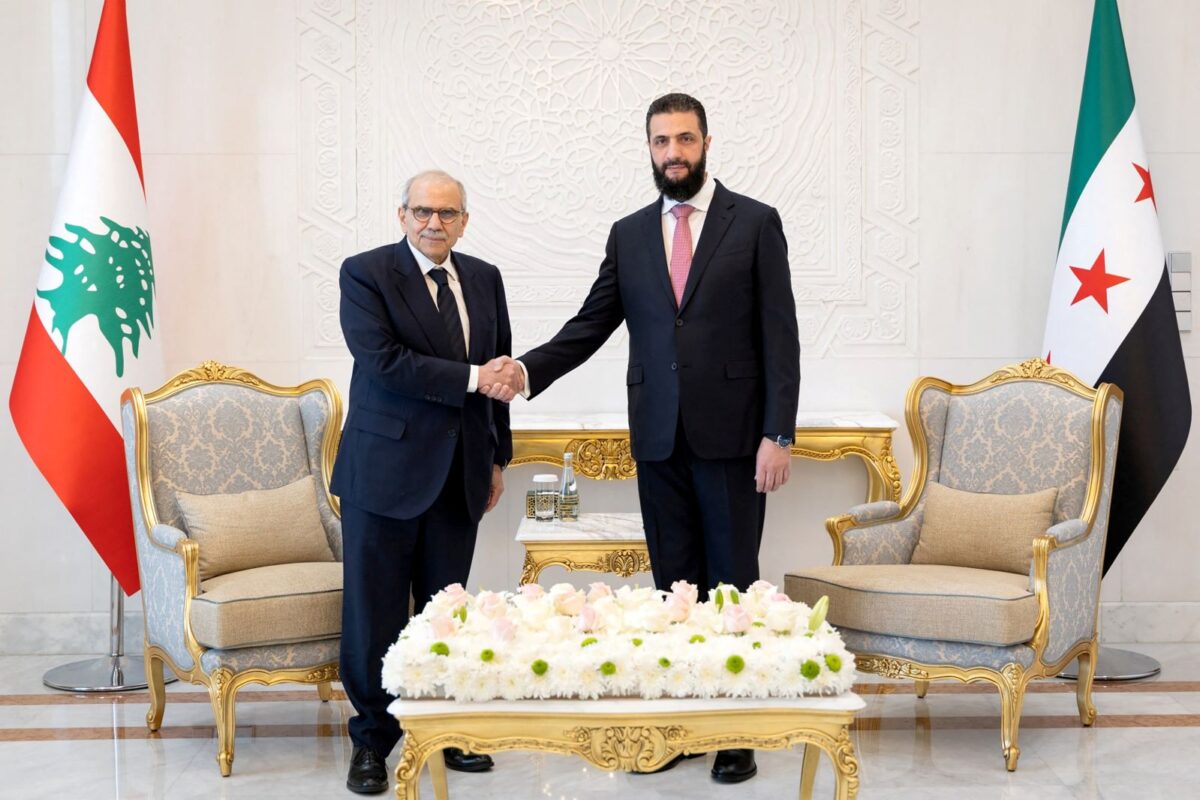
This handout photo provided by Syria's SANA news agency's Telegram channel on May 9, 2026, shows Syrian President Ahmed al-Sharaa (R) shakeshands with Lebanese Prime Minister Nawaf Salam at the People's Palace in Damascus. (Photo by SANA / AFP) /
Lebanese Prime Minister Nawaf Salam traveled to Damascus over the weekend alongside a high-level ministerial delegation, aiming to boost ties with Syria’s relatively new government. Following talks with Syrian President Ahmed al-Sharaa on Saturday, Salam said they had made “significant progress.”
Salam said the visit focused on “strengthening bilateral relations in the fields of economy, transport, and energy,” which is why the relevant ministers accompanied him. Prior to meeting President Ahmed al-Sharaa, Lebanese ministers held separate discussions with their Syrian counterparts. The visit marked Salam’s second trip to Syria since the fall of the Assad regime.
Salam also announced that a Lebanese-Syrian Business Council is expected to convene in Damascus in the coming weeks for the first time, according to Lebanese news reports. Lebanon is seeking to import electricity from Syria, and they raised the possibility of reaching an agreement on natural gas transit.
Lebanon hosts a million Syrian refugees, which it seeks to return to the war-torn country. Another issue discussed was the fate of missing persons from the Syrian civil war. At the same time, Lebanon’s prisons are currently filled with 2,000 Syrians — some of whom committed attacks against the Lebanese Army and others are affiliated with terrorism charges. Al-Sharaa is seeking their return to Syria, which is one reason Lebanon is currently debating a general amnesty law. Under this legislation, some detainees could potentially be released and transferred to Syrian custody. More than a hundred Syrians were already moved from Lebanese prisons to Syrian facilities in March.
Border security and trade were also central topics of discussion. While the border remains a key trade route that both countries aim to develop, Lebanon and Syria are also seeking to curb smuggling networks that, under Assad, served as a major illicit arms supply route for Hezbollah. Although these activities have declined, Syrian authorities have conducted several operations along the border to arrest suspects. Both the Lebanese and Syrian governments are currently opposed to Hezbollah, which has recently been accused of plotting attacks inside Syria targeting senior government officials.
Both Lebanon and Syria continue to have territory in their southern regions occupied by Israel, which has established buffer zones along its border with both countries.
In Lebanon
Lebanon-Israel talks in Washington: Lebanese and Israeli officials are set to hold discussions in Washington on Thursday and Friday. Prime Minister Nawaf Salam told Al Jazeera that Lebanon aims to reinforce the current ceasefire, secure an Israeli withdrawal from Lebanese territory, and seek the release of Lebanese detainees held in Israel.
Salam condemns Israeli occupation: The Lebanese Prime Minister stated that tensions along the border with Israel have escalated significantly during the war, with Israel now occupying 68 towns, which, he said, account for nearly half of the territory south of the Litani River. Salam added that the scale of destruction in these areas resembles that seen in Gaza. Prior to the conflict, there had been only five disputed areas under Israeli control, he said.
Saudi Arabia’s role in Israel-Lebanon relations: While the United Arab Emirates continues to deepen ties with Israel, Saudi Arabia appears more cautious about moving too closely toward normalization. According to Lebanese media reports, Riyadh is seeking to avoid internal Lebanese tensions during the Hezbollah disarmament process, particularly between Sunni and Shia communities, amid concerns that such divisions could escalate into broader regional instability.
Netanyahu hopes for collapse of Iran’s “axis of resistance”: Israeli Prime Minister Benjamin Netanyahu said he hopes Iran and its allies — including Hezbollah, Hamas, and the Houthis — will ultimately disintegrate. According to Netanyahu, Israel has already significantly weakened these groups, though they have not yet reached the point of collapse.
Israel issues further evacuation warnings: Israeli military spokesperson Avichay Adraee called on residents in southern Lebanon and the Bekaa region to evacuate to areas at least one kilometer away from several towns.
Attacks continue: According to media reports, the Israeli military carried out 42 attacks on Sunday, including 11 drone strikes and 15 bombardments. An Israeli soldier was killed in a Hezbollah drone attack on Sunday, as the militia has stepped up its drone operations against the Israeli military.
In The Region
Trump rejects Iranian proposal: After Tehran submitted its response to Washington’s proposal aimed at ending the war between the two countries, U.S. President Donald Trump dismissed the Iranian plan, calling it “totally unacceptable.” Part of the American proposal was the reopening of the Strait of Hormuz as well as a scaling back Iran’s nuclear program. Iran responded by stating that “the satisfaction of others is not important,” according to a spokesperson for the Iranian Foreign Ministry. Trump has said if negotiations fail, he is ready to resume bombing Iran.
Netanyahu seeks removal of Iran’s enriched uranium: Prior to the U.S. response to Tehran, Trump reportedly coordinated with Israeli Prime Minister Benjamin Netanyahu via phone call, according to U.S. media reports. Netanyahu also told CBS that Israel seeks the elimination of Iran’s enriched uranium stockpiles before the war concludes, indicating that soldiers might enter Iran to take the enriched uranium.
Oil prices rise amid stalled negotiations: Oil prices rose again this morning as negotiations between Washington and Tehran continued to show little progress. Tehran has blocked the Strait of Hormuz during the ongoing U.S.-Iran conflict in an effort to pressure Washington into halting its military operations.
France and the U.K. to discuss Strait of Hormuz security: The defense ministers of France and the United Kingdom are expected to meet on Tuesday to discuss measures to secure passage through the Strait of Hormuz — a critical route for global oil trade. London and Paris are also deploying naval vessels to the region, prompting Tehran to warn that such actions would provoke an immediate response.
U.S. naval presence expands in the Strait of Hormuz: Washington has deployed more than 20 naval warships to the region, where they are currently blocking Iranian vessels from passing through the coastal area.
Iraqi parliament discusses potential Israeli base in its own country: According to news reports, the Iraqi parliament will summon its Defense Minister after the Wall Street Journal reported that Israel might have built a secret base in the Iraqi desert. Allegedly, the outpost was built before the war with Iran and served for military operations during the war.
What We’re Reading
Lebanon taps veteran diplomat to lead talks with Israel amid U.S. push for broader security deal. Now examines the newly appointed role of veteran diplomat Simon Karam, who is tasked to lead the negotiation with Israel this week. On the Lebanese side, the focus has been on ending the war as well pushing for the withdrawal of the Israeli army inside Lebanon. Political goals, like normalizing ties, seem to have a lower priority, as they might cause an internal backlash given the ongoing hostilities. The discussions are seen as an early test of whether both sides, with U.S. mediation, can turn the fragile ceasefire into a longer-term border stability agreement.
Why Lebanon Matters to the United States and Why a Durable Lebanese Peace with Israel Is a Strategic Imperative. Lara Alameh argues that Lebanon is strategically important to the United States because it serves as a key battleground for countering Iranian influence in the region. With Hezbollah operating as Tehran’s proxy inside Lebanon, she contends that a durable peace agreement with Israel could strengthen Lebanese state institutions and create conditions for Hezbollah’s eventual disarmament.
The Blood and Ink of Lebanon’s Press. Now’s managing editor Makram Rabah reflects on Martyrs’ Day in Lebanon, highlighting the long history of violence and intimidation against journalists and intellectuals since Ottoman-era executions in 1916. The author argues that decades later, Lebanese journalists continue to face assassination, fear, and impunity, with figures like Gebran Tueni, Samir Kassir, and Lokman Slim cited as victims of a political culture that suppresses dissent, particularly linked to militia structures like Hezbollah. Rabah argues that meaningful commemoration requires ending impunity and applying equal justice for all perpetrators, whether internal or external, so that press freedom can be genuinely protected.
When Washington Speaks Lebanese: Can Lebanon Afford to Stop Listening? Elissa El Hachem argues that Lebanon is facing a narrowing diplomatic window with Washington, which is pushing it to engage directly in negotiations involving Israel. She frames Lebanon’s hesitation, including President Joseph Aoun’s reluctance to meet Benjamin Netanyahu, as a deeper problem of internal division and competing authorities that undermines true sovereignty. She argues that if Lebanon does not decisively act through its state institutions, it risks losing relevance and having its future decisions shaped by other external actors.