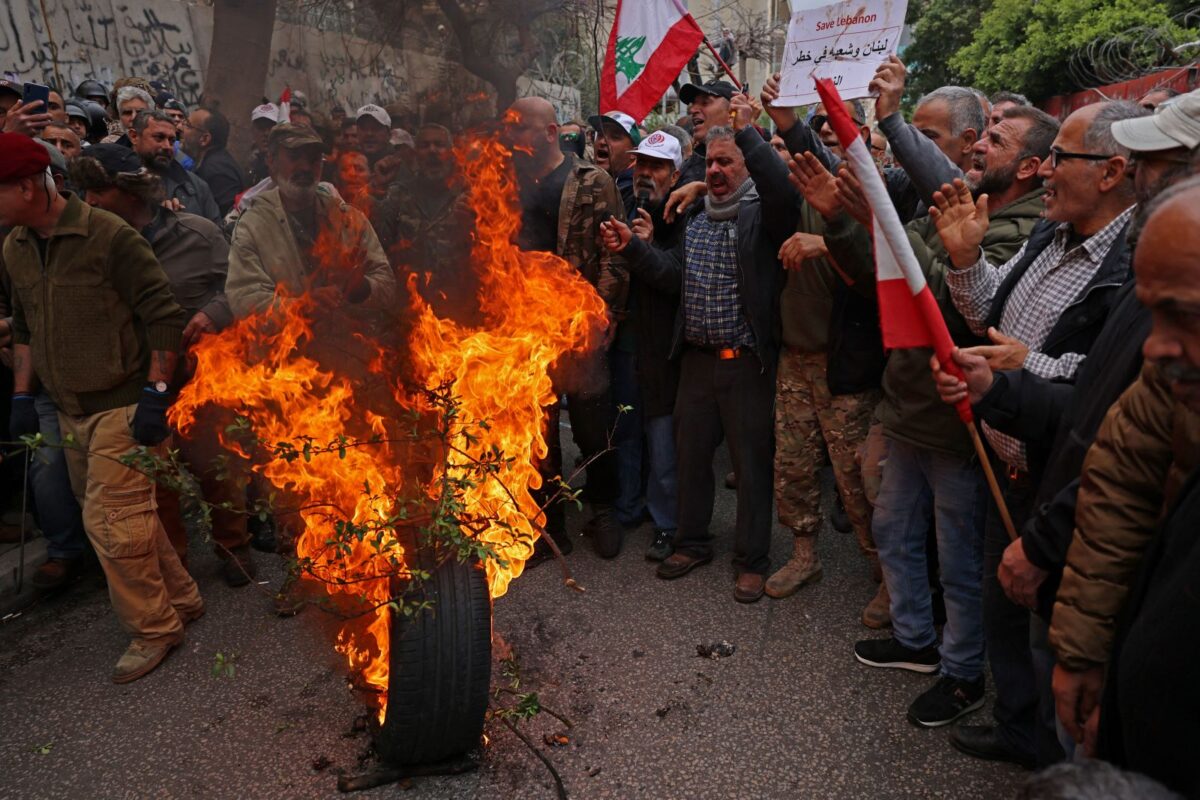
Retired servicemen burn a tyre outside Lebanon's central bank during a demonstration demanding inflation-adjustments to their pensions, in Beirut on March 30, 2023. (Photo by JOSEPH EID / AFP)
Lebanese social media seems to have developed its own, more efficient, measure of inflation. Forget the consumer price index: the indicator everyone is watching is the monthly generator bill.
As the August bills arrived, social media filled with photographs of invoices, kilowatt-hour calculations, and comparisons with rents and salaries. Reports described bills ranging from roughly $300 to as much as $1,000. A single air conditioner suddenly seemed to have acquired the spending habits of a small industrial plant.
In most countries, economists debate inflation after the statistical office releases the numbers. In Lebanon, households learn about it when the generator-bill collector knocks on the door. By then, no econometric model is really necessary.
In most countries, economists debate inflation after the statistical office releases the numbers. In Lebanon, households learn about it when the generator-bill collector knocks on the door. By then, no econometric model is really necessary.
The official response followed a familiar rhythm: a ministerial meeting, decisions, then explanations. The Energy Ministry set the August tariff at 48,241 lira per kilowatt-hour, up 18.4% from July, after the diesel price used in the calculation rose 21.3% in a month. At the ministry’s own exchange rate, that sanctioned, official, fair price is about 54 US cents per kilowatt-hour. The Economy Ministry promised tighter inspections to curb unjustified fees. Everyone explained what could not be done instead of what could.
The inflation nobody is celebrating
According to Lebanon’s Central Administration of Statistics, annual inflation stood at 15.69% in July 2026, down from 17.25% in June. On a month-over-month basis, the Consumer Price Index declined by 0.03%.
On paper, this is disinflation. BLOMINVEST attributed the easing, in part, to weaker consumer demand amid the renewed conflict. A slowing inflation rate sounds like good news, but it may simply mean households have less room to spend.
In any other country, recreation is the first thing a household gives up. In Lebanon, it appears to be the last. Education and food cannot be postponed anywhere.
The composition is less comforting. Recreation, amusement, and culture, which make up 2.4% of the CPI basket, rose 43.2% year over year. Education, with a 6.6% weight, rose 35.72%. Food and non-alcoholic beverages, one fifth of the basket, rose 14.49%. In any other country, recreation is the first thing a household gives up. In Lebanon, it appears to be the last. Education and food cannot be postponed anywhere.
The BLOM Lebanon Purchasing Managers’ Index tells a similar story. It stood at 50.1 in August, down from 50.7 in July, marking the third month above the 50 no-change threshold, even as output and employment declined and new orders contracted. At 50.1, the Lebanese private sector is the statistical equivalent of a patient whose pulse is technically present.
Fighting inflation is not rocket science
Fighting inflation in a small, open, and heavily import-dependent economy is not rocket science. The causes may be complex, but the toolbox is familiar: monetary, sectoral, and fiscal.
Normally, the first line of defense is monetary policy: interest rates and liquidity, transmitted through banks and credit, which move spending and prices. Lebanon has largely lost that mechanism. Credit no longer serves as a transmission channel; the economy is close to fully dollarized, and the banking system is deeply impaired. Banque du Liban can restrict lira liquidity, but it cannot push it through a banking system that is not functioning.
What remains is the exchange rate itself. For an economy that imports much of what it consumes, a stable currency is an important anti-inflation anchor. Lebanon’s dependence on imported food, fuel, and consumer goods means that higher oil, freight, and transport costs pass quickly into domestic prices. The lira has remained broadly stable at around LL89,500 to the dollar since mid-2023. That stability matters. But it is not free, and it is not the same as monetary normalization.
The World Bank explicitly states that recent exchange-rate stability has been maintained through tighter domestic-currency liquidity and a partial drawdown of foreign-exchange reserves. Between mid-February and the end of April, reserves fell by $642 million, although part of the decline reflected valuation effects. By the end of August, they stood at $11.6 billion. In Lebanon, monetary policy has shifted to defending a single number, relying on exchange dealers rather than the banking sector.
There is another problem. If Lebanon’s nominal exchange rate remains fixed while Lebanese prices rise faster than those of its trading partners, the real exchange rate appreciates. Lebanon becomes progressively more expensive in dollar terms, even though the dollar price of the lira has not changed.
Then there is sectoral policy. Governments cannot regulate greed. They can regulate market power: enforce competition, scrutinize margins, and make it harder for an external shock to become an excuse for all domestic prices to move in one direction. That matters most in an economy that buys abroad most of what it consumes, because every external shock reaches the household through a domestic seller who decides how much of it to pass on.
By June 2026, even amid war and contraction, the merchandise trade deficit had reached $8.65 billion, with imports rising and exports falling.
And then comes the third instrument, fiscal policy, which brings us to the budget.
A budget that balances by not looking
The preliminary 2027 budget sets expenditure and revenue at about LL614.945 trillion, or $6.87 billion, 15% above 2026 and nearly 40% above 2025. The projected deficit is zero.
There is nothing inherently wrong with balancing a budget. Lebanon spent decades proving the opposite. The problem is what the zero measures.
There is nothing inherently wrong with balancing a budget. Lebanon spent decades proving the opposite. The problem is what the zero measures.
A budget balance is a single number in a sequence, not the end of the sequence. It tells you whether this year’s revenue covers this year’s spending, and it can only reach zero here because it leaves out debts accumulated before this year. Lebanon remains in default. The World Bank estimates public debt at around 130.6% of GDP in 2025, with restructuring negotiations still not begun more than six years after the default and Eurobond arrears continuing to accumulate.
A household can also balance this month’s spending if it does not open the statements for the loans on which it has already defaulted.
The financing side is where the politics become clearer. Projected tax revenue rises from LL439.6 trillion in the 2026 budget to LL528.2 trillion in the preliminary 2027 draft, a 20% increase, accounting for roughly 86% of projected revenue. VAT alone generates LL205.7 trillion, almost 39% of tax revenue. All taxes on income, profits, and capital together generate LL79.6 trillion. A consumption tax paid by everyone raises more than two and a half times what the state collects from income, profits, and wealth together.
The spending side poses a different question: what is the state spending on? Wages, salaries, and social benefits account for about 53.5% of the entire budget. Public Works and Transport receives LL22.9 trillion, or 3.7%, while Energy and Water remains a minor spending category despite electricity being one of the defining constraints of daily life.
That is what makes the phrase “fiscal discipline” so slippery. Discipline is necessary, and freezing public-sector wage corrections until 2030 is a form of it. But the official price of a kilowatt-hour rose 18.4% in a single month. Discipline is not a development strategy, and a balanced budget is not the same as a repaired state.
The opportunity cost of war
The World Bank’s Lebanon Economic Monitor: A Conflict-Torn Economy, published this summer, quantifies the war’s cost to recovery. Real GDP growth in 2025 was revised up to 4.2% from 3.5%, the fastest expansion since the 2019 crisis. Then hostilities escalated sharply on March 2.
The World Bank now expects the economy to contract by 6.4% in 2026. It estimates the conflict will cut growth by 10.4 percentage points, with roughly $3 billion in lost tourism receipts and a $570 million consumption shock.
The World Bank now expects the economy to contract by 6.4% in 2026. It estimates the conflict will cut growth by 10.4 percentage points, with roughly $3 billion in lost tourism receipts and a $570 million consumption shock.
That is opportunity cost in its purest form. A recovery that took six years to appear was erased in four months.
What normalization actually costs
Crisis normalization is usually described as a social phenomenon: resilience, dark humor, and the famous Lebanese ability to open a beach bar next to a bombed building. That description flatters everyone involved.
The more consequential normalization is institutional. It begins when the state stops treating the crisis as something that has to be solved and starts treating it as an environment to be administered.
The more consequential normalization is institutional. It begins when the state stops treating the crisis as something that has to be solved and starts treating it as an environment to be administered.
The banking system remains deeply impaired, yet economic life has reorganized around cash and dollarization. The state remains in default, yet a budget can be presented with a zero deficit. Public electricity remains inadequate, yet an elaborate monthly system calculates the fair price households should pay for its private replacement. The exchange rate remains stable, but that stability is bought with reserves.
These are variations on the same settlement: preserve the appearance of stability, manage the consequences, and postpone the restructuring that would change the system itself.
That is why the generator bill is more than a generator bill. It is the most visible receipt in a model where households directly absorb the cost of institutional failure: private electricity, higher prices, weaker purchasing power, and taxes that keep the state running without rebuilding it.
The danger is not that Lebanon has failed to adapt. It has adapted remarkably well. The danger is mistaking adaptation for recovery. A functioning economy does not ask households to become their own electricity company, bank, and shock absorber. Neither a fiscal surplus nor a defended exchange rate can substitute for the institutions that would make either of them worth having.
The August bill therefore tells us something larger than the price of a kilowatt-hour. Lebanon has become adept at calculating the cost of living amid the crisis. The question is when it will begin calculating the cost of ending it.
Khalil Gebara is an academic and researcher.
The views in this story reflect those of the author alone and do not necessarily reflect the beliefs of NOW.