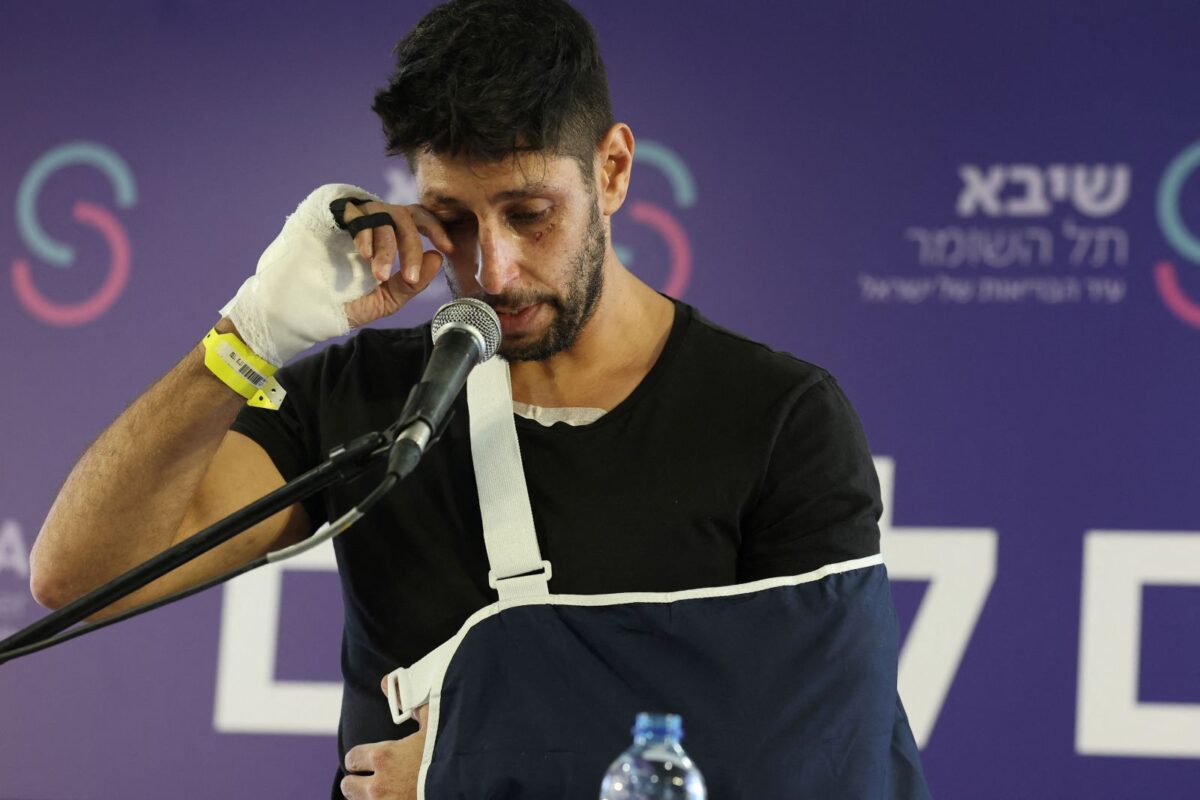
Photo by GIL COHEN-MAGEN / AFP. Israeli singer and Netflix hit series Fauda actor Idan Amedi -- who was wounded in the Gaza Strip where he was serving as a reservist earlier this month -- addresses a press conference at Hashomer hospital in Ramat Gan, near Tel Aviv, on January 25, 2024, amid continuing battles between Israel and the Palestinian militant group Hamas in Gaza.
There is a peculiar hypocrisy Lebanon has perfected: it will binge an Israeli television series to the top of the national charts, then treat a citizen who dares say “Shana Tova” as if they’d committed treason. Fauda, an Israeli drama, written in Hebrew, produced in Israel, has repeatedly topped Netflix’s most-watched list here, including its most recent season, built around the trauma of October 7, released while Lebanon itself was being dragged into war. Lebanese watched anyway, in large numbers, and loved it.
Yet wish a Jewish person anywhere in the world a happy new year, Shana Tova, the way we openly wish Muslims a blessed Hijri new year or Christians a merry Christmas, and you’ve crossed a line no one dares cross.
The problem isn’t the religion. It’s that Lebanon has spent seventy years refusing to separate “Jewish” from “Israeli,” collapsing a faith into a flag until acknowledging one became indistinguishable from endorsing the other.
Not because Judaism is foreign to Lebanon. It isn’t. Judaism is one of Lebanon’s constitutionally recognized sects, on equal legal footing with its Christian and Muslim communities since the state’s founding. The problem isn’t the religion. It’s that Lebanon has spent seventy years refusing to separate “Jewish” from “Israeli,” collapsing a faith into a flag until acknowledging one became indistinguishable from endorsing the other.
Beirut’s Wadi Abu Jamil was once the heart of a real, rooted Jewish community, anchored by the Maghen Abraham synagogue, built in the 1920s. Lebanese Jews were doctors, merchants, neighbors. Then came 1948 and 1967, each war chipping away at that community, until civil war swallowed the country in 1975: Wadi Abu Jamil emptied out, the synagogue was shuttered, and the last rabbi Lebanon ever had walked out the door. No religious authority has replaced him since.
They haven’t come back, not because any law bars it, but because there’s nothing left to return to, no clergy, no seat in a sectarian system that guarantees every other community a voice, no protection from a state that has let Jewish cemeteries be vandalized and let “Jewish” and “Zionist” be used as interchangeable slurs for decades.
And this is where the real question sits: do we dare feel this, plainly, whenever extremism or totalitarianism kills civilians, or only when the killer and the victim fit a script we’re comfortable with? Americans grieved 9/11 openly. Syrians still grieve Houla, where Assad’s forces massacred over a hundred civilians in 2012, and Ghouta, where his regime gassed more than 1,400 people the following year. Lebanese grieve August 4 openly, because the state itself failed us. Iranians who lived through the January 8–9 crackdown, when the IRGC opened fire on protesters nationwide, killing by independent estimates anywhere from several thousand to tens of thousands in two days, were met instead with silence and a government that still won’t release an honest number. Gaza’s dead are mourned ever since I could remember. Israelis grieve October 7 too.
Every one of these is the same category of loss: civilians killed by terrorists, extremism, or by a regime willing to slaughter its own people to stay in power. All of them deserved to be mourned, without asking first who did the killing or who the victims were.
That conflation isn’t law, it’s a habit, one Hezbollah and its allies have every interest in maintaining, because a public that could separate a religion from a state might start asking why a seventy-year-old wartime statute still dictates what Lebanese are allowed to feel out loud.
The 1955 Boycott of Israel law is a boycott of a state. It bars contracts, trade, and contact with Israeli nationals and territory. It says nothing about Judaism as a faith, and nothing in it criminalizes wishing a Jewish person a happy new year. That conflation isn’t law, it’s a habit, one Hezbollah and its allies have every interest in maintaining, because a public that could separate a religion from a state might start asking why a seventy-year-old wartime statute still dictates what Lebanese are allowed to feel out loud. The law is now openly debated in Beirut, caught between regional shifts and quiet American pressure to reconsider it, yet the one proposal moving through parliament seeks to expand its criminalization, not narrow it.
So the country keeps clicking play on Doron Kavillio’s latest mission, keeps debating a law nobody has the courage to touch, and keeps pretending that selective grief is principle rather than what it actually is: fear dressed up as ideology.
Elissa E Hachem is a journalist and political writer specializing in regional affairs and governance. Former Regional Media Advisor at the U.S. State Department’s Arabic Regional Media Hub, with broad experience in strategic communication across government and private sectors.
The views in this story reflect those of the author alone and do not necessarily reflect the beliefs of NOW.