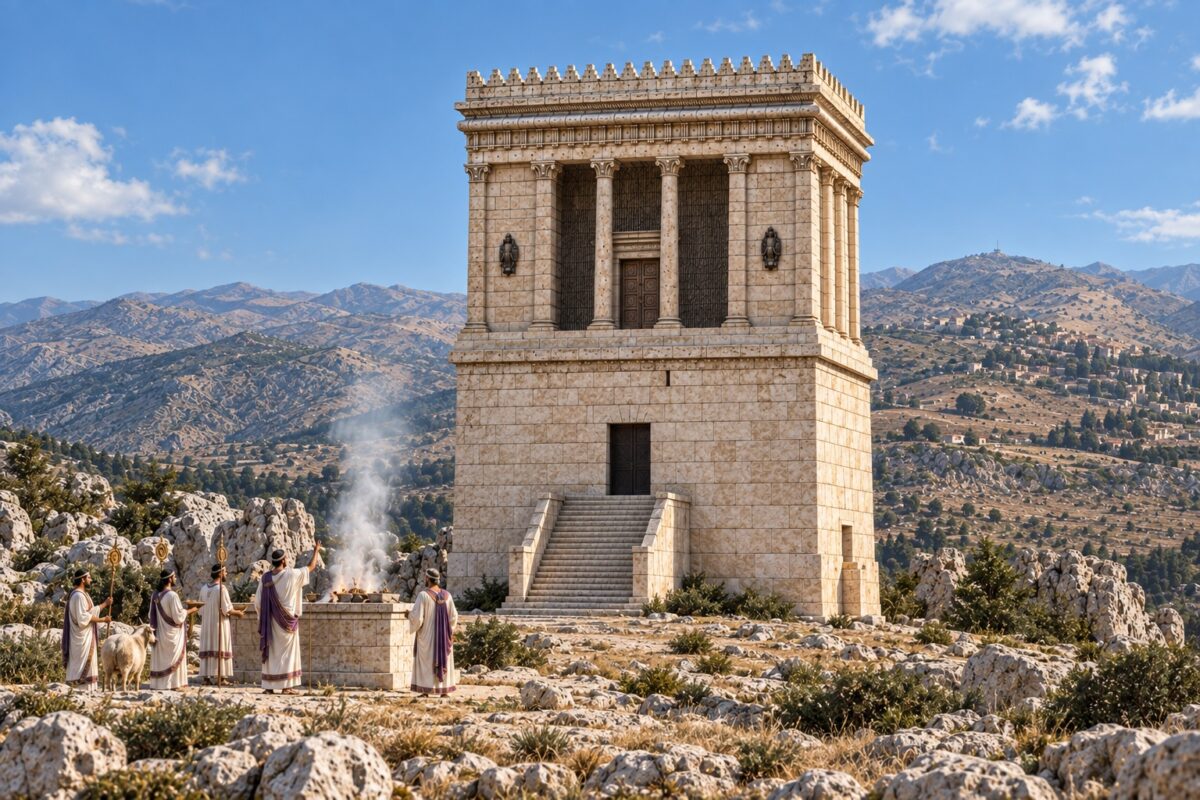
How can the remains of a Roman-era tower in Faqra explain the integration of Lebanon into the Roman Empire? What do its two inscriptions tell us about the syncretism between local gods and the imperial cult within the empire? The answers to these two questions can be found on a Roman-era tower in the region of Faqra, in the town of Kfardebian, in the highlands of Kisrawan
Beneath Mount Sannine, the site of Qalaat Faqra occupies the western edge of a basin open to the southwest, overlooking the valleys of the tributaries of the Nahr el-Kalb, at an altitude of around 1,500 meters. The ruins are surrounded by jagged formations of beautiful dolomitic limestone.
The site, known locally as Qalaat Faqra (“the castle of Faqra”), is divided into three sectors: the tower and monumental altars on the hill to the north; the small temple to the south and lower down, toward the Nabaa el-Laban stream; and the great sanctuary between the two. Remains of an ancient settlement, Roman and/or Proto-Byzantine, are visible near the tower and between the small temple and the great sanctuary. The site was recognized as highly significant for the Roman period from an early stage of its study, and one of its iconic structures, the “Naiskos” (small temple), appeared on the 250-lira banknote.
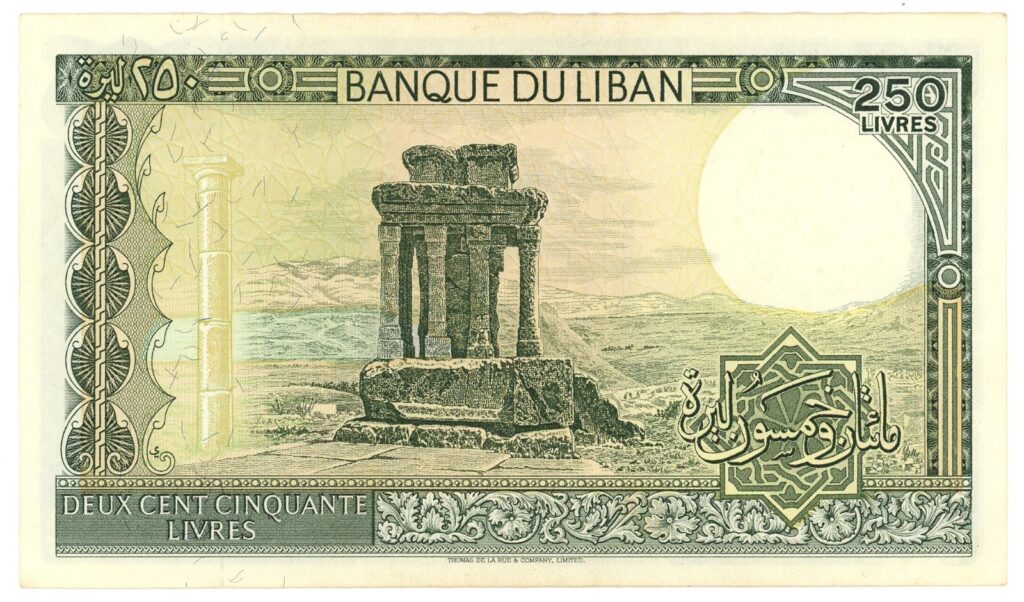
The Faqra Naiskos or small temple featured on the 250 Lebanese Lira banknote, 1986 edition.
Twenty-nine inscriptions have been found at the site, several of which remain fragmentary and await further interpretation. Among them, two found on the tower are of particular importance.
The tower, one of the site’s most striking structures, stands on a rise to the north on a cubic base 15.67 m per side, reached by an eighteen-step exterior staircase to a mid-height main door and a smaller ground-level door at the southeast corner. Surviving blocks permit a reconstruction of its elevation: an upper story of pilasters and an Egyptian cornice, a loggia above the main entrance, and an internal system of corridors and staircases leading to a small guarded room at its core, the whole topped by Phoenician-style crenellations.
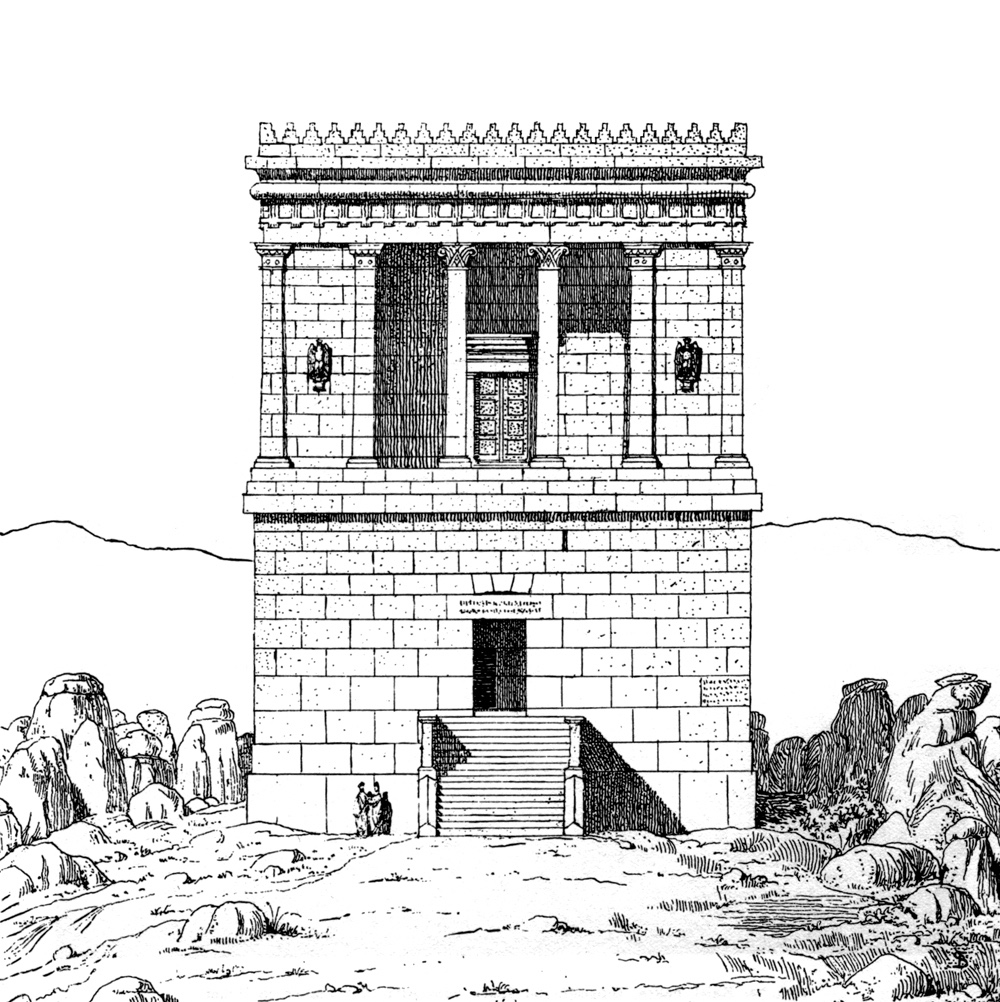
Suggested reconstruction of the Qalaat Faqra tower by B. Schulz, in Römische Tempel in Syrien, Krencker & Zschietzschmann 1938, p. 50, fig. 73.
This eclectic form once invited readings of the building as a tomb or a strongbox for sanctuary property. However, analysis of the two inscriptions, together with the tower’s location facing the monumental altar, now firmly establishes that the building held a cultic, religious function.

Lintel inscription
This cultic function is first evident on the lintel inscription. Arriving in front of the tower and facing the doorway, is an inscription in Greek in two lines. The first line presents no major difficulties in reading:
“To Emperor Tiberius Claudius Caesar”
From its opening line, the lintel inscription reveals itself as a dedication to the Roman Emperor Claudius, who reigned from 41 to 54 AD. Dedicating a tower to a ruler was a recognized practice elsewhere in the Roman East, and set against this background, the tower of Qalaat Faqra fits a broader imperial pattern across the empire.
The story of the tower of Qalaat Faqra, also identified as the Tower of Claudius, testifies to how local traditions were absorbed within the Roman imperial system, and how local elites participated in this imperial building process even in the highlands of Mount Lebanon.
The second line proves harder to read. The late Jesuit scholar Fr. René Mouterde, writing in 1939, believed he could identify in it the name of the dedicators: a village community that took its name from the nearby stream, the Nahr el-Leben, the “River of Milk,” whose source lies very close by, a people he called the Pègègalaxioi, “the people of the Milk Spring.” Scholars have since restored a different reading, identifying instead the name of Gaius Cassius Longinus, governor of Syria from 44 AD, precisely the date recorded on the cornerstone inscription. The involvement of the Roman governor, and the mention of his name, sits well with the importance of the monument. Given this, the lintel inscription may accordingly be read as follows:
“To Emperor Tiberius Claudius Caesar Augustus and to the ancestral god Beelgalasos, under Gaius Ca[ssius Longinus —].”
The second inscription can be found on a cornerstone, located on the eastern face toward the southeastern corner and halfway up the base, is very legible. Written in Greek in rather large letters across five lines, it reads:
“In the year 355, under Tholos Rabbomos (or son of Rabbomos), epimelete, (this monument) was constructed at the expense of the Great God.”
The cornerstone inscription indicates first the date of the tower’s completion. The year 355 of the Seleucid era corresponds to the year 43 of our era, that is, to the third and fourth years of the reign of Emperor Claudius. Second, it mentions the name of the “epimeletes”, or commissioner, Tholos Rabbomos. And third, it indicates the origin of the funds that covered its costs: the great god himself!
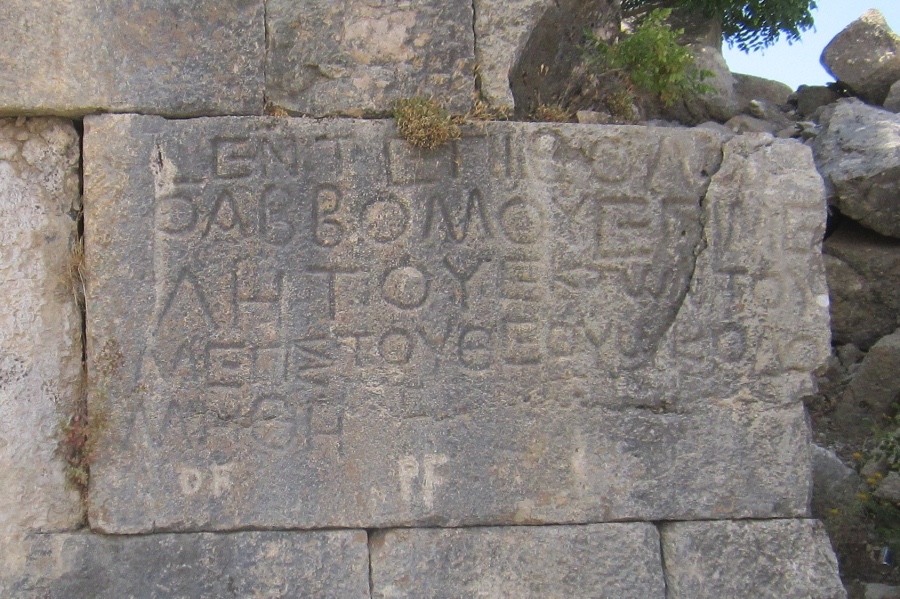
Cornerstone inscription
The god’s name and title, as they appear across the site’s inscriptions, offer insight into religious belief in the highlands of Lebanon. On the lintel inscription, the local god is named Beelgalasos, described as an ancestral god, emphasizing his role as protector of a community; and associated with the Roman emperor, who is named first. The cornerstone inscription, in turn, describes him as the “Great God”, underscoring his supreme standing. The god’s name carries Baal as its first element, spelled according to the usual Western pronunciation, “Bel”. Its second element, Galasos, may derive from an semitic root, meaning “high mountain, rough and hard ground”.
In front of the tower, and below it to the east, stand two structures. The larger is a monumental sacrificial altar, its function confirmed by the discovery of ash and bone fragments among its ruins during H. Kalayan’s 1945 restoration. It measures roughly 5.30 m per side; its crenellated parapet is interrupted on the east side to leave a passage, and a movable wooden staircase presumably gave access to the upper level.
Sadly, this monument lies in neglect: its archaeological precinct has no formal protection, and the site shows visible signs of damage, disrepair, and vandalism. This condition is not unique to Qalaat Faqra; it reflects a broader pattern in which Lebanon’s archaeological heritage receives little institutional investment or public engagement.
The tower’s position relative to this altar lends further support to its cultic function. The two structures lie approximately on the same axis, and from the altar’s platform one could see the tower’s loggia and the statues it may have housed, a spatial relationship that binds them into a single ritual complex. The dedication carved on the lintel, addressed jointly to the reigning emperor and to the local god Beelgalasos, allows the tower to be read as a monument of the imperial cult: Claudius thus stood associated with the great god of Qalaat Faqra. The smaller monument is the naiskos, the small temple or shrine that would have served for devotional rituals.
At the moment of the tower’s dedication, two serious incidents had just strained relations between the Jewish king Agrippa and the Roman governor of Syria, Marsus. Given its proximity to Agrippa’s territories, the sanctuary of Qalaat Faqra could not remain indifferent to the threat of a conflict in which it risked becoming entangled, and it may be supposed that the tower’s construction was not unrelated to these circumstances. It was in this historical context that the tower, dedicated to Claudius, was erected by the inhabitants of Qalaat Faqra at the expense of their god’s treasury, the tower’s construction and its dedication finding their explanation precisely in this moment of political tension.
The territories of the eastern Mediterranean were conquered by Rome under Pompey the Great in 63 BC. Parts of these new lands were administered through client kings, such as the Herodian dynasty, before being regrouped and placed under a Roman governor in the first century AD. The Pax Romana (the long period of relative peace and stability across the Roman Empire) had already been developing since the reign of Emperor Augustus (27 BC–14 AD). Both the archaeological and textual evidence point to a period of great prosperity for what would become Lebanon under the Roman Empire. The monumental temples constructed everywhere, and this tower among them, stand as witnesses to this long era of prosperity, which would last until 636 AD.
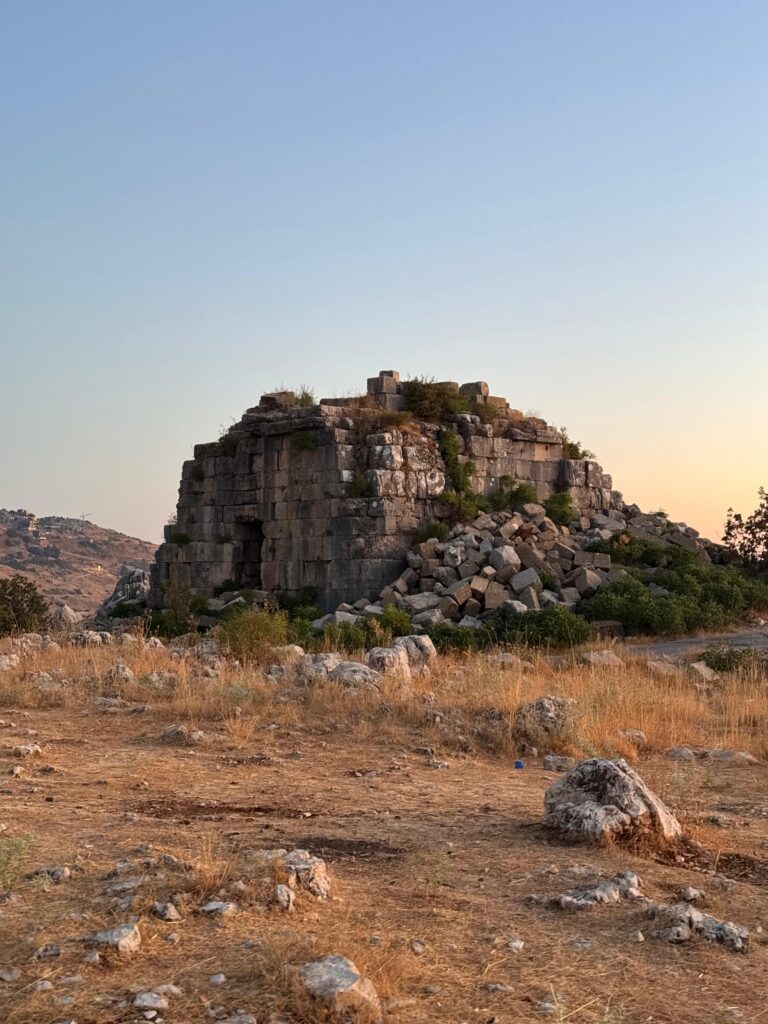
Ruins of the Tower, picture taken by the author in August 2026
The story of the tower of Qalaat Faqra, also identified as the Tower of Claudius, testifies to how local traditions were absorbed within the Roman imperial system, and how local elites participated in this imperial building process even in the highlands of Mount Lebanon. It is a monument of the Roman imperial cult, the practice of venerating the emperor as a divine or semi-divine figure, often alongside local gods, served as a unifying force that bound the empire’s diverse provinces to Roman authority. Dedicated jointly to Claudius and to the ancestral god Beelgalasos, and raised under the eye of the Roman governor of Syria at the very moment of the province’s expansion into the former Herodian kingdom, the tower of Qalaat Faqra offers a rare instance of this imperial ideology reaching deep into the highlands.
Sadly, this monument lies in neglect: its archaeological precinct has no formal protection, and the site shows visible signs of damage, disrepair, and vandalism. This condition is not unique to Qalaat Faqra; it reflects a broader pattern in which Lebanon’s archaeological heritage receives little institutional investment or public engagement. The tower of Claudius still awaits the attention of the state and of specialists, who alone can secure its preservation and make its story, one chapter in the long history of Roman Lebanon, accessible to those who might otherwise never encounter it.
Charles al-Hayek is a public historian and the founder of Heritage and Roots.
The views in this story reflect those of the author alone and do not necessarily reflect the beliefs of NOW.
Bibliography
Aliquot, Julien. La Vie religieuse au Liban sous l’Empire romain. Beyrouth: Presses de l’Ifpo, 2009. doi:10.4000/books.ifpo.1411.
Collart, Paul. “La tour de Qalaat Fakra.” Syria: Archéologie, Art et histoire 50, no. 1–2 (1973): 137–161.
Rey-Coquais, Jean-Paul. “Qalaat Faqra: un monument du culte impérial dans la montagne libanaise.” Topoi: Orient-Occident 9, no. 2 (1999): 629–664.