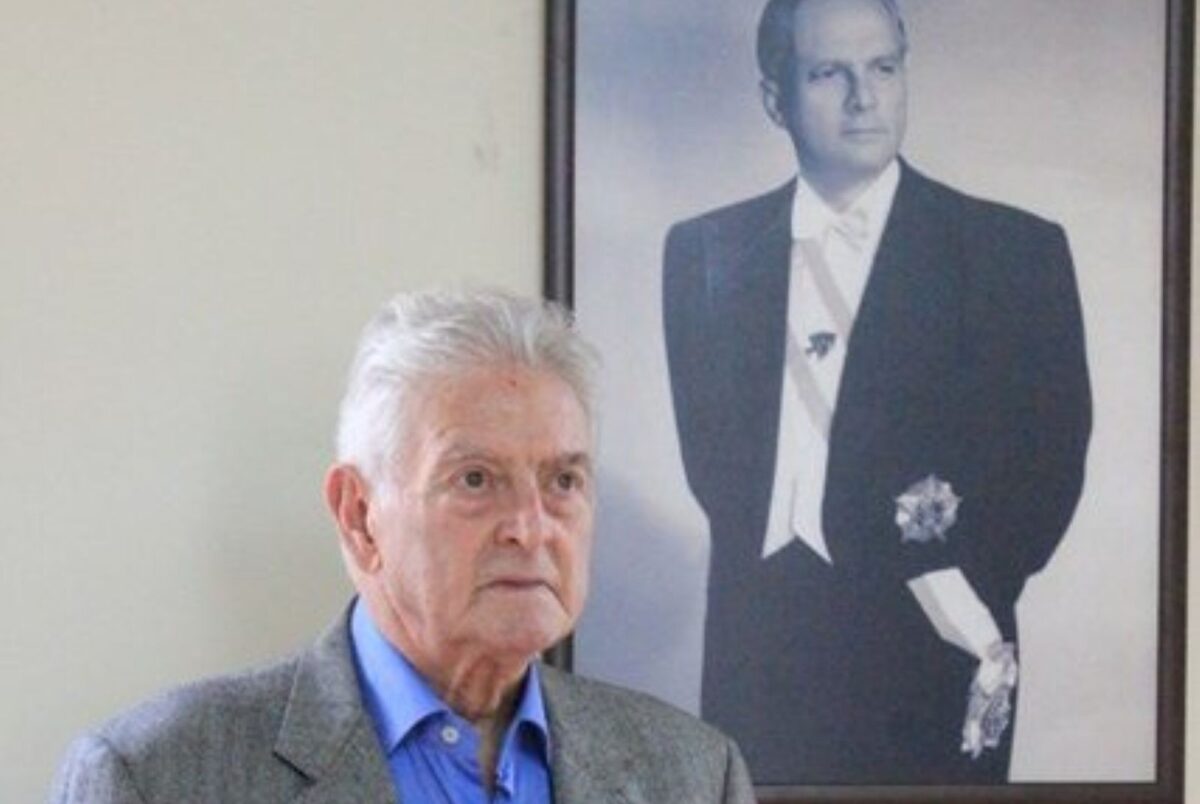
At the funeral of our dear Dory Camille Chamoun—a champion of Lebanon’s Second Independence and a symbol of the Independence Uprising—we witnessed an outpouring of affection and respect deeply rooted in Mount Lebanon. It recalled a time when politics, at its best, was not merely a struggle for power, but an expression of commitment, loyalty, and moral courage.
In bidding farewell to Dory Chamoun, we also bid farewell to something of the old Lebanon: the Lebanon we knew in people’s homes, village squares, and churches; the Lebanon where a handshake carried the weight of a promise and people stood by their word.
That Lebanon was not destroyed solely by corruption, recklessness, wars, occupations, or the projects that reduced it to a battleground. It was also destroyed—perhaps above all—by the collapse of ethics in public life, and by the transformation of politics from public service and responsibility into a profession built on lies, flattery, and evasion of accountability.
Dory was always among the first to say things exactly as they were—without filters, embellishment, or political sophistry. He did not search for carefully calculated expressions that would please everyone, nor did he hide behind the grey positions that keep politicians safe. He said what he believed plainly and accepted the consequences.
Dory was always among the first to say things exactly as they were—without filters, embellishment, or political sophistry. He did not search for carefully calculated expressions that would please everyone, nor did he hide behind the grey positions that keep politicians safe. He said what he believed plainly and accepted the consequences.
One could disagree with a position he took, an interpretation he offered, or a choice he made. But no one could question his sincerity, his courage, or his commitment to the Lebanese state, its sovereignty, and its freedom.
At a time when honesty became almost an offence, Dory Chamoun remained honest. At a time when shifting positions was marketed as political wisdom, he remained faithful to his convictions. He never mastered the art of selling illusions, nor did he try to become a polished political product designed for television screens and fashionable salons. He remained a true son of Deir el-Qamar: stubborn when stubbornness was necessary, irreverent in the face of pretense, and sometimes disarmingly direct—but never false.
Today, Dory Camille Chamoun lies in repose at the Church of Our Lady of the Hill in Deir el-Qamar, where the people of the mountain, from its many villages, families, and communities, will come to say goodbye.
They will not come merely because he was the son of President Camille Chamoun, one of Lebanon’s most consequential statesmen, or because he inherited a great name and a formidable political legacy. They will come because Dory earned a distinct place in their hearts.
They will come because he was brave and decent. Because he remained close to ordinary people, spoke their language, understood their concerns, and never addressed them from behind the walls and closed doors of power.
Farewell to Dory Chamoun is also farewell to a political era in which disagreement still had meaning, rivalry still had limits, and words still carried weight. It was hardly a perfect era, but it understood that politics without ethics becomes little more than a transaction, and that leadership without courage is merely an empty title.
Farewell to Dory Chamoun is also farewell to a political era in which disagreement still had meaning, rivalry still had limits, and words still carried weight. It was hardly a perfect era, but it understood that politics without ethics becomes little more than a transaction, and that leadership without courage is merely an empty title.
At Our Lady of the Hill church in Deir El Qamar , we are not simply laying a political figure to rest. We are saying goodbye to a man of the mountain and part of its living memory—to a symbol of independence and freedom.
Dory Chamoun will remain with us through his candor, his wry smile, his courage, and that increasingly rare quality Lebanon so desperately needs: simple human decency.
May Dory rest in peace. May his family and all those who loved him find strength and consolation. And may Deir el-Qamar, the mountain, and Lebanon be comforted in his memory.
Makram Rabah is the managing editor at Now Lebanon and an Assistant Professor at the American University of Beirut, Department of History. His book Conflict on Mount Lebanon: The Druze, the Maronites and Collective Memory (Edinburgh University Press) covers collective identities and the Lebanese Civil War. He tweets at @makramrabah