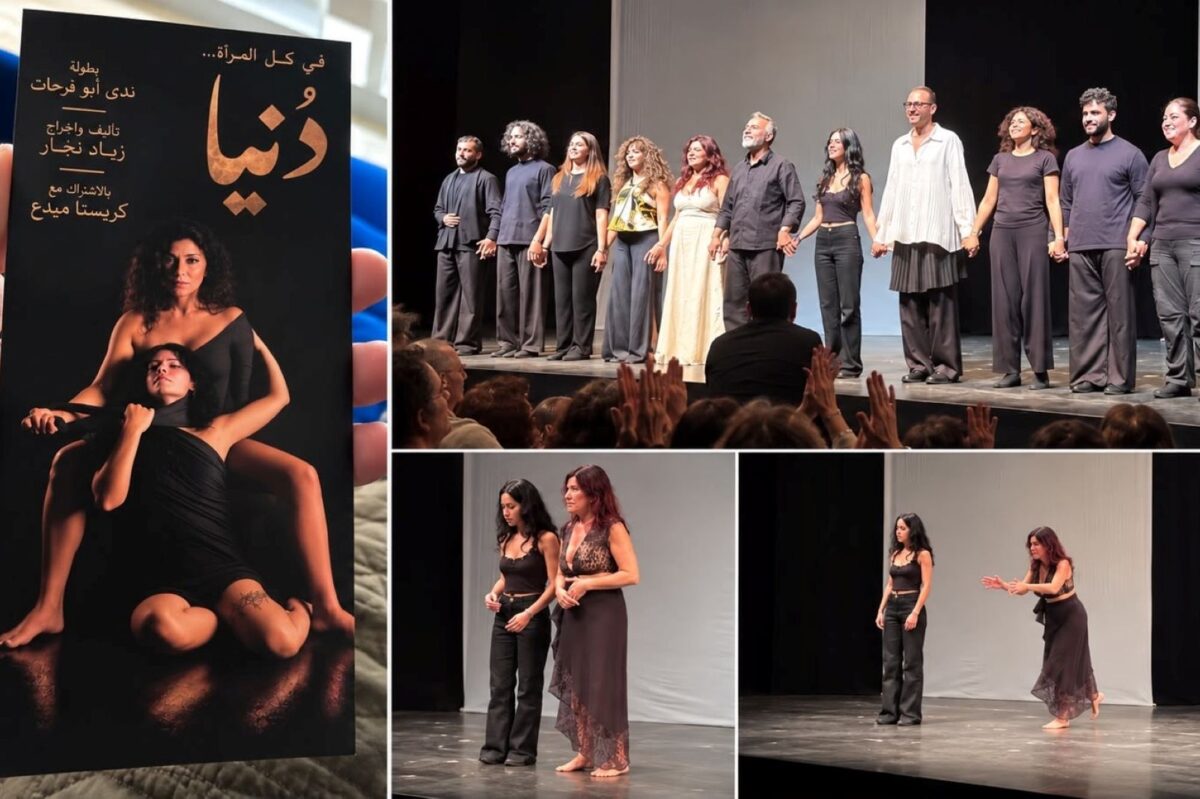
There are plays that entertain, plays that provoke, and then there are those rare productions that manage to do both without sacrificing either. Dunia, starring Nada Abu Farhat and written and directed by Ziad Najjar, belongs firmly to the latter category. It is funny, painful, intimate and, above all, profoundly human.
At its heart, Dunia is a reflection on the lives of single mothers and the peculiar burden society places upon them. It explores the pressures of raising children while simultaneously navigating a world that is always watching, judging and questioning. But the play reaches beyond motherhood. It is also about what it means to grow up and survive as a woman in a society still largely structured around men and their expectations.
This is where the comedy and tragedy of Dunia meet. The laughter never feels imposed upon the story, nor does the sadness become melodramatic. Instead, humor emerges from the absurdities and contradictions of everyday life—the small humiliations, compromises and social expectations that women are somehow expected to absorb with grace. We laugh because the situations are recognizable, and sometimes we laugh precisely because the alternative would be to cry.
And then there is Nada Abu Farhat.
Nada does not simply occupy the stage; she takes possession of it. She is a force of nature—funny one moment, vulnerable the next, fierce when she needs to be, and capable of changing the emotional temperature of the room almost instantly. There is something wonderfully unforced about her performance. She never seems to be asking the audience to admire her acting. Instead, she draws you into the character until the performance itself almost disappears. That is the mark of a star, and Nada Abu Farhat is unquestionably a star in her own right.
The production itself deserves equal praise. The staging is elegant without becoming unnecessarily elaborate, allowing the performers and the story to remain at the center. Particularly effective is the use of live music throughout the performance, played by Ziad Najjar himself. Rather than functioning merely as accompaniment, the music becomes another presence on stage, helping move the audience between humor, tension, tenderness and reflection.
But perhaps what struck me most about Dunia was simply the fact that it exists.
Making theatre in Lebanon today is itself an act of stubborn optimism. Serious theatre has few investors, little institutional support, and virtually none of the sustained state patronage that allows cultural life to flourish elsewhere. Artists, directors, actors, musicians and producers continue largely because they believe the stage still matters. They keep fighting the good fight, often with resources that bear little relationship to the talent and commitment involved.
That makes productions like Dunia worth celebrating beyond their artistic merits.
I left the theatre entertained, moved and thinking about what I had just watched. That is precisely what theatre should do. Dunia reminds us that behind the social labels we casually impose—single mother, divorced woman, independent woman—there are complicated human beings negotiating dignity, desire, motherhood, judgment and survival.
A wholehearted bravo to Nada Abu Farhat, Ziad Najjar and the entire cast and crew. Lebanon needs more theatre like this—and, just as importantly, Lebanese theatre deserves people willing to stand behind it.
Makram Rabah is the managing editor at Now Lebanon and an Assistant Professor at the American University of Beirut, Department of History. His book Conflict on Mount Lebanon: The Druze, the Maronites and Collective Memory (Edinburgh University Press) covers collective identities and the Lebanese Civil War. He tweets at @makramrabah