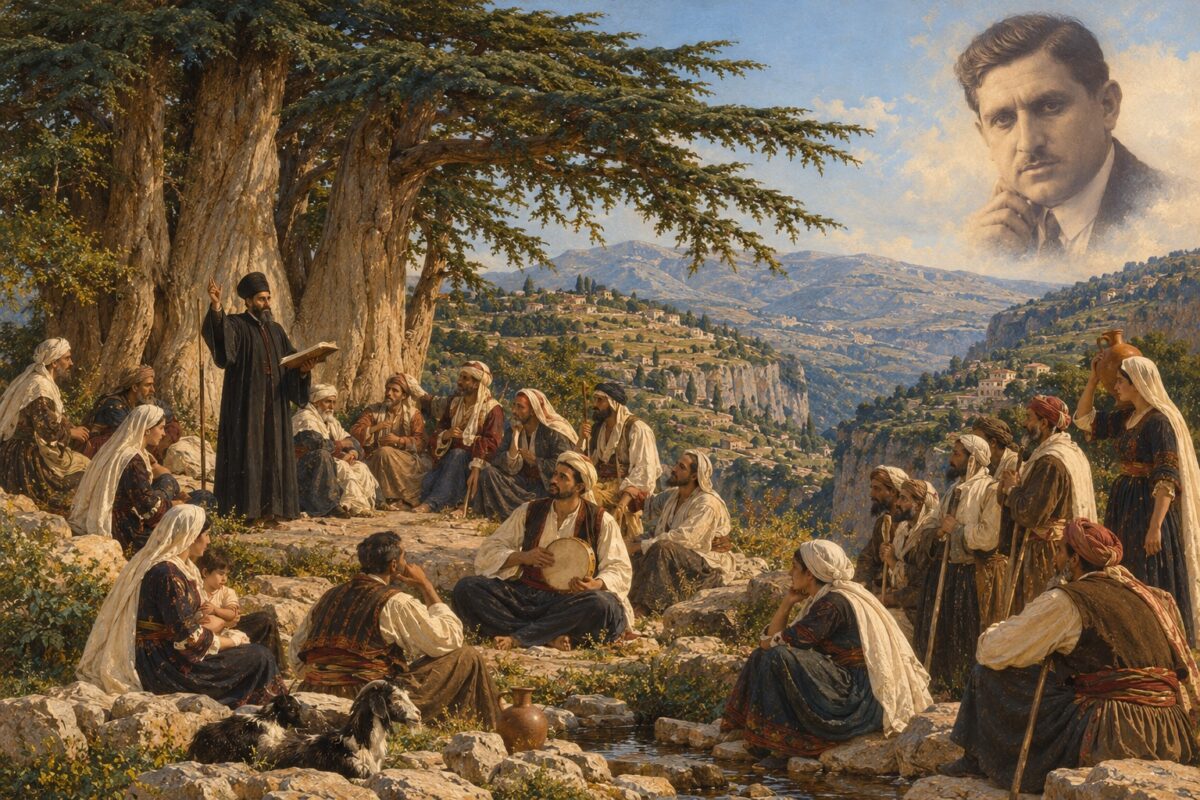
Vernacular sung poetry forms part of the cultural heritage of every country. In Lebanon and the Levant, it takes the name of zajal, a living art celebrated at weddings, village gatherings, and poetic contests. International recognition came in October 2014, when UNESCO inscribed Lebanese zajal on the Representative List of the Intangible Cultural Heritage of Humanity. The official statement described it as a form of Lebanese folk poetry, declaimed or sung during social and family celebrations and in daily life, and noted that during poetic contests, troupes of poets deliver verses, often as challenges, before a diverse audience, to the rhythm of the daff.
Behind this festive surface lies a question for the historian: can zajal serve as a source for understanding Lebanese history? Across seven centuries, poets have used it to record events, lament catastrophes, describe hardship, and give voice to identities. Read critically, between myth and fact, these verses may reveal how the people of Lebanon perceived their history as they lived it.
The meaning of the term already points toward performance. In the Arabic dictionary, zajal denotes singing, sound, and the raising of the voice. Linguistically, it derives from zajala, to throw or to push, and the zajjal is the one who throws; the name may well come from the way zajal poets hurl verses at one another. In its technical sense, zajal is poetry composed in the colloquial language, free from the rules of classical Arabic, in a strophic structure.
Locally, in Lebanon and Syria, and in Mount Lebanon in particular, zajal was known as al-qawl (“the utterance” or “the saying”), and the one who uttered it was called al-qawwal (“One who recites”). Locals used some forms of this vernacular poetry to chronicle events or to express notions of identity and belonging, and this is where zajal begins to speak as a historical witness. Four sets of zajaliyyat (vernacular poems) in particular can help the Lebanese reconstruct episodes of their history: two from the Mamluk period, one from the Ottoman period in the eighteenth century, and a last from the early twentieth century, under the French Mandate.
Can zajal serve as a source for understanding Lebanese history? Across seven centuries, poets have used it to record events, lament catastrophes, describe hardship, and give voice to identities. Read critically, between myth and fact, these verses may reveal how the people of Lebanon perceived their history as they lived it.
Scholars agree that the first identified zajal poem from what is now Lebanon is the zajaliyya of Sulayman al-Ashluhi, possibly an Orthodox priest from Akkar who lived in the late thirteenth and early fourteenth centuries. Composed of sixty verses and entitled “The Destruction of Tripoli”, it describes the fall of Crusader Tripoli to the Mamluks in 1289 and is preserved in the Vatican Library. The poem opens on a note of personal grief:
Oh, the sorrow of my heart, never free from grief;
in Tripoli, the tale of my sorrow began.
That grief had a concrete cause. The Mamluk conquest of Tripoli on 26 April 1289, after a five-week siege, was a violent event, and in its aftermath Sultan Qalawun ordered the city razed to the ground. The echoes of this catastrophe must have reached the neighbouring region of Akkar, which lay within the Crusader County of Tripoli. Using zajal to chronicle such events was likely a local tradition, and the priest from Ashluh, a now abandoned village in Akkar, set it down in writing, in a tragic register:
O eye, let weeping and wailing be your habit;
and should I weep, the tears burn as they fall.
From lament, the poet moves to narrative. Drawing probably on eyewitness accounts, he describes the Mamluks, whom the poem calls “Turks”, storming the city, pillaging it, and killing the Crusader knights:
Weep for the Christians, weep for what has befallen them, O my brethren.
The Turks have stormed into the marketplaces,
bearing swords that cleave through solid rock when drawn;
how many a knight have they slain, despite his might and grandeur.
The destruction of the city’s monuments, and of its churches above all, draws his deepest sorrow. He gives particular attention to the Melkite (Rum Orthodox) church of Tripoli, the detail that has led scholars to identify him as an Orthodox priest:
Who would have believed that Tripoli would fall to ruin?
What a tragedy: those lofty structures reduced to rubble.
…
As for the churches, they have only deepened my sorrow;
the church of the Rum, too, has added to my grief.
I remember them when they bustled with the festivities of holy days.
The document holds major importance because it allows us to reconstruct the conquest from a forgotten, and at times silenced, perspective: that of rural locals who witnessed the fall of a great urban centre and the violent transition that followed, experiences that rarely find a place in heroic narratives of conquest. It also offers material for reconstructing the linguistic context of the period, since al-Ashluhi wrote in a colloquial Arabic that remains understandable to Lebanese readers today.
Two centuries later, in the late Mamluk period, around the 1480s, zajal became a vehicle of identity construction and historical recording in the hands of the Maronite Bishop Jibrail Ibn al-Qilai (1440–1516), who made it a mission by embedding in it historical, social, and religious themes. Born to a family from the village of Lehfed in the highlands of Byblos, he was the first Maronite to study abroad, first in Cyprus and then in Rome, through the Franciscan mission, and he returned as a missionary to his people.
He found the Maronites living through an identity crisis caused by the presence and spread of the Jacobites (Syriac Orthodox) in northern Mount Lebanon. The Jacobites already had a local presence, and their numbers were growing through refugees arriving from Iraq; they were also better educated and wealthier than the Maronites. From their major centres of literary activity, such as Sadad in the Anti-Lebanon range, they sent books and educated priests to convert the Maronites. They even succeeded in bringing the muqaddam of Bsharri, Abd al-Munim II (r. 1471–1495), into their Miaphysite Syriac Orthodox Church. Jacobite proselytism was gaining ground and drawing the Maronites away from the Catholic Church, to the point that a Maronite convert, Nuh of Bqufa, was elected Jacobite patriarch. Rome grew worried, and the Maronite patriarch needed a strategy to counter this influence. The answer came through zajal.
To educate a community whose members were mostly illiterate, Ibn al-Qilai chose al-qawl, the traditional poetic expression of the Mountain, the best and fastest means of teaching. Into it he cast the epic traditions about the Maronites’ beginnings in Mount Lebanon, explaining to them their heroic origins and their Catholic faith. His most famous work, Madiha ala Jabal Lubnan (Panegyric on Mount Lebanon), has served as an important source for writing Lebanese history. It opens with a declaration of method:
I begin in the name of God, the Merciful,
and grant safety to whoever is afraid;
we praise in the sweetest of melodies,
we proclaim the vicissitudes of this age.
How the ages change,
and minds are bewildered within them;
were it not found in the written lines,
no one would tell of it.
Yet the histories tell us
of what came to pass in our homeland,
and of those who came before us,
dwellers on Mount Lebanon.
In these opening verses, Ibn al-Qilai explicitly uses the vocabulary of the historian: tawarikh (histories), al-astur (the written lines, meaning written sources), and mawatin (homeland, meaning Mount Lebanon). The Madiha also reveals how Ibn al-Qilai understood the community he addressed. Across his writings, he treats the Maronites as a single communal subject, for whom division, whether doctrinal or political, represents a deviation from the norm. The Madiha defines them through three elements: union with Rome, internal cohesion, and ownership of Mount Lebanon. Epic in size, conception, and themes, it narrates the struggle of free Maronites against Muslim invasion and heresy, and despite its theological content its tone remains heroic. Ibn al-Qilai is regarded as the author of the theory of Maronite perpetual orthodoxy, still central to Maronite historiography and identity today. Drawing on historical material mixed with legend, he argued that union with Rome had been the original state of the Maronite Church since its establishment, and that the Maronites prospered whenever they held to it. Each lapse into heresy, which he blamed on Jacobite “infiltration”, set off a cycle of calamity ending in the loss of political independence to Muslim rule, as divine retribution for their sins. Cohesion around the patriarchs and the muqaddams formed the other pillar: united under this joint leadership, the “People of Marun” triumphed and defended their mountain homeland; divided by sin or heresy, they fell to invasion. In his admonition of Bsharri, seat of the converted muqaddam and home to many locals who had abandoned their Maronite faith for the Syriac Orthodox Church, the Jacobites, whom he calls heretics, emerge as strangers, and he rebukes Bsharri in these words:
Yes, the heretic’s reputation is black …
The Pope excommunicates him with proof
Be aware of my words, be aware…
…In adultery you conceived and bore a demon.
The fruit of Jacob dwells within you
Yet Jacob is powerless to protect you
Cast out the Jacob who resides in you
And accept the blessings from this moment on.
And I, a sinner, pray on your behalf
To God, that He may accept you
The Mountain itself becomes sacred ground, and no stranger may settle. In the case of Bsharri, the stranger bears a name: “Jacob”, a metaphor for the Jacobites, casts the Syriac Orthodox as the antagonists of the Maronites. Elsewhere in the zajaliyya, Ibn al-Qilai calls the Mountain “our country”, “our homeland”, and once “Maruniyya”, the land of the Maronites. In all this, Ibn al-Qilai emerges as the earliest Maronite historian of Maronite identity, and his verses may well echo the collective memory of a community hit hard by the Mamluk campaigns of 1260–1283 in Mount Lebanon and by Jacobite proselytism in the fifteenth century. His language matters as much as his content. Contrary to the narrative widespread today that the Maronites spoke Syriac in this period, Ibn al-Qilai wrote in colloquial Arabic, in a dialect resembling present-day Lebanese, as these verses show.
Beyond epic and identity, zajal also preserves the texture of everyday hardship, which makes it a source for the social history of Lebanon. An unknown zajaliyya, published by the historian Isa Iskandar al-Maalouf in the journal al-Mashriq in 1920, dates to 1791 and describes high prices, hunger, and distress at the beginning of the rule of Emir Bashir al-Shihabi II.
This year we have dated, our misfortunes we have set down, in the ledger we have written them, so the children’s children may read them…
I had put aside a few piasters, my vineyards were like a forest, my house was stocked with provisions and bedding, with fine clothing and new garments.
Three years have passed over us, and all three of them were cursed.
The poet here acts as a chronicler, consciously dating, recording, and addressing future generations “so the children’s children may read them”, and his verses document the economic collapse of a household in precise material terms.
Yet zajal has received little academic attention or systematic documentation, and apart from a handful of leading historians, few Lebanese scholars have engaged with it as a historical source. Its survival raises a further challenge. Its transmission remains largely informal, and this informality is also its point of greatest fragility.
In the nineteenth and early twentieth centuries, zajal poets multiplied and the genre took on a political dimension, expressing the formation of a Lebanese national identity. The life of Rashid Nakhleh (1873–1939) illustrates this well: a great poet and the first modern theorist of zajal, he was a senior official in the administration of the Mutasarrifiyya of Mount Lebanon and under the French Mandate, the author of the national anthem, and the first to carry the title “Prince of Zajal”. Through figures like him, zajal became an effective nationalizing cultural agent. In the same generation, the platform belonged to Shahrur al-Wadi, “The Blackbird of the Valley” (1894–1937). Born Asaad al-Khouri al-Fghali in Bdedun, he improvised zajal at the age of ten. In 1928 he founded his own zajal troupe, the first of its kind in Lebanon. His performances carried the early notion of Lebanese nationalism to a wider public, translating the complex intellectual arguments of the advocates who took part in the making of Greater Lebanon in 1920 into the everyday, popular language of zajal. In his verses, he expressed his love for Lebanon as a homeland, used the cedar as a national symbol, and drew on a proverb popular in the days of the Mutasarrifiyya (1861–1918) about owning a resting place for one’s goat in Mount Lebanon, a metaphor for the good fortune of those who lived there:
Lebanon, no homeland is as dear to me;
how sweet to linger in the shade of its cedar.
Forever, O Lebanon, we will keep saying:
blessed is the one who holds in you a resting place for his goat.
He also lived at a time when the first wave of Lebanese emigration had run its course, leaving the first Lebanese communities abroad, still bound to their families at home. His zajal reflects on emigration as a wound that haunts Lebanon and drains it of family and friends:
O sea, you are the gateway of emigrations;
you cast far from us our families and friends.
O sea, how many curses pursue you,
from old men, women, and boys…
His granddaughter, the famous singer Sabah, was influenced by her grandfather and carried the age-old tradition of Lebanese zajal first to Egypt and then back to Lebanon, in a modern setting: films, public performances with modern acoustics, and later video clips.
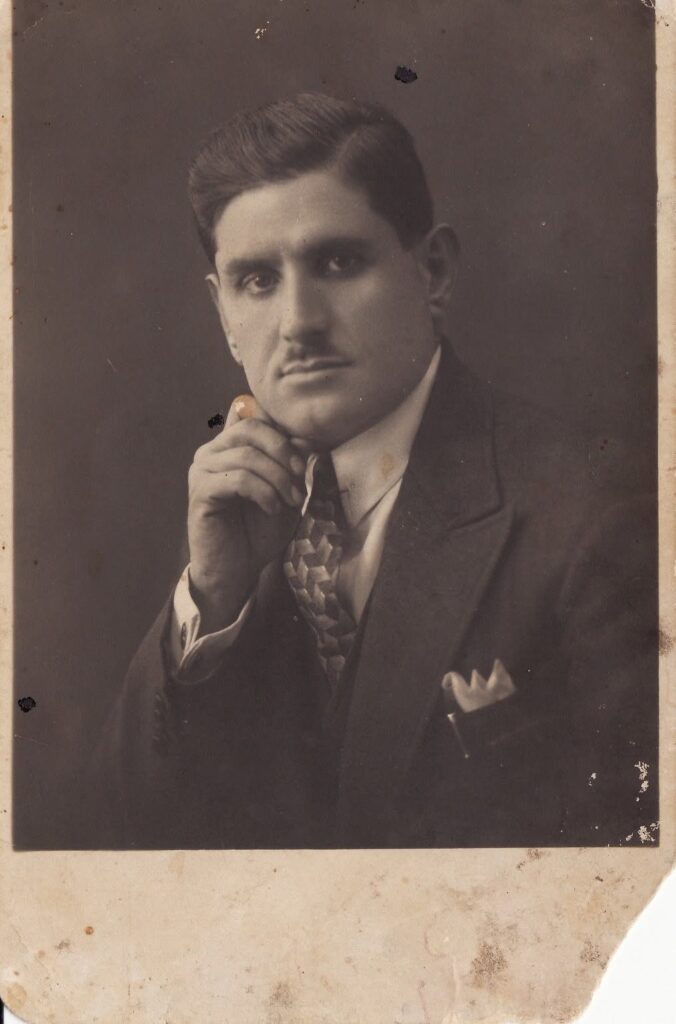
Portrait of Asaad Al Khoury Al Faghali nicknamed Shahrour al-Wadi
Taken together, this selection of zajaliyyat from different periods shows how this local art was used to chronicle events, make them public, and carry notions of belonging, identity, and early nationalism, functioning, one might say, as an early form of local public history.
Can we, then, read Lebanese history through its vernacular poetry? The zajaliyyat examined here suggest that we can, provided we read them as historians read any source: critically, in context, and with attention to the space between myth and fact. Whether preserved orally or in writing, zajal records how locals perceived history as it unfolded. In this sense, it offers a perspective that chronicles and official records rarely capture, and it deserves a place among the fundamental sources for the history of Lebanon. Yet zajal has received little academic attention or systematic documentation, and apart from a handful of leading historians, few Lebanese scholars have engaged with it as a historical source. Its survival raises a further challenge. Its transmission remains largely informal, and this informality is also its point of greatest fragility. Studying, documenting, and teaching zajal thus becomes a single task: preserving a source so that, in the words of the anonymous poet of 1791, the children’s children may still read it.
Charles al-Hayek is a public historian and the founder of Heritage and Roots.
The views in this story reflect those of the author alone and do not necessarily reflect the beliefs of NOW.