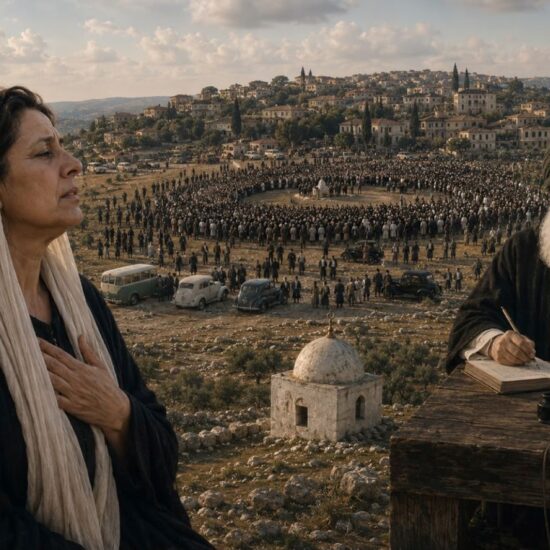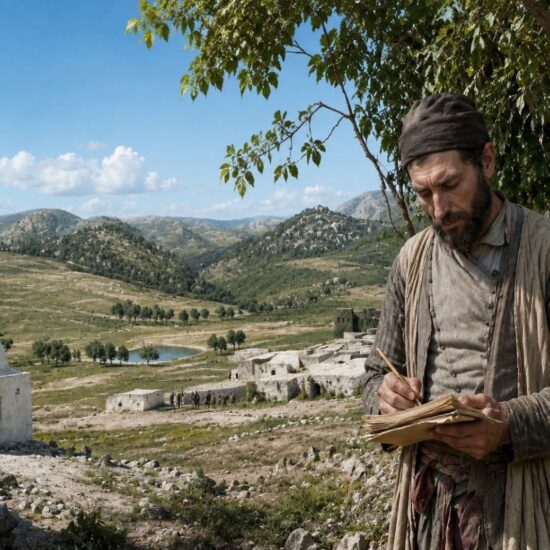
“...Berytus the lamented lies low on the ground.” With this verse, Joannes Barbucallus, a Greek grammatist writing in the Eastern Roman empire, closed one of his epigrams on the destruction of Berytus, Roman Beirut, in the earthquake of 551 AD.
The recent commemoration of the August 4 blast has brought back into view images of destruction, testimonials, and collective and individual memories of that day. Setting the tragic dimension of the event alongside its documentary afterlife, this is precisely how primary sources come into being, and it is from material of this kind that future historians will question, cross-examine, and eventually write the history of 2020. The parallel invites a set of questions about the deeper past of the city: what do the surviving sources tell us of how earlier calamities that befell Beirut were described? What information about the city can we draw from them? Public legend holds that Beirut has been destroyed and rebuilt seven times, though the documentary record suggests a more modest count. For sheer magnitude, the clearest historical parallel to the August 4 blast is the earthquake of 551, one man-made and the other a natural disaster, yet comparable in scale and in the kind of testimony each produced.
“Here I lie, the luckless city, no longer a city, with my dead inhabitants, most ill-fated of all towns. After the Earth-shaker’s shock Hephaestus consumed me. Alas, how excellent my beauty who now am dust! But as ye pass by bewail my fate, and let fall a tear for destroyed Berytus.”
The Beirut earthquake struck on 9 July 551 AD, with an estimated magnitude of 7.1–7.3 (Ms 7.2) and a maximum intensity of IX–X on the EMS-92 scale. Modern seismological analysis places the epicenter offshore of Beirut, attributing the rupture to movement along the strike-slip Roum fault, part of the broader Levant/Dead Sea fault system. The earthquake triggered a regional tsunami along the Lebanese coast, compounded by a landslide near Al-Batroun and a fire that burned in Beirut for nearly two months. Casualty estimates run as high as 30,000 in Beirut alone. The city’s law school, one of the Roman Empire’s three official centers of legal study, was destroyed, and its faculty and students relocated to Sidon. Several scholars frame the event as the structural turning point that closed Berytus’s late-antique golden age.
One of the principal accounts comes from Agathias Scholasticus, at the time a law student in Alexandria, who described the destruction in his Histories (2.15), composed some years after the event. His account opens:
“In summer time, roughly during the same period, there was a violent earthquake in Constantinople and in many parts of the Empire… The lovely city of Berytus, the jewel of Phoenicia, was completely ruined and its world-famous architectural treasures were reduced to a heap of rubble, practically nothing but the bare pavements of the buildings being left.”(1)
Agathias writes from within the Eastern Roman Empire and situates Berytus in the province of Phoenice Maritima, whose capital was Tyre. Berytus’s fortunes had long been organically tied to Roman policy: a city relatively minor by comparison with Sidon or Tyre had been elevated into a center of Roman influence through a decision taken nearly five centuries earlier, when Augustus, the first Roman emperor, declared Beirut a Roman colony in 15 BC and granted it the Ius Italicum, the same legal standing as cities of Italy. Veterans of the Roman army were settled in the city and its territories, and it was renamed Colonia Iulia Augusta Felix Berytus: Colonia for its status, Iulia Augusta in honor of Julia, the emperor’s only daughter, and Felix, fortunate. Fortunate it proved to be. The city controlled the grain of the Beqaa and, for two centuries, the city of Heliopolis and its sanctuary. Its architecture followed Roman models throughout: a forum, temples, baths, and a substantial aqueduct together made Berytus an image of Rome in the East. This urban fabric was what the earthquake of 551 destroyed. Agathias also supplies an important insight into why Berytus mattered so greatly to the Roman world: it was a center of learning. He writes:
“…Many of the local inhabitants were crushed to death under the weight of the wreckage, as were many cultivated young men of distinguished parentage who had come there to study the Law. There was, in fact, a long tradition of legal studies in the city, and the law schools conferred an aura of peculiar privilege and distinction on the place…”(2)
The Law School of Berytus was one of the Roman Empire’s foremost centers of jurisprudence. Its earliest documented mention dates to 238–239 AD, though its origins are generally traced to the early third century under the patronage of the Severan emperors. The school drew students from across the empire and held such standing that Emperor Justinian I restricted the official teaching of law to only three locations: Rome, Constantinople, and Berytus. Justinian singled out Berytus alongside the imperial capitals as the sole provincial city entitled to teach law, styling it Nutrix Legum, the nursing mother of law. Agathias also records what followed the earthquake, and the disappearance of the school from the historical record:
“…the professors of law moved to the neighbouring city of Sidon and the schools were transferred there, until Berytus was rebuilt. The restored city was very different from what it had been in the past, though it was not changed beyond recognition, since it still preserved a few traces of its former self. But this rebuilding of the city and the subsequent return of the schools was not to take place for some time yet…”(3)
Alongside the factual register of Agathias’s Histories, a second and very different testimony survives in poetic form. Joannes Barbucallus was a Greek epigrammatist active in the mid-sixth century AD. Eleven of his epigrams survive in the Greek Anthology, two devoted to the destruction of Berytus. Barbucallus gives voice to the destroyed city itself in a first epigram:
“Here I lie, the luckless city, no longer a city, with my dead inhabitants, most ill-fated of all towns. After the Earth-shaker’s shock Hephaestus consumed me. Alas, how excellent my beauty who now am dust! But as ye pass by bewail my fate, and let fall a tear for destroyed Berytus.”(4)
Christianity had been the official religion of the empire since 395, yet the poem still invokes the Earth-Shaker, an epithet of Poseidon, classical god of the sea and of earthquakes, together with Hephaestus, god of volcanoes and of smiths. The scale of destruction, whether Barbucallus witnessed it directly or received the account from others, must have been considerable to inspire such a verse. In a final, tragic gesture, he calls on travelers passing near the ruined city to weep for Berytus. In a second epigram, he writes:
“Where is Cypris, the keeper of the city, that she may see her who was once the seat of the Graces become the dwelling-place of spectres? The city is the tomb of dead men who had no funeral; under her ashes we, Beroe’s many thousands, rest. Engrave on one stone above her, ye dear survivors: ‘Berytus the lamented lies low on the ground.”(5)
Here Barbucallus again turns to the ancient gods, invoking “Cypris”, a common epithet of Venus/Aphrodite, addressed in this epigram as the city’s protector. This echoes the long-standing association of Berytus with Venus/Aphrodite in the Roman period, an association that reaches back further still to Astarte, the great Phoenician goddess. The poet casts her as a figure lamenting the city’s ruin. The line’s pathos rests on the reversal it stages: Cypris, goddess of beauty, love, and the Graces, is asked to look upon what was once “the seat of the Graces,” now reduced to a haunt of ghosts. The city’s former association with elegance and grace stands in stark relief against its new identity as a place of death and desolation. Barbucallus continues by naming the city the tomb of dead men who had no funeral, an abomination in ancient thought, since the absence of funeral rites condemned souls to a terrible fate. Beyond its value as testimony to the earthquake itself, the epigram highlights the persistence of classical culture and cult well beyond the Christianization of the empire and the city.
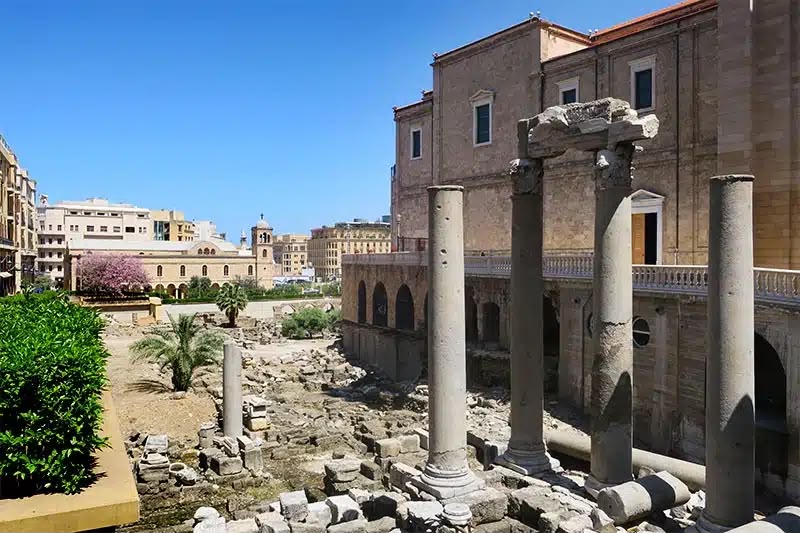
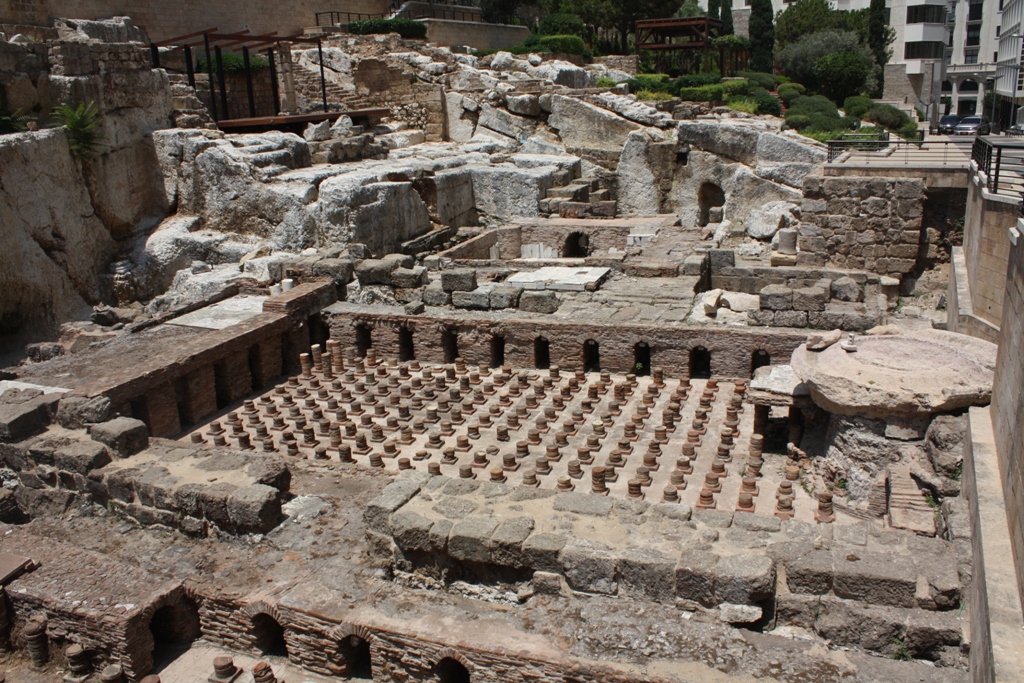
Ruins of Roman structures, Downtown Beirut
Several further sources corroborate and extend this picture. John Malalas provides a precise date, computed from the fourteenth indiction (1 September 550 to 31 August 551 CE), which for the month of July yields 551 CE. He records:
“In the 14th of the Indiction there was a large, fearsome earthquake in the whole land of Palestine, in Arabia, and in the territory of Mesopotamia, Antioch, and both Coastal Phoenicia and Lebanesia. In this catastrophe, the following cities suffered: Tyre, Sidon, Berytos, Tripolis, Byblos, Botrys, and parts of other cities. Multitudes of people were trapped in them. In Botrys, part of the mountain called Lithoprosopon, which rose beside the sea, broke off, fell into the sea, … At the time of the earthquake, the waters withdrew a mile toward the open sea, and many ships were destroyed. By God’s command the sea was restored to its ancient bed.”(6)
Malalas thus situates Beirut within a much wider regional disaster and adds the detail of the sea’s retreat and return, the tidal wave that compounded the earthquake’s toll.
It is from exactly this kind of layered, partial, and differently inflected material, factual and poetic, official and personal, that the history of a city’s calamities is eventually written. The sources gathering today around August 4 will, in time, be read by future historians in much the same way.
A further account comes from an anonymous pilgrim from Piacenza, in northern Italy, who traveled to the Holy Land around 570 CE and left a Latin narrative of his journey. He writes:
“And from there we came to Syrian Tripoli, where Saint Leontius rests. This city was destroyed in the time of Emperor Justinian by an earthquake along with other cities… Then we came to the most splendid city of Beirut, in which there was recently a university. This city was destroyed; we were told by the bishop of the city that all of the people, with the exception of pilgrims, who died there were known by name, and numbered at least 30,000. This city lies under the mountains of Lebanon. From Beirut we came to Sidon, which lies partly in ruins and is also next to Lebanon.”(7)
The pilgrim’s account confirms the death toll transmitted by other sources and extends the picture of destruction along the Phoenician coast, from Tripoli through Byblos and the city of Triaris to Beirut and Sidon.
Finally, John of Ephesus offers an account that closely parallels Malalas, describing how the sea rose against the people from behind while the earthquake brought the city down in front of them, a vivid image of a population caught between the collapsing city and the returning wave.
Taken together, these testimonies, the historian’s precise register in Agathias, the poet’s mythological register in Barbucallus, the chronicler’s date and regional scope in Malalas, the pilgrim’s eyewitness itinerary, and John of Ephesus’s echo of the same catastrophe, give the modern historian several converging routes into a single event. Each source records the same city in its own idiom. It is from exactly this kind of layered, partial, and differently inflected material, factual and poetic, official and personal, that the history of a city’s calamities is eventually written. The sources gathering today around August 4 will, in time, be read by future historians in much the same way.
Charles al-Hayek is a public historian and the founder of Heritage and Roots.
The views in this story reflect those of the author alone and do not necessarily reflect the beliefs of NOW.
Endnotes
(1) Agathias, Histories, Book 2, p. 47, passage 15.
https://archive.org/details/histories-agathias-1975-books-02-04/page/47/mode/1up?q=berytus
(2) Agathias, Histories, Book 2, p. 47, passage 3.
https://archive.org/details/histories-agathias-1975-books-02-04/page/47/mode/1up?q=berytus
(3) Agathias, Histories, Book 2, p. 47, passage 4.
https://archive.org/details/histories-agathias-1975-books-02-04/page/47/mode/1up?q=berytus
(4) Joannes Barbucallus, Greek Anthology, 9.425.
https://anthologiagraeca.org/passages/urn:cts:greekLit:tlg7000.tlg001.ag:9.425/
(5) Joannes Barbucallus, Greek Anthology, 9.426.
https://anthologiagraeca.org/passages/urn:cts:greekLit:tlg7000.tlg001.ag:9.426/
(6) John Malalas, Chronographia, paragraph 18.485.
https://topostext.org/work/793
(7) The Piacenza Pilgrim, paragraph 1.
https://andrewjacobs.org/translations/piacenzapilgrim.html