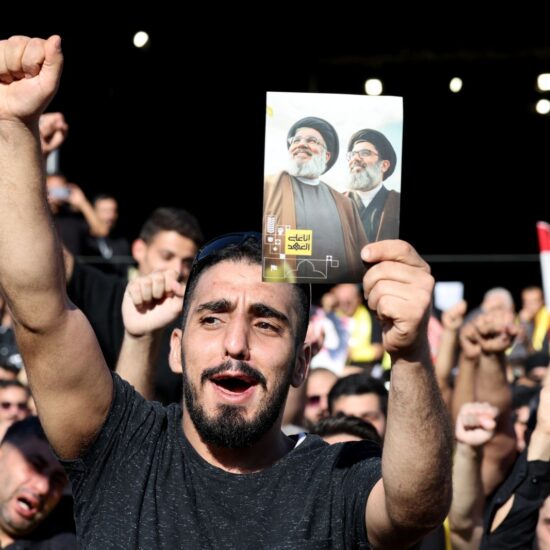
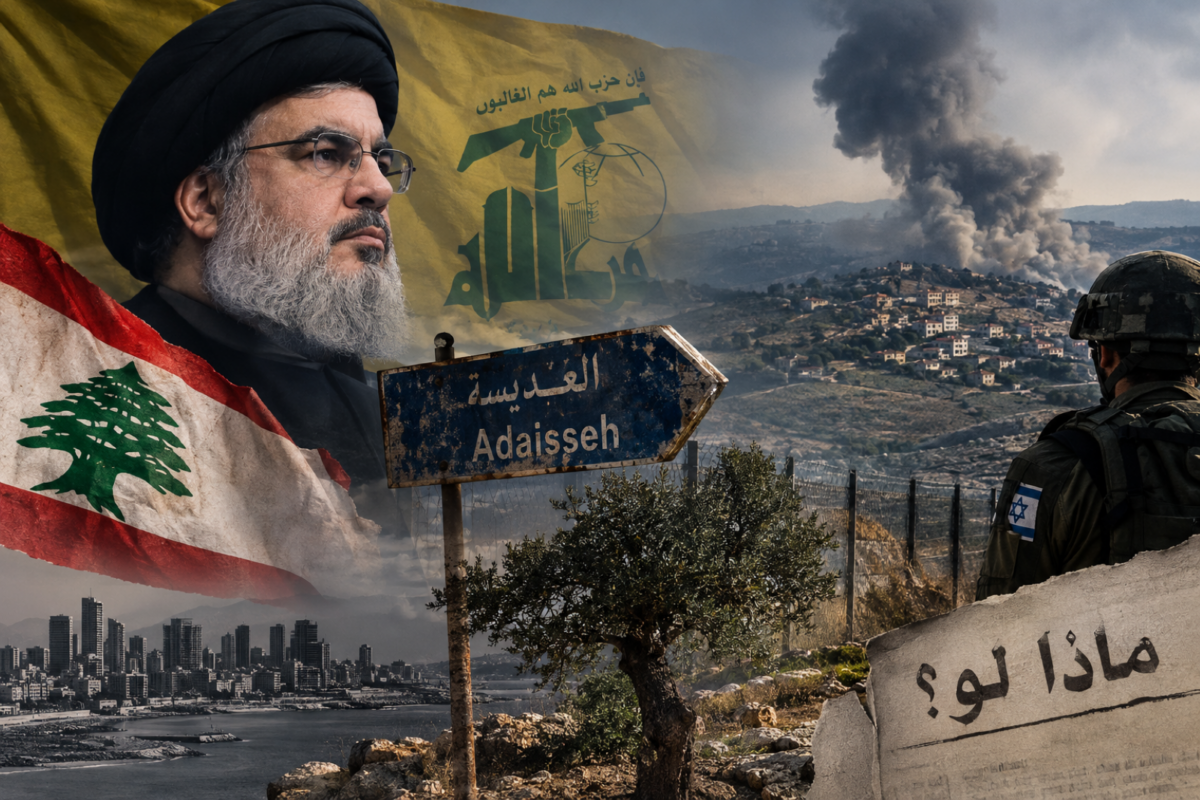
October 8 marks three years since Hezbollah’s unilateral decision to join the Aqsa Flood. Over the past three years, we have heard many accounts of this decision. A recurring version holds that the former Secretary General of Hezbollah, Sayyed Hassan Nasrallah, was not told of the attack in advance. He woke to the news and an urgent request from Hamas to join. Tehran told him to do what he judged best. His Shura Council was split between those who said Lebanon was in no shape for war and those who saw the long-awaited moment to strike Israel. He chose the middle ground: a limited strike on the Shebaa Farms at dawn on October 8, enough to show solidarity with Gaza and avoid a sectarian rift with Hamas, while keeping Lebanon out of a full war.
A limited, managed strike on October 8, 2023, proved a fatal decision, as subsequent events showed.
A limited, managed strike on October 8, 2023, proved a fatal decision, as subsequent events showed. Whatever readiness Hezbollah and its leadership believed they had did not come close to what Israel was preparing for. In 2023, Hezbollah was still stuck in the mindset of August 2006, the belief that it had established some kind of deterrence against Israel. Hezbollah did not account for the damage it had caused by intervening in Syria, by provoking a mini civil war in Lebanon in 2008, by draining whatever was left of the Lebanese economy, infrastructure, and services, by damaging relations with Arab countries, by advancing Iran’s expansionary regional ambitions, and by the spoils its leadership acquired from its influence over the Lebanese system. Still, for the past three years, Hezbollah, its allies, and its pundits have been repeating the same argument: whatever Hezbollah did, Israel would have attacked Lebanon anyway.
Still, for the past three years, Hezbollah, its allies, and its pundits have been repeating the same argument: whatever Hezbollah did, Israel would have attacked Lebanon anyway.
A matter of faith
We have heard this sentence all our lives, and it is as old as the 1949 Armistice Agreement, if not older. One school argues that Israel has always had claims in Lebanon, on its land and in its waters, and that the presence of Palestinian armed groups until 1982, and other groups after 1982, including Hezbollah, was simply an excuse to invade and occupy. Even without armed militias, Israel would have found reasons to invade and occupy. Another school argues that the absence of a state monopoly on weapons opened the door to every invasion. Hezbollah, naturally, belongs to the first. Both read the same events and reach opposite conclusions. The raid on Beirut airport in 1968, Operation Litani in 1978, the invasion of 1982, and the July war of 2006 all followed armed attacks that Israel traced back to Lebanon. For one camp, each was a pretext. For the other, each was a cause. After seventy years, it has become a spiritual question. A matter of faith: you believe or you don’t.
After seventy years, it has become a spiritual question. A matter of faith: you believe or you don’t.
Ferguson in Adaisseh
Since I read Niall Ferguson’s Virtual History: Alternatives and Counterfactuals, I have become fond of asking “what if.” Ferguson’s rule is that a counterfactual is serious only when the alternative was actually considered at the time. In our part of the world, where one man’s decision can redraw a region, it is more than an academic exercise. Saddam Hussein’s decision to invade Kuwait in 1990 is the classic example, and we are still paying for it.
So let us apply it to October 8, 2023. On the eve of that day, the presidency had been vacant since October 2022, and a caretaker government was managing the vacuum. The 2022 elections brought a group of reformist MPs who quickly learned that a few seats produce plenty of press conferences and intellectual debates, and very few laws. Reforms were deadlocked, including those tied to the IMF staff-level agreement signed in April 2022, and the deadlock let a cash and informal economy flourish. Relations with the Gulf were at their lowest, while Bashar al Assad, back in the Arab League, had never felt more confident.
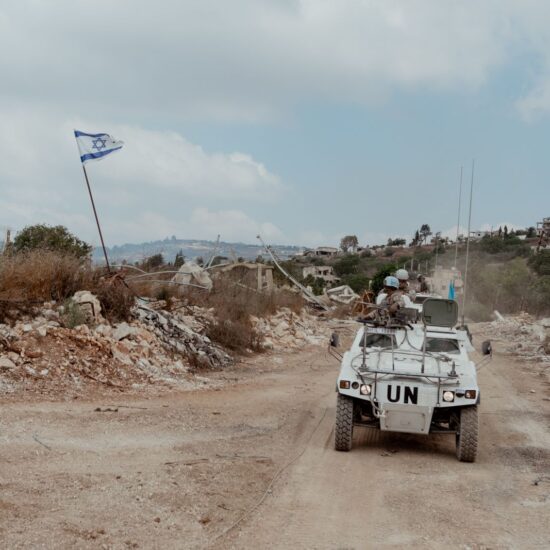
Hezbollah was at the peak of its power. Its grip on appointments, the judiciary, and the security agencies had never been tighter, including deniability. Its smartest achievement was shifting the national debate from a political discussion about who decides war and peace to a technical one about deposits, banking reforms, and the IMF. You felt that since 2019, Lebanon had become an open debate between John Maynard Keynes and Milton Friedman over the best economic recipes. The South, meanwhile, was flourishing. Government money, financed by debt, had built its roads and infrastructure, and emigrants’ savings showed in every new building and house. The border with Israel had been the quietest Arab border since 2006. If you wanted to measure tension in Adaisseh, in the far south, the measure was who would reach the olive tree between the two fences first.
This was the closest Lebanon had come to testing the first school. Had Hezbollah stayed out and Israel still attacked Lebanon during or after the war on Gaza, the believers would finally have had their proof. Had Israel not attacked, the other school would have had its own.
The proof that will never come
Today, Israel occupies some 55 towns and villages in the South. After a second war that Hezbollah opened on March 2, 2026, this time for Iran to avenge the killing of Ayatollah Ali Khamenei, more than 4,300 people have been killed this year alone, and over a million have been displaced. The believers will say this proves their point: Israel is expansionary and wants the land and the water. The real problem is that we will never know, because the current occupation came after two wars that Hezbollah started.
Hezbollah has always insisted that its victories are divine. Three years after October 8, with the South destroyed and occupied, we still cannot define what victory is, so we are left to accept that it is divine. The same theology underlies the argument that Israel would have attacked anyway. It asks for faith, not proof. By joining the war on October 8, Hezbollah not only lost it. It ensured its central argument can never be tested.
Only one way remains to test this theory. Let the Lebanese state alone decide on war and peace. Let the state enforce the disarmament of Hezbollah and all other militarized non-state actors. If Israel still invades Lebanon, even when no armed group fires across the border, the first school will finally have its proof, for the first time since 1949. That Hezbollah still refuses to hand over its weapons suggests it already knows which answer it fears.
Khalil Gebara is an academic and researcher.
The views in this story reflect those of the author alone and do not necessarily reflect the beliefs of NOW.