
I should begin by apologizing for writing this article in English rather than Syriac, Phoenician, or another language claimed as the authentic voice of our ancestors. This is hardly a sign of disrespect. These languages deserve preservation and study. Syriac retains religious and cultural importance, while modern Aramaic varieties still have speakers. But respect for a linguistic inheritance does not oblige Lebanese citizens to adopt it, much less accept it as a test of whether they belong.
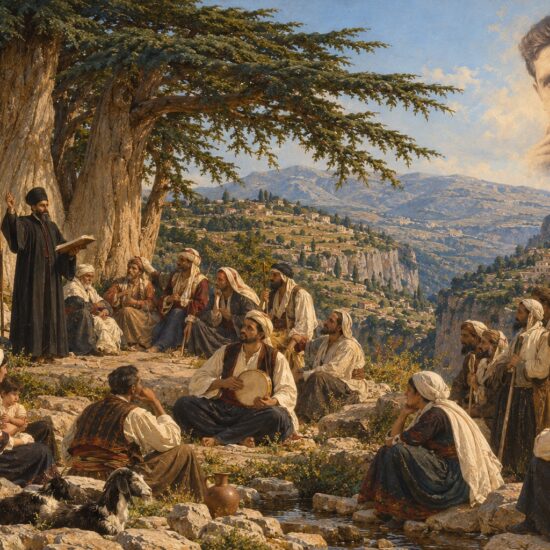
A recent podcast offered precisely this confusion, packaged as an exercise in historical enlightenment. What emerged was a hallucination of a different kind: pseudo-scholarship in which linguistics, genetics, and history were recruited to validate a predetermined identity. Foreign terminology supplied the academic atmosphere. Certainty supplied the evidence. Lebanon’s complicated past became a story of an authentic people robbed of their identity and condemned to extinction unless they recovered it.
The first fallacy turns language into political destiny. Those who read French supposedly absorb French politics, while those who read Arabic embrace Arab causes. An invocation of the Sapir–Whorf hypothesis then gives this leap the appearance of scientific authority.
The first fallacy turns language into political destiny. Those who read French supposedly absorb French politics, while those who read Arabic embrace Arab causes. An invocation of the Sapir–Whorf hypothesis then gives this leap the appearance of scientific authority.
Yet influencing how people perceive or describe something is hardly the same as determining their political allegiance. Lebanese writers have used Arabic to challenge Arab nationalism and French to condemn French colonialism. People who speak the same language disagree about religion, government, war, and almost everything else. A language does not issue its speakers a party membership card.
The linguistic demonstrations are equally unconvincing. A resemblance between a Lebanese expression and a Syriac word becomes conclusive proof of origin, then a certificate of the speaker’s true identity. But resemblance among related languages cannot, by itself, establish who borrowed what from whom. That requires dated evidence, comparison, and an account of how sounds and meanings changed.
Syriac influences on Lebanese speech are a legitimate subject of inquiry. They do not make every familiar Lebanese sentence Syriac, any more than using “merci” makes someone French. Nor does writing down a dialect automatically settle its status as a language.
Syriac influences on Lebanese speech are a legitimate subject of inquiry. They do not make every familiar Lebanese sentence Syriac, any more than using “merci” makes someone French. Nor does writing down a dialect automatically settle its status as a language.
Genetics receives an even more extravagant promotion. Evidence of ancient ancestry is presented as though it demolishes historians’ accounts of migration and the formation of communities. But genetic continuity and migration can coexist. Populations can retain substantial local ancestry while incorporating newcomers and changing their languages, religions, and political affiliations.
DNA cannot tell us how a religious community understood itself at a particular moment. It certainly cannot decide what its descendants must become. Genes speak neither Syriac nor Arabic, belong to no sect, and confer no superior claim to citizenship.
The same method reduces modern Lebanese history to a defeat in 1943, making subsequent catastrophes the inevitable consequences of that original mistake. This spares the storyteller the inconvenience of examining each period, its actors, and their responsibilities.
The insistence on recasting the port explosion as an attack on Ashrafieh and Christian suburbs exposes the political purpose of this reasoning. Those neighborhoods suffered terribly. Recognizing their suffering requires no confiscation of Beirut’s shared catastrophe. Turning the explosion into sectarian property pushes other victims to the margins of an identity narrative.
The insistence on recasting the port explosion as an attack on Ashrafieh and Christian suburbs exposes the political purpose of this reasoning. Those neighborhoods suffered terribly. Recognizing their suffering requires no confiscation of Beirut’s shared catastrophe. Turning the explosion into sectarian property pushes other victims to the margins of an identity narrative.
The American University of Beirut also becomes a target. A historian associated with it is dismissed through sweeping accusations, replacing engagement with his arguments and sources. Neither AUB nor its scholars are beyond criticism. But criticism requires intellectual work.
Across generations, AUB has educated, treated, and served people from Lebanon and the region. It will continue to offer them knowledge, care, and reasons to build a shared future. That contribution carries considerably more love for this country than platforms that cultivate suspicion and market resentment as cultural rescue.
To be fair, the podcast concludes by rejecting the imposition of language or identity. That assurance deserves acknowledgment. It also clashes with an argument that makes one language indispensable to a community’s survival and treats other choices as collective suicide.
My rejection may mean little to these self-appointed guardians. My Lebanese identity does not require their approval. Neither language, religion, nor blood is a prerequisite for belonging. Anyone claiming the authority to prescribe another person’s identity adopts a silly and fascistic attitude, however loudly they profess to oppose fascism.
My rejection may mean little to these self-appointed guardians. My Lebanese identity does not require their approval. Neither language, religion, nor blood is a prerequisite for belonging. Anyone claiming the authority to prescribe another person’s identity adopts a silly and fascistic attitude, however loudly they profess to oppose fascism.
This pathetic performance offers Lebanon no viable identity. It offers another policeman—this time carrying a dictionary.
This article originally appeared in Elaph.
Makram Rabah is the managing editor at Now Lebanon and an Assistant Professor at the American University of Beirut, Department of History. His book Conflict on Mount Lebanon: The Druze, the Maronites and Collective Memory (Edinburgh University Press) covers collective identities and the Lebanese Civil War. He tweets at @makramrabah