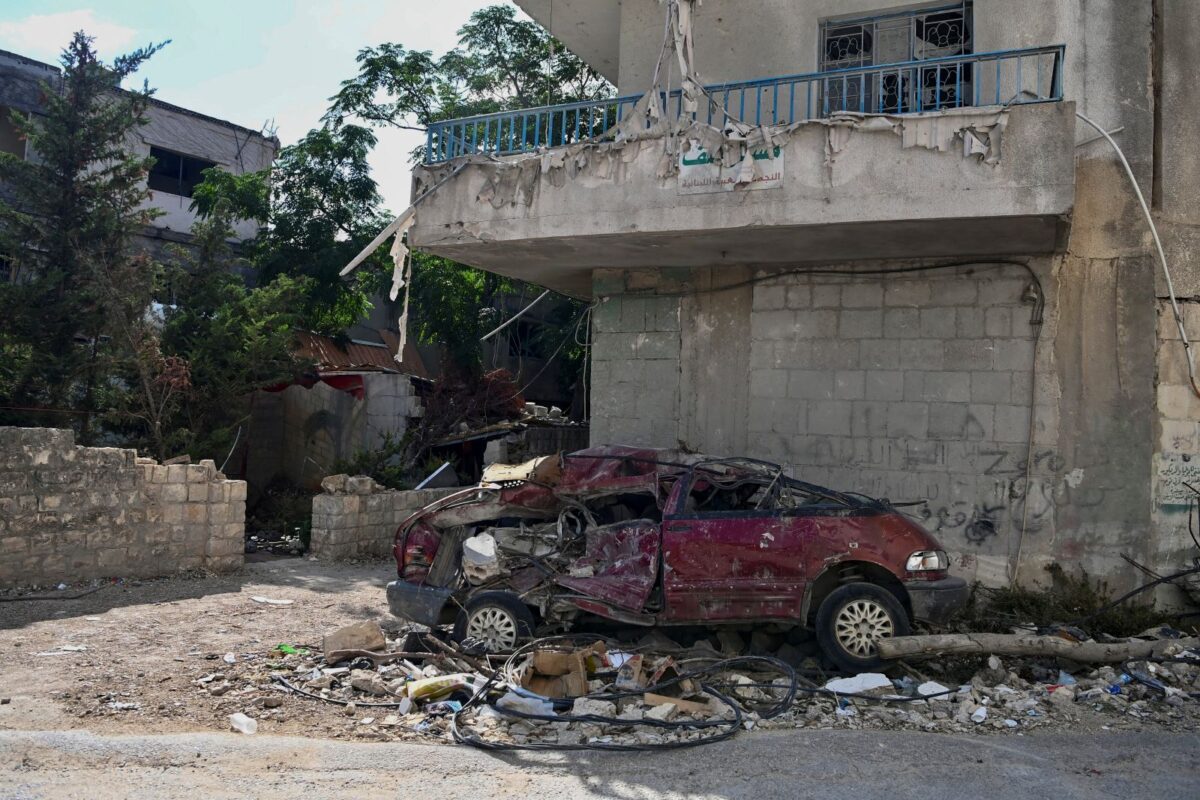
A view shows a crushed car surrounded by rubble beside a damaged building in Nabatieh, Lebanon, on September 21, 2026. Buildings in central Nabatieh were destroyed during Israeli airstrikes on the city. (Photo by Nadezda Tavodova Tezgor / Middle East Images / Middle East Images via AFP)
The explosives seized at Dahr al-Baydar expose Lebanon’s predicament with brutal clarity. Hezbollah moves its instruments of death across the country, while the state waits for a shipment to fall into its hands. Then come the questions that should hardly require political courage: Who ordered the delivery? Who prepared it? Who was waiting to receive it? Arresting the driver and his companion will mean little if the investigation stops before reaching the people who gave the orders.
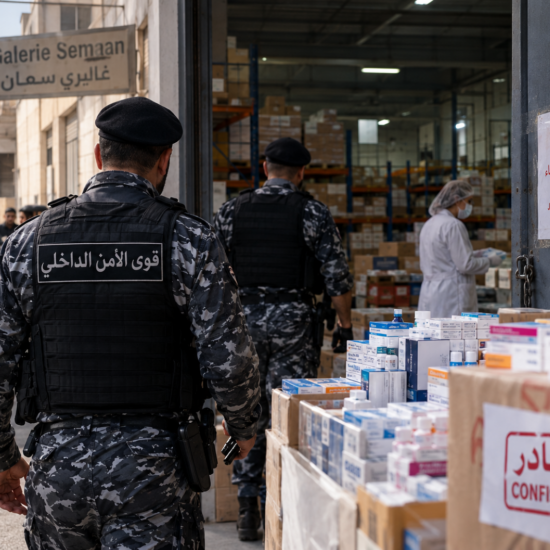
Published reports put the seized cargo at approximately 780 kilograms, including explosives and related materials, reportedly bound for Beirut’s southern suburbs. Hezbollah has acknowledged ownership, claimed the explosives were intended for use against Israeli forces, and demanded their return. The party apparently expects the state to treat the interception of its arsenal as an administrative inconvenience.
A shipment of this scale requires procurement, technical preparation, transport arrangements and a destination equipped to receive it. Behind the men in the vehicle stands an organization that controls storage facilities and issues instructions. An investigation that confines itself to the couriers leaves the machinery of the operation intact.
The road to liberating southern Lebanon does not run through Beirut. Hezbollah has no right to turn the capital and its suburbs into military warehouses, or to demand that Lebanese citizens accept every shipment of explosives as another contribution to national liberation. This excuse has been exhausted. People are expected to fear Israel while remaining silent about the weapons passing outside their homes. Anyone who objects risks being branded a traitor, as though patriotism were measured by a willingness to live beside someone else’s explosives.
Fear of assassination is understandable in a country where bombs have repeatedly eliminated individuals and altered political balances. Establishing the intended use of this shipment remains the investigators’ responsibility. Protecting the public, however, cannot depend on waiting for a crime to occur. The state must uncover the storage sites, transport networks and chain of command. Confiscating one shipment while leaving that infrastructure untouched merely gives its operators an opportunity to correct whatever mistake exposed them.
This raises an unavoidable question about Lebanon’s intelligence agencies: Where were they before the vehicle reached the checkpoint? What do they know about the movement of weapons inside the country? Every intercepted shipment should prompt an investigation into those that passed undetected. Celebrating the seizure is the easy part. Following it to its source is the test.
When security agencies make managing their relationship with Hezbollah and avoiding its displeasure their overriding concern, they help preserve its military power. An official who accepts the party’s arsenal as a permanent fact, then works to contain public anger about it, is protecting that arsenal in practice. His intentions offer little reassurance to the people living in its vicinity.
The personnel who stopped the vehicle must have the full backing of their superiors. Their work should lead to further arrests and the dismantling of the network they exposed. Reports of political pressure to secure the release of the detainees and recover the explosives demand scrutiny. The investigation involving military prosecutor Claude Ghanem must be allowed to reach those responsible, without being reduced to another settlement negotiated over the heads of the Lebanese. (imlebanon.org)
Hezbollah retained its freedom to move its arsenal, and the public remained responsible for absorbing the consequences.
The memory of Kahaleh should have been warning enough. In 2023, an overturned ammunition truck was followed by an armed confrontation that left two people dead. Residents discovered how quickly the movement of weapons through their town could turn it into a battlefield. The underlying problem survived. Hezbollah retained its freedom to move its arsenal, and the public remained responsible for absorbing the consequences.
Against this backdrop, army commander General Rodolphe Heikal’s remarks about restoring compulsory military service reveal a disturbing confusion of priorities. Speaking on the sidelines of the army marathon, Heikal expressed hope that conscription would return, presenting it as a means of strengthening national unity. Yet military service was abolished through legislation. Restoring it requires political decisions, legislation, funding and safeguards. A commander’s enthusiasm at a sporting event settles none of these questions.
The army commander serves under civilian authority. He has no independent mandate to reorganize the lives of Lebanese citizens. Before proposing new obligations for the public, Heikal should demonstrate that the institution he commands can enforce the obligations already imposed on those who carry weapons outside the state.
On this central issue, he has yet to provide sufficient evidence of the leadership his position demands. The measure is clear: implementing the decision to place weapons under exclusive state control, dismantling the parallel military structure and enforcing the authority of public institutions. Continued delay, accompanied by speeches about bringing young Lebanese together in barracks, transfers the burden to citizens while leaving the source of division armed.
Lebanese taxpayers finance an army that is supposed to protect them and uphold their sovereignty.
Lebanese taxpayers finance an army that is supposed to protect them and uphold their sovereignty. Securing football and basketball matches is a legitimate duty, but it cannot become the measure of military performance while an armed party continues to move explosives beyond effective state control. The constitution must apply beyond the gates of a stadium. Its authority must reach the warehouses, vehicles and commanders of those who refuse to obey it.
Before another generation is summoned to military service, citizens also deserve guarantees that their sons will not become drivers, escorts or personal attendants for officers and their families. Lebanon needs a professional military, with oversight capable of curbing patronage and the misuse of personnel. National unity begins with equality before the law. It cannot be built by conscripting some citizens while allowing others to remain inside an organization that reserves the right to wage war.
The Dahr al-Baydar shipment inevitably recalls the explosives used to assassinate Rafik Hariri. That attack involved a substantially larger explosive charge, and the Special Tribunal for Lebanon ultimately convicted three Hezbollah members for their roles in the crime. Those were convictions of individuals; they nevertheless give demands for accountability a concrete judicial foundation. Justice cannot remain a slogan invoked at commemorations and abandoned whenever enforcement becomes politically inconvenient.
Hezbollah’s campaign against the investigation into the Beirut port explosion belongs in this discussion as well. Its efforts to undermine the investigating judge carry a political responsibility of their own, regardless of what the judiciary ultimately establishes about the causes of the explosion and those responsible. A party that obstructs the search for answers cannot expect the public to accept its assurances about dangerous materials on trust.
Hezbollah places a rifle as its emblem, has fought for Iran’s regional project in Syria and supported Tehran’s allies in Iraq and Yemen, yet continues to demand that the Lebanese regard its military infrastructure as a guarantee of their safety. Dahr al-Baydar offers another reason to reject that demand.
Gambling on Hezbollah’s restraint means gambling with Lebanese lives. Protecting those lives requires dismantling its capacity to impose armed decisions on the country, a military leadership prepared to carry out its duty, and a civilian authority willing to judge that leadership by results. Every postponement leaves the Lebanese closer to the next catastrophe.
Gambling on Hezbollah’s restraint means gambling with Lebanese lives. Protecting those lives requires dismantling its capacity to impose armed decisions on the country, a military leadership prepared to carry out its duty, and a civilian authority willing to judge that leadership by results. Every postponement leaves the Lebanese closer to the next catastrophe.
This article originally appeared in Elaph.
Makram Rabah is the managing editor at Now Lebanon and an Assistant Professor at the American University of Beirut, Department of History. His book Conflict on Mount Lebanon: The Druze, the Maronites and Collective Memory (Edinburgh University Press) covers collective identities and the Lebanese Civil War. He tweets at @makramrabah