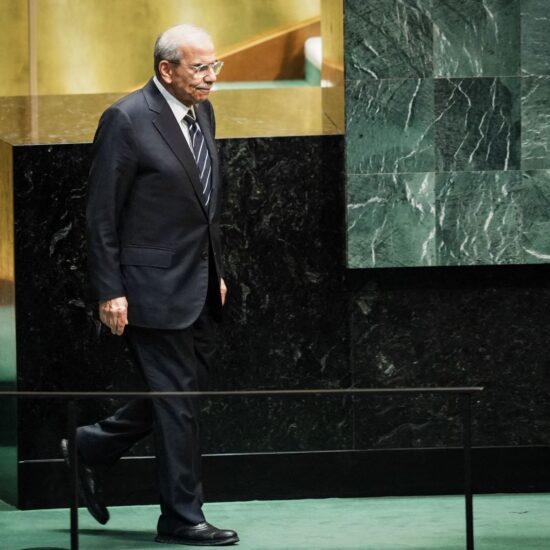
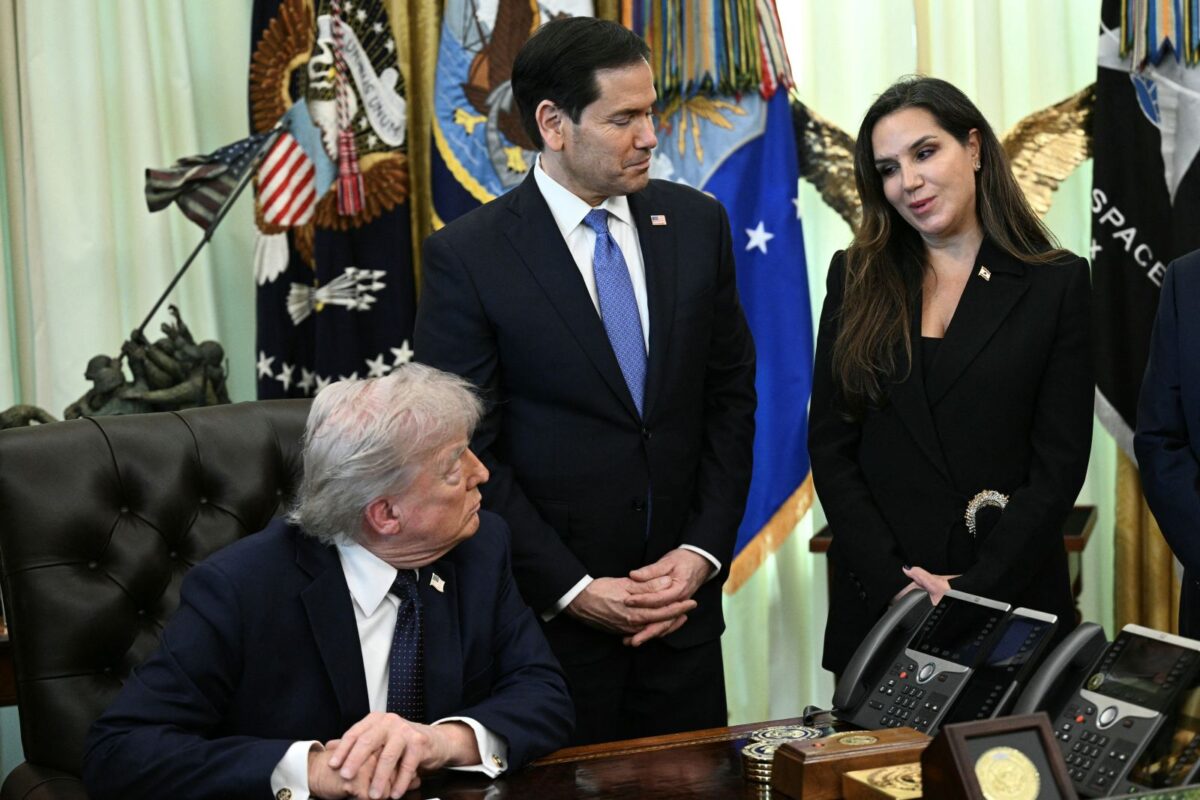
Photo by BRENDAN SMIALOWSKI / AFP. US President Donald Trump and US Secretary of State Marco Rubio listen to Lebanon Ambassador to the US Nada Hamadeh Moawad speak during a meeting with Lebanon Ambassador to the US and Israel Ambassador to the US, at the White House in Washington, DC on April 23, 2026.
The Trump administration is outraged. It should be. But outrage without accountability is nothing more than diplomatic theater.
The complaint filed against Lebanon’s ambassador to Washington, Nada Hamadeh Moawad, one of Lebanon’s most effective diplomatic representatives in years, is a disturbing illustration of how political intimidation can be dressed up as judicial action.
The allegations, circulated through media associated with Hezbollah’s political camp and invoking accusations of treason over her supposed contact with the Israeli ambassador, were unsubstantiated. They were recycled into a legal complaint by a pro-Hezbollah lawyer and referred to Lebanon’s military judiciary.
The case has now been dismissed without charges. But that should hardly be considered a victory for the rule of law.The scandal is that such an accusation could reach the military judiciary in the first place.
More disturbing is the institution itself: a military judicial system inherited from an era of Syrian domination, sustained by successive Lebanese governments, and tolerated by successive American administrations.
More disturbing is the institution itself: a military judicial system inherited from an era of Syrian domination, sustained by successive Lebanese governments, and tolerated by successive American administrations.
Washington called the complaint “embarrassing.” What is truly embarrassing is that the United States has spent decades supporting the Lebanese Armed Forces without insisting on an end to military trials of civilians.
For those of us who have confronted this machinery of intimidation, none of this is surprising.
No civilian, regardless of the alleged offense, should ever stand trial before a military tribunal.
I know this system firsthand. Years ago, I was personally targeted by an attempt to use the military judiciary against me. I refused to be intimidated and challenged its abuse of authority.My position then remains unchanged today: No civilian, regardless of the alleged offense, should ever stand trial before a military tribunal.
During the Syrian occupation, the military judiciary served as an instrument for suppressing political opposition and silencing dissent. The occupation ended in 2005. The machinery survived.
Human Rights Watch has repeatedly documented serious abuses within this system, including the prosecution of activists and journalists, restrictions on due process, and allegations of torture.
The problem is structural. Military judges remain tied to the defense establishment, undermining the independence and transparency expected of an impartial judiciary. And Washington has looked the other way.
Joseph Aoun, now president of Lebanon, can no longer hide behind the limits of his former position as army commander. When American officials questioned him about the military tribunal, he reportedly characterized the issue as above his pay grade, placing responsibility with then-President Michel Aoun.
Perhaps that argument was convenient then. It is indefensible now.
The responsibility that supposedly belonged elsewhere now sits squarely on President Joseph Aoun’s desk.
But the controversy surrounding Ambassador Moawad is only part of the story.
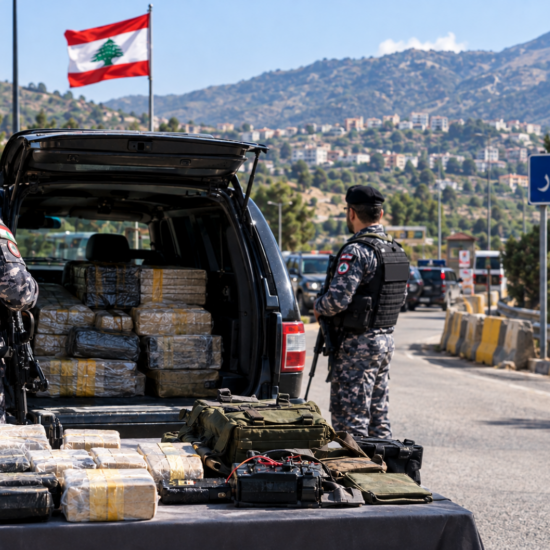
In recent days, Lebanese authorities intercepted approximately 780 kilograms of explosives, including TNT and C4, at Dahr al-Baidar. Hezbollah subsequently acknowledged ownership of the shipment, claiming the explosives were intended for operations against Israeli forces.
This is not speculation about who owned the explosives. It is an admission.
The intended destination and use remain matters for investigation. Yet the discovery raises an unavoidable question: how can an armed organization continue transporting such quantities of explosives across Lebanese territory while the military judiciary entertains complaints against civilians and diplomats over alleged political offenses?
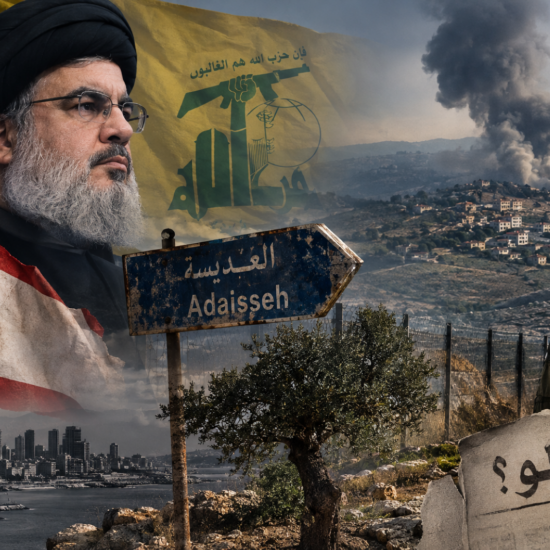
The seizure is evidence of Hezbollah’s continuing armed operations outside exclusive state control. It also demands scrutiny of whether the security and judicial institutions tasked with enforcing the law can act independently of Hezbollah’s political influence.
That question is hardly new.
We have witnessed the long struggle for accountability following Rafik Hariri’s assassination and repeated obstruction of the Beirut port explosion investigation. The persistence of armed power outside the state continues to raise fundamental questions about the ability of Lebanon’s judiciary to operate without interference.
The military tribunal must not become another instrument through which political influence overrides justice.
Washington must stop treating these contradictions as problems that can be managed through statements of disappointment.
American assistance to the Lebanese Armed Forces must be tied to enforceable human rights benchmarks, transparent oversight, and a legislative commitment to removing civilians entirely from military jurisdiction.
Supporting the Lebanese Army does not require accepting an exceptional judicial system that has repeatedly threatened civilian liberties.
Supporting the Lebanese Army does not require accepting an exceptional judicial system that has repeatedly threatened civilian liberties.
Nor can Lebanon’s government invoke sovereignty while preserving institutions that undermine the rights of its own citizens.
Military courts should have jurisdiction over military personnel for military offenses. Civilian crimes, without exception, belong before independent civilian courts operating transparently and respecting due process.
Ambassador Moawad deserves an unequivocal defense. But protecting one distinguished diplomat while leaving ordinary Lebanese exposed to the same machinery of intimidation would be a profoundly inadequate response.
If Washington truly wants a sovereign Lebanon, it must demand institutions worthy of a sovereign state.
If Washington truly wants a sovereign Lebanon, it must demand institutions worthy of a sovereign state.
The test is not whether the United States can protect an ambassador it respects.
The test is whether Washington and Lebanon’s government will finally confront a military judicial system that has outlived its legitimacy.
Anything less is complicity dressed up as diplomacy.
Anything less is complicity dressed up as diplomacy.
Makram Rabah is the managing editor at Now Lebanon and an Assistant Professor at the American University of Beirut, Department of History. His book Conflict on Mount Lebanon: The Druze, the Maronites and Collective Memory (Edinburgh University Press) covers collective identities and the Lebanese Civil War. He tweets at @makramrabah