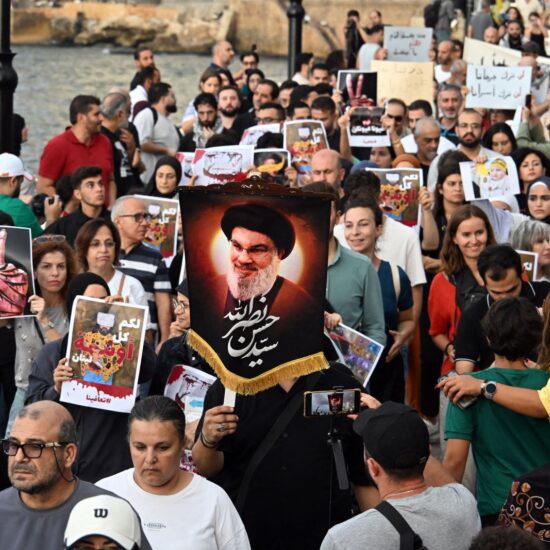
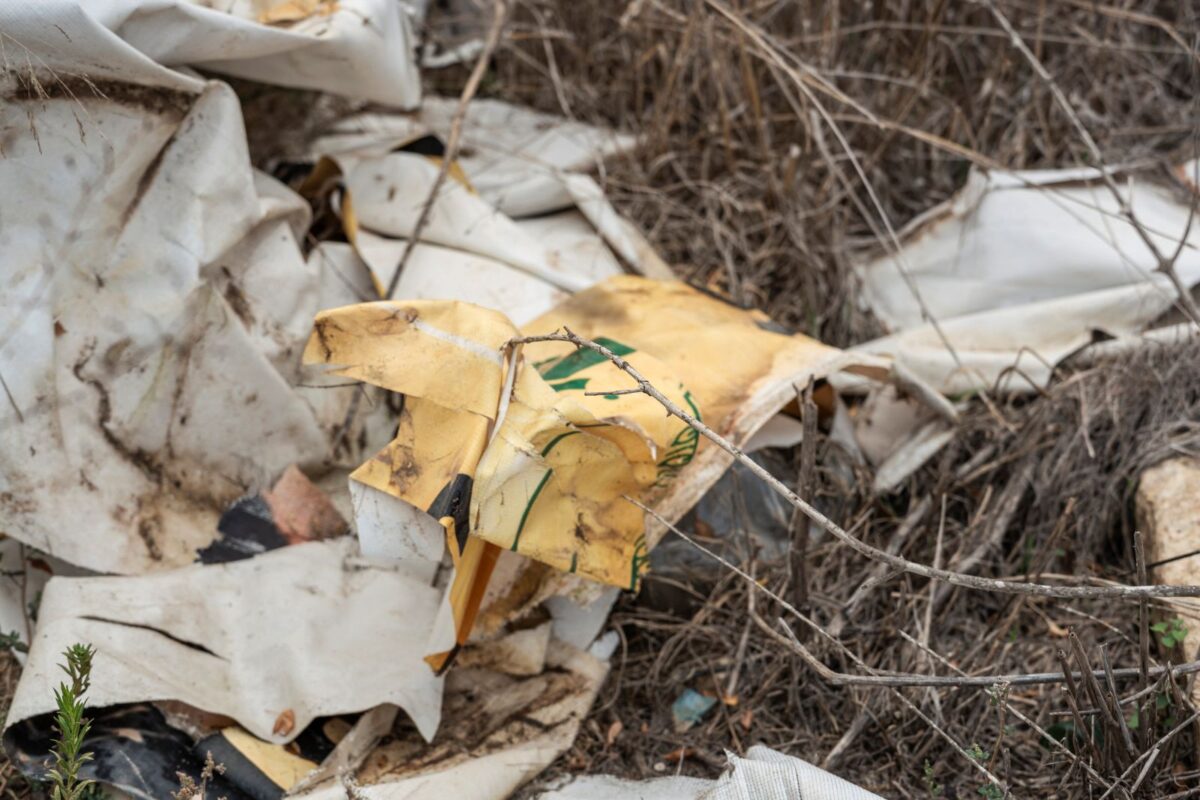
A torn Hezbollah poster lies in a field in the village of Klayaa, southern Lebanon on October 29, 2026. (Photo by Silvia Casadei / Middle East Images / Middle East Images via AFP)
Government Commissioner to the Military Court Judge Claude Ghanem filed charges against the individuals, two of whom are currently in custody.
The truck was travelling from the Bekaa Valley towards Beirut when security forces intercepted it and discovered 250 kilograms of TNT and 250 kilograms of C4 explosives. The identities of eight defendants have been established, while five others are known only by their military aliases. Judge Ghanem referred the case to Military Investigative Judge Ghada Abou Alwan to conduct further investigations and issue the necessary arrest warrants.
The charges include offences against internal state security, violating government decisions, possessing weapons and explosives, and forming an unlawful association aimed at undermining state authority and its standing. The relevant legal provisions carry penalties of up to 10 years of hard labor.
Hezbollah acknowledged ownership of the explosives after the seizure, with MP Hassan Fadlallah arguing that the shipment was intended for use against Israel. The group rejected the charges, with MP Hussein al-Hajj Hassan describing them as unjust and politically motivated, arguing that those involved should be honored rather than prosecuted.
The case has also fueled tensions within the government over accountability and the handling of Hezbollah’s weapons. It comes amid mounting international pressure on Lebanese authorities to hold those responsible for the shipment accountable and prevent the return of the seized explosives to the group.
In Lebanon
Israeli army carries out strikes and sweeping operations in Southern Lebanon: Israeli forces carried out shelling and sweeping operations in several areas of southern Lebanon, continuing military activity along the border despite ongoing diplomatic efforts to contain tensions. The latest operations add to concerns over the persistence of Israeli military pressure on southern Lebanon and the fragility of the security situation.
Beirut airport seizes largest cocaine shipment in its history: Lebanese Customs, in coordination with General Security, foiled a major drug-smuggling operation at Rafic Hariri International Airport on October 31, seizing 46.7 kilograms of cocaine from a Syrian passenger arriving from Accra, Ghana, aboard a Middle East Airlines flight. The drugs were concealed in 40 packages using sophisticated packaging designed to evade airport screening equipment. Electronic tracking devices were also discovered inside the packages. Preliminary investigations indicated that the suspect had previously entered Lebanon through the Masnaa border crossing before travelling to Ghana and returning with the shipment. The suspect was arrested as investigations continue to identify the intended recipient and those involved in the alleged smuggling network. Prime Minister Nawaf Salam praised the coordination between security agencies and reiterated the government’s commitment to preventing Lebanon’s airports, ports and border crossings from being used for drug trafficking and other illegal activities.
Lebanon faces Israel’s growing military superiority: Lebanon faces an increasingly uneven military balance with Israel, whose military and intelligence capabilities give it considerable freedom to shape developments along its northern front. The Israeli strategy is no longer limited to pushing Hezbollah away from the border or preventing attacks, but also seeks to restrict the group’s ability to rebuild its military infrastructure, cut its supply routes and weaken its ties with Iran. Lebanon’s economic and institutional crisis, alongside the Lebanese Army’s limited resources, further exposes the country’s vulnerability. Hezbollah’s military capabilities do not eliminate this imbalance or guarantee that Israel will refrain from expanding its operations.
Israeli escalation scenario raises fears of wider war in Lebanon: Concerns are growing over the possibility of a wider Israeli military escalation in Lebanon amid stalled negotiations and disagreements over the proposed international monitoring mechanism. Lebanon has rejected an Israeli proposal to assign monitoring responsibilities to a non-governmental organization instead of forces from European or African countries, arguing that such an arrangement would undermine its sovereignty. Diplomatic sources have warned that Hezbollah’s potential involvement in a renewed regional confrontation in support of Iran could trigger a broader Israeli military campaign, potentially extending north of the Litani River and targeting major southern cities, Beirut’s airport and ports, and Beirut’s southern suburbs. These remain reported escalation scenarios rather than confirmed military plans.
Finance Minister announces measures against tax-evading businesses: Finance Minister Yassine Jaber announced measures targeting companies and institutions that have failed to meet their tax obligations, including referring the files of 107 non-compliant businesses to the Financial Public Prosecution after issuing warnings and requesting payment. The measures also include facilitating tax settlements, reducing penalties, expanding electronic tax declarations, removing inactive and fictitious companies from tax records and introducing electronic invoicing to improve transparency. Jaber stressed that the objective is to recover public funds and distinguish between businesses facing genuine financial difficulties and those deliberately evading their obligations. He also highlighted the seriousness of failing to transfer value-added tax collected from consumers to the state treasury.
In the region
Qatari LNG tanker attacked in Gulf waters: A Qatari liquefied natural gas tanker, Al Maayda, was attacked by unidentified objects while sailing in the Arabian Gulf on Friday evening. No crew members were injured and no environmental damage or gas leakage was reported. The incident comes amid heightened maritime security concerns in the Gulf, with the United Kingdom Maritime Trade Operations also reporting a separate incident involving a commercial vessel struck by an unidentified projectile and issuing a distress signal. The attacks have renewed concerns over the security of vital shipping routes and energy supplies in the region.
Syria foils plot to target Home refinery and dismantles IS Cell: Syrian intelligence services have foiled an alleged plot to target the Homs oil refinery, although authorities have not disclosed further details about the suspected perpetrators or how the operation was prevented. In a separate security operation, Syrian authorities arrested two suspected Islamic State members in Deir Ezzor accused of carrying out a series of assassinations. The arrests followed investigations into the killing of Ibrahim al-Jassem, a Defense Ministry member who was shot near al-Rashid Mosque in the city of al-Mayadin. Weapons and ammunition were seized during the operation.
Saudi-Led Coalition intercepts Houthi ballistic missile: The Saudi-led coalition announced that its air-defense systems intercepted and destroyed a ballistic missile launched by Yemen’s Houthi movement towards Saudi Arabia’s southern region. Saudi Civil Defense authorities also issued early warnings of potential danger in Najran, Taif, Abha and Khamis Mushait, urging residents to follow official safety instructions. The warnings were later lifted after authorities announced that the danger had passed in the affected areas.
Manama Dialogue calls for regional de-escalation and stronger Gulf defense: The 2026 Manama Dialogue concluded with Gulf calls for regional de-escalation, stronger collective defense and international cooperation to protect maritime routes and energy supplies. Saudi Arabia stressed that safeguarding international shipping lanes requires a collective response and warned against using strategic waterways as instruments of political or military pressure. Bahrain called for a regional security framework that remains open to Iran, provided it respects national sovereignty and international law. Gulf states also condemned the attack on the Qatari LNG tanker Al Maayda and expressed solidarity with Doha, warning of the potential consequences for global energy markets.
Tehran awaits Qatari mediation and ateumps decision amid renewed military threats: Iran is awaiting the outcome of Qatari mediation and US President Donald Trump’s decision on whether to resume military strikes, amid rising regional tensions and warnings from Iranian military officials that any renewed confrontation could extend beyond West Asia. Foreign Minister Abbas Araghchi said negotiations over a proposed two-day plan to reopen the Strait of Hormuz were progressing but had not yet produced a final agreement. He stressed that progress depended on the other side’s response and maintained that Tehran continued to insist on its seven conditions. Trump described the talks as progressing well while questioning Iran’s reliability. Meanwhile, Iran’s Supreme Leader Mojtaba Khamenei ordered the armed forces to remain prepared to respond to any attacks, with military officials warning that a future conflict could be prolonged and extend beyond the region.
What We’re Reading
Where Are Lebanon’s Missing Centuries? – This article by Charles H. al-Hayek examines how Lebanon’s historical narrative overlooks several centuries between the Arab conquest in 636 and the establishment of Greater Lebanon in 1920. It argues that museums and school textbooks give considerable attention to ancient civilizations but offer limited coverage of the Arab-Islamic and Ottoman periods that helped shape modern Lebanese society. The piece explores how religious communities, language, cultural identity and political autonomy developed over these centuries, arguing that a fuller understanding of Lebanon’s past requires addressing these historical gaps rather than relying on selective or romanticized accounts.
In a Cracked Wall, Fadia Ahmad Finds the Outline of Lebanon – This feature by Rodayna Raydan explores Lebanese photographer and filmmaker Fadia Ahmad’s photography book Échos – Echoes, which brings together more than two decades of images reflecting identity, memory and belonging. It centers on a photograph Ahmad took of a damaged wall in a Beirut home following the August 4, 2020 port explosion, where the fractured plaster appeared to form the outline of Lebanon. The article examines how Ahmad uses photography to explore the relationship between personal and collective memory, the experience of living between cultures and the beauty found in everyday imperfections. It also highlights how cities preserve the traces of their histories through their buildings, streets and inhabitants.
Lebanon Does Not Have a Vote in Israel’s Election, So Why Is It Acting Like It Does?
This opinion piece by Elissa El Hachem examines Lebanese reactions to Israel’s political and electoral developments, questioning why so much attention is being placed on whether Benjamin Netanyahu remains in power rather than on the implications of Israel’s broader security policy towards Lebanon. It argues that Netanyahu’s potential political alternatives should not automatically be viewed as more favorable to Lebanon, pointing to Gadi Eisenkot’s military record and his association with the Dahiyeh doctrine. The article’s central argument is that Lebanon cannot base its security or political future on the outcome of an Israeli election. Instead, it should focus on strengthening state authority, addressing Hezbollah’s weapons and establishing its own position in negotiations with Israel.
Rafik Hariri Airport and the Politics of Distrust – In this article Khalil Gebara examines the controversy surrounding Rafic Hariri International Airport following the lifting of US flight restrictions on Lebanon and an International Civil Aviation Organization assessment highlighting serious certification and safety shortcomings. It explains the historical reasons behind Washington’s aviation restrictions, including past attacks and hijackings, while examining why the airport’s expired certification has become a wider public concern. Gebara argues that the issue extends beyond Hezbollah’s influence over the airport, pointing instead to years of institutional negligence, weak oversight, inadequate firefighting capacity and insufficiently trained inspectors. The article highlights how the Lebanese public’s lack of trust in state institutions has turned a technical aviation issue into a broader question about governance and accountability.
When Civil Peace Becomes a Veto – In this opinion piece, Ramzi Abou Ismail, PhD examines how fears of renewed civil conflict can be used to limit accountability in Lebanon, focusing on the government’s handling of the Dahr al-Baidar explosives case. It questions the cabinet’s decision to postpone consideration of referring the case to the Judicial Council and examines the political pressure surrounding efforts to establish responsibility for the shipment. The article argues that maintaining civil peace should not mean allowing powerful political actors to operate beyond the reach of the law. It also examines Nabih Berri’s role in mediating political tensions, questioning whether such interventions strengthen state institutions or reinforce a system in which public authorities remain dependent on political intermediaries. The central argument is that accountability must proceed through independent institutions, regardless of political affiliation, without allowing the threat of instability to become an obstacle to justice.