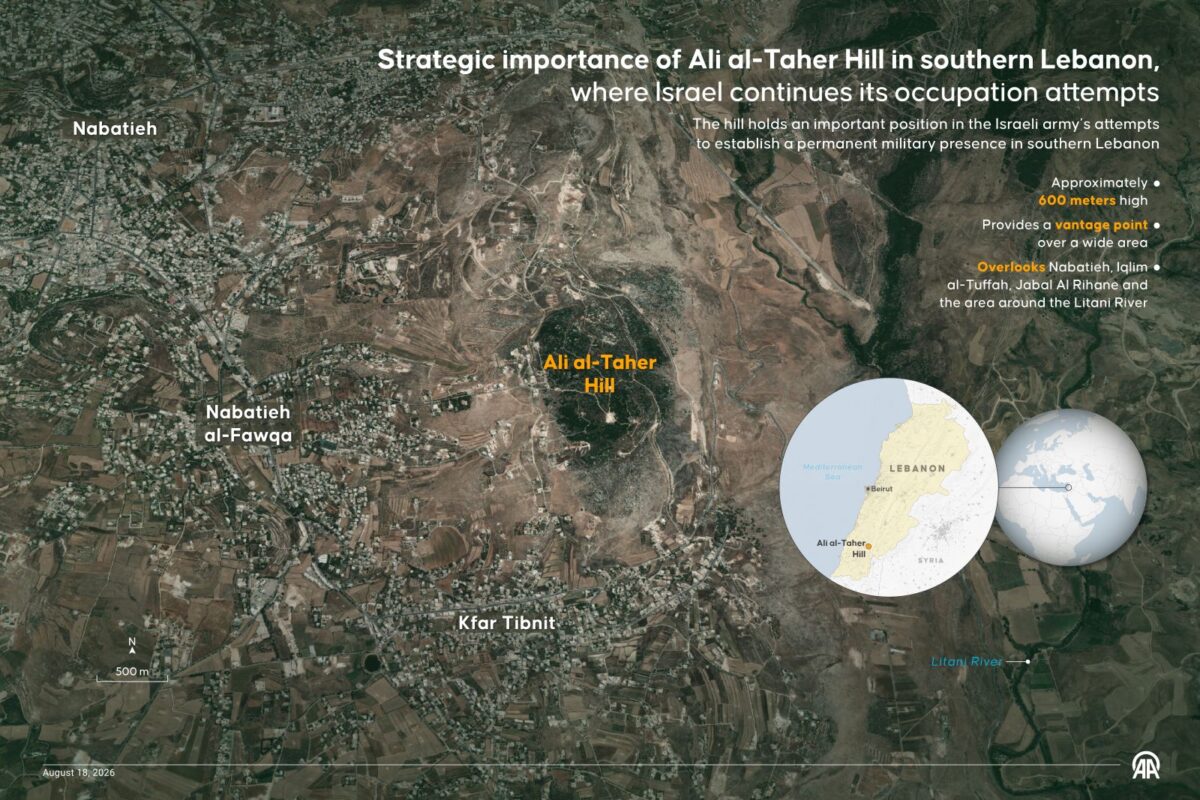
ANKARA, TURKIYE - AUGUST 18: An infographic titled "Strategic importance of Ali al-Taher Hill in southern Lebanon, where Israel continues its occupation attempts" created in Ankara, Turkiye on August 18, 2026. The hill holds an important position in the Israeli army’s attempts to establish a permanent military presence in southern Lebanon. Mehmet Yaren Bozgun / Anadolu (Photo by Mehmet Yaren Bozgun / ANADOLU / Anadolu via AFP)
Israel says it has established operational control over the strategically important Ali al-Taher ridge in southern Lebanon, marking a significant development in its military presence south of the Litani River and adding pressure to an already fragile ceasefire. The ridge, located around 15 kilometers from the Israeli border and near Nabatieh, overlooks large parts of southern Lebanon and is considered strategically important because of its elevated position and the underground infrastructure that Israel says Hezbollah had built beneath it. Israeli forces said they had cleared two underground routes in the area and were continuing operations to neutralize the infrastructure. Hezbollah has not publicly confirmed Israel’s claim of control, while Lebanese officials and military experts have said they have been unable to independently verify the extent of the Israeli advance.
The ridge has become one of the main flashpoints in the fighting in southern Lebanon in recent weeks. Israel has maintained that its forces will remain in what it calls a security zone until Hezbollah is disarmed and threats to northern Israel are removed.
The Israeli military’s capture of the ridge also comes amid continued strikes across southern Lebanon, despite the ceasefire framework. The latest escalation has extended beyond the immediate security zone, with Israeli strikes killing civilians and damaging infrastructure, including a hospital in southern Lebanon. The developments have raised further questions over the prospects of the Lebanon-Israel framework and whether the Lebanese Army can assume control of areas currently contested between Israel and Hezbollah.
The issue has also taken on a domestic political dimension. Speaking Sunday at the Lebanese Forces’ annual ceremony in Maarab, Lebanese Forces leader Samir Geagea criticized the response to the fall of Ali al-Taher, saying the ridge should have been handed over to the Lebanese Army rather than dismissed as empty or insignificant. Geagea called for a state that can “decide and act” and urged Lebanese authorities to take practical steps to establish state authority. He described the current moment as a “time of truth and difficult decisions,” arguing that the implementation of the framework agreement depends on dismantling military and security wings operating outside the state, particularly those belonging to Hezbollah.
Geagea’s comments come as southern Lebanon faces renewed Israeli attacks and continued displacement. He said the framework agreement represents the only available opportunity to stop the current war and prevent the repetition of conflicts along the southern border, but argued that its success ultimately depends on establishing the state’s exclusive authority over weapons and territory.
In Lebanon
Ali al-Taher remains a flashpoint: Israel says it has established operational control over the strategic ridge after clearing Hezbollah fighters from tunnels beneath it. The Lebanese Army had been proposed to take over the position as part of US-mediated efforts, but Hezbollah rejected the handover. The development risks further complicating negotiations over Hezbollah’s weapons and Israel’s military presence in southern Lebanon.
Geagea demands state action: Lebanese Forces leader Samir Geagea called for a state capable of taking “decisive” action and urged Hezbollah to dissolve its military and security wings. He said Lebanon is facing a difficult and tragic situation, with hundreds of thousands displaced, extensive destruction and an uncertain economic and political outlook.
Aoun urges international pressure on Israel: President Joseph Aoun called on the United States and the international community to pressure Israel to halt its continued violations and attacks in Lebanon. Aoun has repeatedly called for the implementation of the ceasefire and an end to Israeli military operations on Lebanese territory.
Israel releases Lebanese detainees: Israel released five Lebanese detainees amid continued diplomatic contacts between Lebanon and Israel. The move comes as negotiations continue around several outstanding issues between the two sides, including detainees and remains.
Israeli strikes intensify across the South: Israeli forces carried out a new wave of strikes across southern Lebanon, with evacuation warnings issued for areas including Deir al-Zahrani and heavy strikes reported around Kfar Roummane, Arab Salim and other areas. The escalation follows continued Israeli-Hezbollah exchanges and comes days after Israel announced that it had established operational control over Ali al-Taher.
Southern schools face uncertainty: Schools in southern Lebanon are preparing school bags and educational supplies ahead of the new academic year, but the return of students remains dependent on security conditions. Communities are also facing the challenge of rebuilding damaged schools while displacement continues.
Electricity sector awaits fuel financing: A fuel tanker remains awaiting the opening of a credit facility, while Électricité du Liban prepares for changes to electricity tariffs and service provisions. The developments come as Lebanon continues to struggle with fuel supplies and the financial sustainability of its electricity sector.
In The Region
Jordan approves natural gas supply to Lebanon: Jordan has agreed to provide Lebanon with natural gas in coordination with Syria, in a move aimed at supporting electricity generation in Lebanon. The arrangement would use regional infrastructure to transport the gas toward Lebanon and comes as Beirut seeks to secure more reliable energy supplies.
Hormuz traffic drops to lowest level since May: Commercial shipping through the Strait of Hormuz has fallen to its lowest level since May following renewed US-Iranian attacks involving vessels. An average of around 10 commodity ships a day crossed the strait over the past 10 days, compared with more than 15 earlier in the period, according to Kpler data cited by Reuters. The decline has raised fresh concerns over global energy supplies and shipping security.
Iraq’s fuel crisis deepens: Fuel shortages are spreading across Iraq, with long queues forming at petrol stations in Baghdad and several provinces. The crisis is adding to already strained public services, including reduced electricity supplies and delays in salaries and pensions, while disruptions to fuel imports linked to the regional war have intensified pressure on citizens.
Syria begins dismantling Assad-era chemical weapons: Syria has begun destroying chemical weapon materials identified by the international chemical weapons watchdog, according to the country’s UN envoy. The move marks an initial step toward addressing the remnants of Bashar al-Assad’s chemical weapons program and complying with international obligations after years of disputes with the Organization for the Prohibition of Chemical Weapons.
What we’re reading:
“Let Them Drink Gasoline” — Makram Rabah, NOW’s Managing Editor examines the Iranian regime’s response to economic hardship and public discontent, focusing on the claim that gasoline is cheaper than water. He argues that the slogan reflects a broader mentality in which the regime treats citizens as instruments of its regional project rather than as people whose basic needs and freedoms matter.
“Who Gave Greater Lebanon Its Name?” — Charles H. al-Hayek: Al-Hayek revisits the origins of the name “Greater Lebanon,” challenging the simplified narrative that the term was simply imposed by French High Commissioner Henri Gouraud in 1920. Drawing on historical records, he traces the concept through Lebanese intellectual and political circles and examines the roles of figures including Bulus Nujaym, Albert Naccache and Daud Ammun before Gouraud formally proclaimed Greater Lebanon.
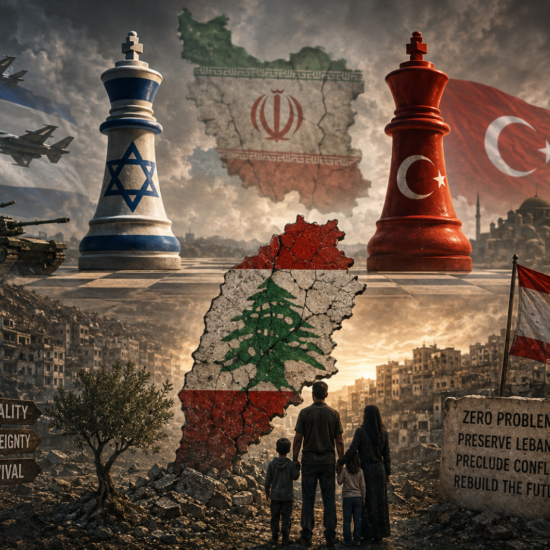
“The Existential Importance of Lebanese Neutrality” — Mohammad El Sahily argues that Lebanon’s survival increasingly depends on adopting a policy of neutrality and avoiding regional conflicts. Against the backdrop of rising tensions between Israel and Turkey and the weakening of Iran’s regional influence, he warns that Lebanon’s continued entanglement in regional power struggles could threaten not only its stability but its territorial integrity.
“Who Will Inherit Lebanon?” — In this piece, Farid Fakherddin examines what Lebanon’s political future could look like as the country moves beyond the era dominated by Hezbollah’s weapons. He argues that the end of Hezbollah’s armed political order should not simply mean transferring power to its traditional opponents, but should instead open a broader transition based on state sovereignty and political inclusion.
“Lebanon Wants to Overhaul Its Financial Sector, But Faces a Bigger Problem” — Laura Hülsemann looks at Lebanon’s efforts to reform a banking sector devastated by the 2019 financial crisis, including recent legislative changes to the banking resolution framework. The article highlights the central unresolved question behind the reforms: how Lebanon can restructure its financial system while still determining how depositors will recover the money they lost.