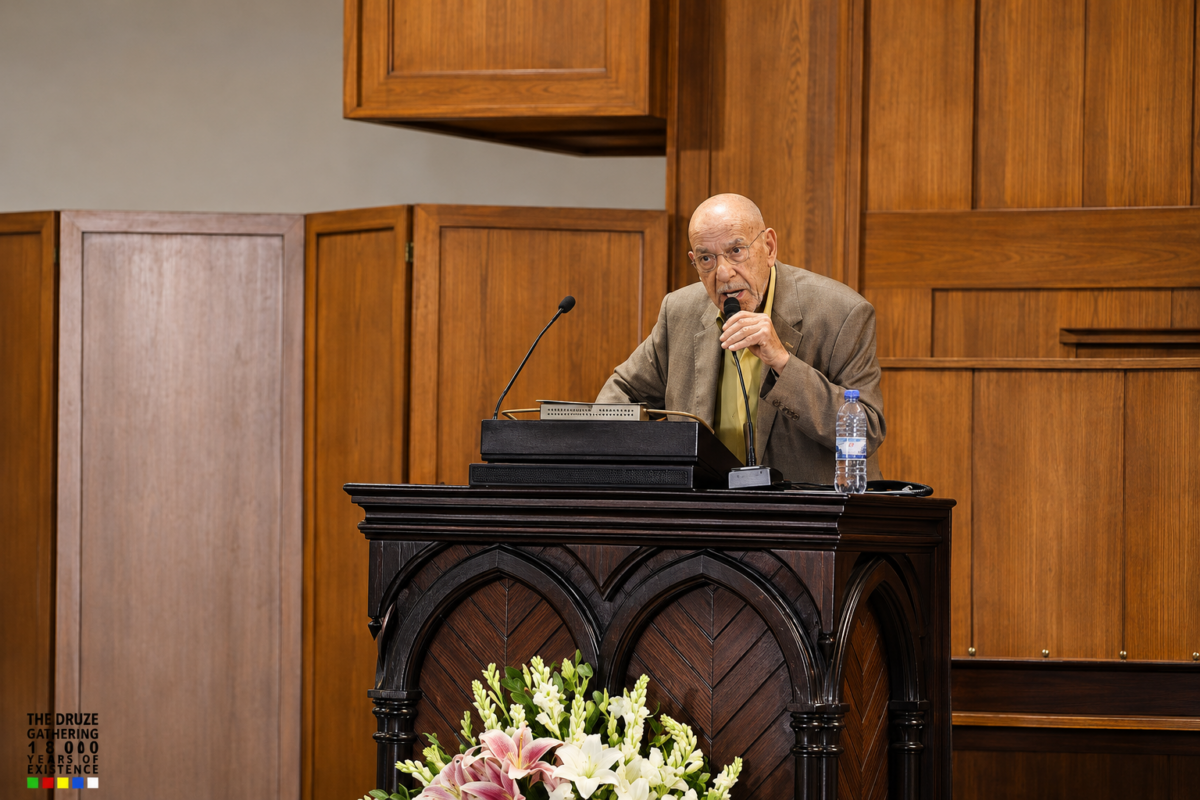
When I think of Engin Deniz Akarlı, I return to October 2018 and his visit to Beirut. Despite his long battle with cancer and his deteriorating health, he made the journey to the American University of Beirut to deliver the opening keynote at our conference, The Druze: Celebrating a Thousand Years of Diversity. His presence was a gift to all of us who had gathered there. Today, remembering that journey, I feel the loss of a friend whose generosity I was fortunate to experience.
My first encounter with Engin had come years earlier, when I was an undergraduate. My mentor, Professor Abdulrahim Abu Husayn, who was one of the great Ottoman historians of his generation, a scholar whose intellectual rigor was matched by his humility and generosity. The three of us drove up to Ayn Anoub, my mother’s village in the Gharb region, where we visited the sarai of Mustafa Arslan. We toured Mount Lebanon together, enjoying Engin’s company. For a young student of history, it was a privilege to share that journey with two historians from whom I would learn so much.
Engin died in Istanbul on November 8 at the age of 81. For those who knew him, the loss is painfully personal. He was a very close friend of my mentor, the late Professor Abu Husayn, and remembering one inevitably brings me back to the other. Both men helped shape my understanding of what it means to be a historian, through their scholarship and through the kindness with which they shared it.
Engin’s The Long Peace: Ottoman Lebanon, 1861–1920, published in 1993, remains indispensable to anyone seeking to understand modern Lebanon. His study of the mutasarrifiyya, the special system of government established in Mount Lebanon in 1861, explained the institutions and compromises that sustained decades of relative stability before the First World War. He gave this experience the depth it deserved, recovering the people and negotiations through which a society scarred by violence learned to govern itself.
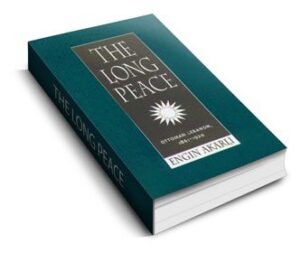
The Long Peace, Akarli’s widely celebrated work analyzes the Mutasarifiyah period through unconventional sources that others had not utilized beforehand.
For a Lebanese historian, the implications of this work reach far beyond a particular period. Engin showed us how carefully we must examine the familiar stories we tell about our country. His command of the Ottoman archives allowed him to restore complexity to a past so often reduced to communal grievances or national myths. Reading him meant taking seriously the possibility that coexistence could be built, and understanding the political effort required to sustain it.
This was scholarship that demanded patience and intellectual honesty. Those of us who read Engin learned to question easy explanations and to respect the evidence, especially when it unsettled our assumptions. Those of us fortunate enough to know him also encountered a humble, generous soul. There was a warmth in dealing with him that made his immense knowledge accessible. I learned from our interactions as I learned from his writing, with admiration and gratitude.
His friendship with Professor Abu Husayn belongs to a scholarly world that I continue to miss. Their learning was something they shared freely with the people around them. Friends and younger scholars benefited from their knowledge and from the example they set. They understood that historical research acquires a life beyond its author when others can use it to ask better questions. To have known them is to carry a debt that teaching and writing can only begin to repay.
With his passing, Middle Eastern studies loses one of its pillars. His work will remain on our shelves and in our classrooms, shaping research by people who may never have had the privilege of meeting him. I hope they will also come to know something of the humanity behind those pages. The historian and the man belong together in the memory we preserve.
Perhaps Engin is now joining the immortals: Kamal Salibi, Professor Abu Husayn, Philip Hitti, Bernard Lewis, Walid Khalidi, Abdel Karim Rafiq and Fouad Ajami, among others whose contributions continue to shape our understanding of the Middle East. I like to imagine him reunited with Professor Abu Husayn, with so much still to discuss. Here, we are left with their books, their example, and the responsibility to pass on what they gave us. Farewell, dear Engin. Thank you for the knowledge, and for the generosity with which you shared it.
Makram Rabah is the managing editor at Now Lebanon and an Assistant Professor at the American University of Beirut, Department of History. His book Conflict on Mount Lebanon: The Druze, the Maronites and Collective Memory (Edinburgh University Press) covers collective identities and the Lebanese Civil War. He tweets at @makramrabah